Have you ever heard the saying, “Don’t throw out the baby with the bathwater”?
A friend and I have both survived near-death experiences—events that altered us permanently. On long drives, we often dive deep into conversations about spirit, soul, God, and nature. We’ve walked away from rigid dogmas—those rules imposed by religion that demand your belief to belong—and instead, we’ve chased after truth. Real truth. The kind you feel in your bones.
Hence, throwing out the bathwater and keeping the baby.
That mindset often leads us to places charged with meaning. On this particular day, we felt called to Gettysburg National Battlefield.
We took the Taneytown exit just before sunset. As we approached the old Cyclorama, my friend said quietly,
“I feel something pulling me here. Something important.”
“Tell me when to stop,” I said.
“Stop.”
We parked beside an older man and his massive Irish Wolfhound, Tanner. He greeted us kindly and shared that he was a local who came to the battlefield seeking meaningful encounters. Usually, he sat at Little Round Top. But tonight, he’d felt drawn here instead.
He’d had a near-death experience—just like us.
For over an hour, the three of us stood and talked. About life. About death. About energy, God, and the battlefield itself. “This place is alive with spirit,” he said. “Something here vibrates because of the hell that happened.”
And I understood exactly what he meant.
We looked around at the silent cannons—posed and waiting, like sentinels. Witnesses to the deadliest battle of the Civil War. I shivered.
We are sensitives—whether born or trauma-made. Drawn like moths to flame. To trauma. To death. To sacred, ruptured ground.
“It’s the energy,” my friend said. “Spiritual energy.”
I couldn’t disagree. What is spirit, if not supernatural energy? The Shekinah. The Holy Spirit. Energy.
She seeks to understand it. Me? I feel it. Especially trauma. It lights something up in me.
You don’t need a wild imagination to be humbled by Gettysburg. The place speaks for itself.
As the sun set (the park remains open until 10:00), we parted ways with the man—three strangers connected through invisible threads. Before he left, he said, “Be careful.”
We drove slowly through the darkening park and passed the Wheatfield. Suddenly, we both felt it—tingling skin, tight throats, nausea. The air felt electric, charged with something unseen. Then, as soon as we passed the bend, it disappeared.
“You felt that?” she asked.
We described it the same way. Yes, I had.
At Devil’s Den, we got out and wandered behind the granite boulders. A low rumble echoed nearby—maybe thunder, maybe phantom cannon fire. That’s not unheard of here.
My friend led me to a tall tree and stood still.
“There’s peace here,” she said.
But I felt dizzy. Nauseous. Unbalanced. “Stand next to me,” I told her. She did—and immediately felt the same. The air smelled metallic.
Blood, I thought, but didn’t say. I know that smell.
Maybe it was the dark. The uneven ground. But we didn’t feel normal again until we walked away.
Later, as we drove past Little Round Top, I was hit by sudden chest pain, nausea, and a sharp pain behind my eye.
For a split second, I thought I’d been shot.
I swerved and pulled over. The sensation vanished.
“Do you still feel peace?” I asked. “No,” she said. “It feels horrible now. So much death. I’m ready to leave.”
As we exited the park, we passed the same cannons we’d seen earlier—but I saw them differently this time. They were more than relics. They were keepers—of sorrow, of pain, of history we can’t possibly comprehend.
They reminded me of my own inner wounds. Silent. Unnoticed by most. But always there.
Not everything in life can be explained. But we’re not alone.
There are hundreds of thousands of us—like Tanner’s owner, like me and my friend—living on the fringe between the seen and unseen. We’ve experienced too much. We’ve been changed. And we’ve been given a gift: vision born from trauma.
A gift that lets us throw out the bathwater—and still keep the baby.
Maybe that’s why we keep returning to places like Gettysburg. Not just to understand the past.
Understanding Triggers: PTSD, Trauma, and the Unexpected Connections
By: Deborah Hill LCSW (Ret.)
I’ve heard it said that death begets death. In other words, when you’re grieving—or helping someone who is—past losses often come rushing back. Old funerals, lingering memories, and unhealed wounds rise to the surface, uninvited.
The same is true with trauma. When someone is navigating severe trauma, another person’s trauma can feel like a mirror, unexpectedly reflecting their own. That’s why I often advise my clients to be cautious with news broadcasts and certain TV shows or films. Until you’ve identified your own trauma triggers, you may unknowingly stumble into a scene too similar to your lived experience, and suddenly you’re not watching a story—you’re reliving your own.
It’s tempting to think trauma triggers are obvious: Such as someone saying, “I experienced child abuse, so I’ll avoid media that deals with abuse.” But trauma imprints itself in the brain like a four-dimensional movie camera, recording not just the event but sights, smells, sounds, body sensations—even the temperature of the room. The obvious isn’t always what sets you off.
.This is what makes living with PTSD so complex. Learning to recognize how trauma affects the brain is step one. Learning your own unique triggers is step two. From there, you begin the work of managing those triggers, lessening their power, and understanding your limits. Most importantly, you learn never to give up—not on your healing, and not on yourself.
What To Do When You’re Triggered
1. Ground Yourself. Take a mental roll call. Where are you? Who’s with you? Are you safe? Tell your brain: I’m in my living room. The curtains are green. I’m drinking Lemon Zinger tea. It may seem silly, but it sends your brain the message: This is now, not then.
2. It’s Okay to Be Triggered. Triggers feel awful. They can cause intense physical, emotional, and even visual flashbacks. But once you’ve calmed down, don’t shame yourself. You reacted because your brain was doing its job—trying to keep you safe. Triggers are like smoke alarms; they may be oversensitive, but they exist for a reason.
3. Become an Investigative Reporter. Keep a log. What were you doing, watching, or thinking when the trigger hit? What did you feel? What happened afterward? Over time, patterns emerge. Maybe it’s the sound of sirens or the scent of a certain food. Even if two people experience the same trauma, their triggers are uniquely personal.
4. Bring Your Insights to Someone Who Can Help. Working with a trauma-informed therapist can make all the difference. Bring your log, your questions, your insights. You are the expert on your own experience. A good therapist isn’t there to “fix” you—they’re there to walk beside you, equipped with tools for the journey.
Herman Melville once wrote in Moby Dick: “To the last I grapple with thee; from hell’s heart I stab at thee; for hate’s sake I spit my last breath at thee.” He was writing about a man’s obsessive pursuit of a sea monster—but perhaps he was also writing about grappling with the monsters within.
Many people live with chronic mental health conditions—depression, anxiety, ADHD, PTSD, and more. These are real, brain-changing diagnoses that often require medication and therapy just to maintain a sense of “normal.” For some, the illness is severe enough that the old normal no longer applies. They’re left to build a new one from scratch.
The same is true for those facing chronic or life-altering physical illness. They too must learn how to cope, adapt, and find a new way forward.
I live with CPTSD, depression, and anxiety. Over the years—both personally and professionally—I’ve seen a pattern: we often see ourselves as broken pieces of china, trying desperately to glue the fragments back together. But at the same time, we treat ourselves like disposable red Solo cups—crushed under the weight of perceived failure, the loss of a “normal” life, self-blame, and anger toward ourselves, others, the universe, even God.
It doesn’t have to be this way.
We deserve better from ourselves. Healing is hard enough. Beating yourself up will only make it harder.
If life has chipped or cracked your fine china, you have every right to grieve. You have every right to mend. But stop letting yourself—or others—treat you like a crushed plastic cup.
Here are some ways to start reclaiming your worth:
Know your limitations—and respect them. Boundaries aren’t weakness; they’re wisdom.
Create a safe space. Whether physical or emotional, make a place where you’re untouchable.
Practice stress reduction. Listen to music. Meditate. Read. Walk in nature. Do what calms your nervous system.
Pay attention to your self-talk. Are you your own worst enemy? Are you constantly angry, hopeless, or stuck in shame?
Spend time with supportive people. Seek out those who lift you up, not tear you down.
Explore a spiritual practice. Remind yourself that you are more than this moment, this diagnosis, or this body. There is a bigger picture—and you are a meaningful part of it, even if you don’t fully see it yet.
You are not broken. You are fine china—fragile, perhaps, but still beautiful. Still valuable. Still worth protecting.
The Show Must Go On: Children Using Perfectionism & Performance to Cope with Trauma.
by: Deborah Hill LCSW (Ret.)
Anna, age four, and Michael, age two (children’s names and ages were changed), were found in their home surrounded by blood and the dead bodies of their parents. At first, everyone understood the devastation these children experienced. Then there came a point where the notoriety wore off, and they were expected to act and feel like they behaved before—only they didn’t. They became super-kids—children who use perfection and performance to cope with trauma.
(I need to make two caveats. Trauma can be from a messy divorce, a close death in the family, or severe illness of the child or a parent, or a terrible car accident. The list can go on and on. The second, not everyone who becomes a performer or perfectionist has trauma in their background.)
Super-kids are children who try to be overly helpful, compliant, or high-achieving to avoid upsetting someone, attempt to gain control of a situation, or feel safe and valued. They tend to take on adult roles or act older than their age, often described as having an old soul. They hide their emotions, appearing fine when inside they are struggling.
How does using perfectionism and performing help the child cope?
1. It offers control in a chaotic world, rather than feeling helpless.
2. In many environments, love and safety feel conditional. A child may learn that being good, impressive, or entertaining earns approval or protection.
3. Performance and perfectionism can provide a powerful distraction from pain.
4. Instead of feeling inherently unworthy, they learn to find value in performance.
5. They give the impression that the child can prevent anything from going wrong by staying ahead of the potential threat.
6. They give the child the feeling that they can control how others perceive them.
I want to emphasize that a child does not consciously choose which skills are necessary to survive. And the behaviors may not initially appear to be performance or perfection coping skills.
What a child wants is to feel safe, protected, and loved. They will do what they need to do, be it perfectionism or performance, to achieve that. The super-kid, is the one nobody expects to be ravaged with internal turmoil.
Important note: Trauma affects each child differently based on age, personality, support system, and type/duration of trauma. One child might act out aggressively; another might become extremely quiet and withdrawn. All trauma responses are adaptations—they made sense at the time the trauma occurred.
References for this blog:
Bessel van der Kolk, The Body Keeps the Score, Diane Poole Heller, The Power of Attachment, Richard C. Schwartz, No Bad Parts, Pete Walker, Complex PTSD: From Surviving to Thriving, Judith Herman, Trauma and Recovery
The headline read: Toddlers found Amid Bloodbath. Four-year-old Amy and two-year-old Abbey (not their real names), had witnessed the murder/suicide of their parents. The girls were rescued a day later playing around their dead parents. The police were able to place the children with extended family thought they could cope. They were wrong.
Amy, once toilet-trained, started soiled her pants on a regular basis. Abbey started sucking her thumb and refused to leave her sister’s side. For reasons no one could understand, the two would suddenly become enraged and on one occasion Amy lunged at her uncle (the current guardian) with a kitchen knife lacerating his leg. Both girls asked frequently, when their parents were coming back. Amy on occasion, would become nauseated and vomit when she would walk in and see her aunt preparing raw meat for dinner. Neither girl slept well and night terrors accompanied with screams that woke the entire house occurred weekly. When they played, the themes were often violent with toys being destroyed and their behaviors escalating into physical fights between them. Abbey refused to be held, would cry a lot and bite herself. Amy refused to play with other children and her daycare provider said she sometimes resembled a trapped animal that lashed out when you tried to come near her.
Their home placement quickly became jeopardized as the already distraught family was not prepared for, nor did they understand, what was occurring. The result, the children ended up in foster care, with a family that had wonderful intentions but was not properly trained on what to expect from traumatized children, how to help them and how to cope.
From the family’s perspective the children should have been relieved and happy to be in a loving, caring environment. They became very confused and angered with the girl’s behavior did not match what they expected. They returned the children to the county for another placement. This happened several times before the girls ended up with a specialized foster care family who already had four special needs children.
The girls were seen by multiple counselors/therapists and doctors. Many of which did not have specialized training in helping children who have been traumatized. By the time the girls were ready to go to middle school, they were separated, living in different homes (the fifth for Amy and the eighth for Abbey), were promiscuous, hard to handle, occasionally heavily drugged by well-meaning doctors and their school performance was very poor with frequent suspensions.
This is a horrendous story. It is horrendous because the children experienced such a horror. Worse because no one knew information to help understand the natural reactions the children were having as a result of the events they experienced. By the time I got the case, years of compounded stress and trauma had to be unraveled.
There is an old myth that children are very resilient that they bounce back from adversity better than adults. Notice I said myth. Children are just as traumatized and reactive as adults to traumatic events. Children, however, often present different then their adult counterparts.
To the unaware adult, the child is acting out, being obstinate, not reacting to the events. The child typically is not able to sit down and tell you or debrief the events the way an adult can. Depending on their age, children are not able to verbally process the events and their meaning due to limited cognitive development. For example, children do not have a concrete understanding of death as being final until around age ten.
The case with Amy and Abbey is extreme; however, traumas do occur frequently to children. Divorce, child and domestic abuse, school bullying, parents who are involved in severe drug and alcohol abuse, deaths or serious illness in the family, loss of income of a parent, moving to a new school and home. All these and many more are examples of events that are very stressful and at times traumatic enough to cause severe reactions in a child.
It is important to anyone with a child who has or is currently stressful and/or traumatic or who work with children to understand the nature of trauma on a child to learn ways children express and process these events.
The brain acts like a movie camera during a traumatic event. It will record the images, sounds, smells and touch feelings associated with it. This occurs so the brain can figure out how to react for protection. Integrate this into the person to make sense of the event. How to self protect if it happens again or try to prevent it from happening again. The behaviors you see in a child are the outward manifestations of these attempts.
Here are some of the behaviors you may find in children coping with extreme stress and or trauma in their life.
Children will typically digress in their developmental levels (forget learned behaviors like toilet training, talk babyish, need stuffed animals to sleep, night lights, want more cuddle time, forget how to do skills learned in school)
Nightmares, night terrors, sleep walking, sleep talking, refusing to go to bed or sleep.
Refusing to eat, over eating, nauseated at certain foods, craving certain foods such as feel good foods, wanting a pacifier or bottle fed.
Refusing to go to the bathroom, soiling their clothing, smearing feces, obsessive masturbating.
Aggressive or violent behaviors, crying spells and tantrums.
A drop in school performance, decrease in grades, acting out in school, not wanting to go to school.
Moodiness, bursts of anger, crying spells, moppyness, laughing inappropriately, pulling out hair, twirling hair, pulling out eye lashes or eye brows, hurting themselves on purpose, clumsiness or accident prone.
Flashbacks (experiencing the trauma event as if it is currently happening), responding to things that remind them of events (the blood of raw meat for someone who witnessed a bloody event).
Promiscuousness, early involvement with smoking, drugs and alcohol, deviant behaviors, abuse of others, abuse of self, disrespect for adults or specific adults.
If extreme stresses or a traumatic event happens to your family, your child or a child in your care, note these reactions. Do not assume the child will manage without help. It is better to act as if need is eminent then to ignore the potential as behaviors of a child’s distress may not show up right away. It may take days or weeks to show. There are times where the child appears to do well and after they reach a more developed cognitive ability (the older they get) their mind will once again address what they experience and this is when you may see behaviors develop. The sooner the child is able to get help, the better things will be for them.
Use the services of school counselors, professional counselors/therapists (make sure they are trained in childhood trauma if trauma is the issue), a doctor’s care maybe necessary as well. Learn all you can about how severe stress and trauma affects children and incorporate this for the children in your care. If you are also a part of the extreme stress or trauma, remember that you are also struggling on various levels. Take care of yourself.
Extreme stress and trauma can occur in anyone’s life. Be prepared if you have or work with children. Know the signs and how to get help. The emotional health and well being of a child may depend on it.
Can another person really influence another enough to cause the first person to commit acts normally not within their personality and choices?
The answer to the first question is very difficult and has to be measured case by case. Even then, the judgment and punishment or rehabilitation of this person is really going to depend on the society in which the events occur. Said differently, there is no definitive yes or no. Defining the actions of the person, their mind set, their motive, the overall effect of their actions and how many people their actions affected all need to be taken into account. Not an easy task when you consider that most of us can’t sit around a table with friends or family and all agree on the definition of things dear to us, like, is there a god, and if so, what is this thing we call god. How does God influence, control, or look like?
What I have been hearing now, in cases of the past and in smaller circles such as in the actions of a friend to another or a spouse to another is, “I would never do that.” “No one could ever make me act that way or do that crime.”
I have bad news for this folks, you really don’t know until you have been faced with the manipulation strong enough to cause a variety of reactions known as Stockholm Syndrome, Helsinki Syndrome, Battered Person Syndrome to name only a few.
All these syndromes are named on events where there is an element of traumatic capture – bonding. Where for reasons of survival and coping, the target or victim bonds or becomes linked with their capture or perpetrator. It can range from: keeping the perpetrator’s actions secret, behaving in a way deemed by the perpetrator to keep the victim/target or their loved ones safe, to falling in love or having deep sympathy toward the perpetrator.
Horribly tortured victims (to use an extreme example) have gone to court to help their perpetrator because of this phenomenon. Whole groups of people have helped kill one another because they so believed in the cause of the perpetrator. Victims/targets commit heinous acts of violence for their perpetrator because either they have been manipulated enough to believe in the cause even if it is totally against their norm. Every day abused people stay with their abuser and tell you they love them and will not go to court to prosecute. I could keep going but I think this is clear enough.
Events where you might be familiar with this phenomenon might be Patty Hearst, Jim Jones cult, Charles Manson family, Salem Witch trial girls, Nazi Germany, some military hazing, college hazing, spousal abuse, child abuse, bullying in school. The list goes on.
I’d like to point out that the victim/target does not have to be in complete bondage (held without physical ability to leave) in order for this to happen. This is because the definition of bondage is larger than physical location. Bondage occurs whenever the victim/target believes there is no way out.
How can this possibly happen to someone?
Unfortunately, it is easier then you might think. The very elements of what most of us would consider a model person make the victim/target shine like the noon day sun to a perpetrator. Traits such as trusting others, people pleasers (people who put others ahead of themselves), people who believe others can change and give them opportunities to do so, sympathetic, empathetic, the world is a wonderful place people, God will protect me people, it won’t happen to me, it happens to other people individuals. NOTE: not everyone with these traits will become a victim/target.
Should we go around not having those traits? No, what a horrible world we would have if we didn’t! But what we need to know is that there are individuals who have learned the art of psychological manipulation and use it to the detriment of someone they know or seek out.
It might be easy to say you can just look at a person and figure out who are the manipulators. Usually, the most dangerous kinds of manipulators appear kind, caring, helpful and claim they have your best interest at heart. Families of these people often know the truth about them, but to the outside world they can appear wonderful, model citizens.
How does manipulation work?
This profile is generic but in my experience and research demonstrates most of the following steps typically used on a victim/target.
They search for their target or happen upon them.
They behave in ways to gain the target’s trust.
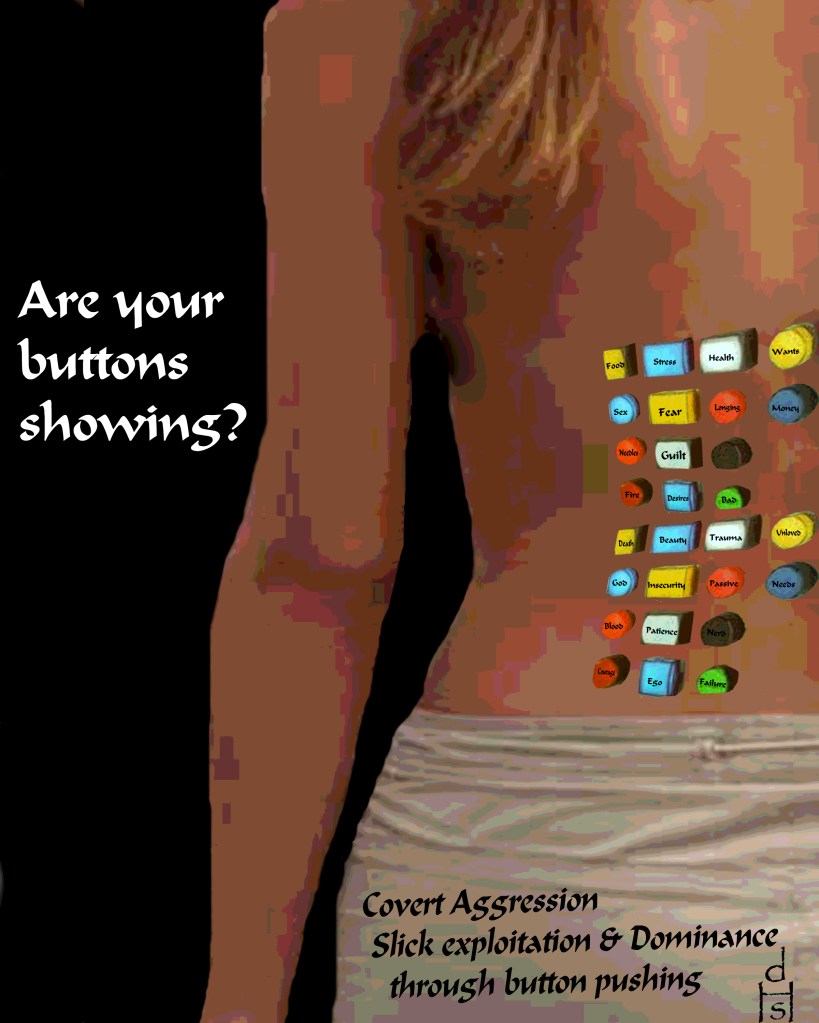
They start manipulating information to confuse the target. i.e. “If you vote for this person, you will lose your house.” Knowing that there is no connection between who you vote for and the status of your home ownership.
Manipulation of information increases and becomes more personal. i.e. “If he loved you, he wouldn’t work so long. I love you and I show it by not working all those hours. Why would you want to be with someone who does not love you when you can be with someone who does?”
They set up situations so the information they are telling the target appears factual.
They work to convince the target that it is in their best interest to listen and do what they say. This can be used through the manipulation of information or through threat and actual violence.
They start to separate the target from familiar family and friends. Anyone who might be perceived as a deterrent by the perpetrator.
The goal of the perpetrator is to cause as much confusion, cause an inability to reality check data fed by perpetrator to target, and wear the target down. This is typically done by causing lack of sleep, food refusal, environmental changes to make the target have to cope more to survive or violence /threat of violence. The key here is the target has to depend more on the perpetrator for their well being. Typically the target starts to trust the perpetrator more than family and friends.
The target starts to see the perpetrator as correct, in their best interest to listen to and agrees to do what they say. Typically, this starts with small things the perpetrator wants the target to do and the target is rewarded. i.e. “If you agree to say nothing about what just happened I promise you I will never beat you up again.” The target does what is asked. There are no beatings and reinforces that the request worked. Only the perpetrator changes from beating-up the target to some other form of torment.
At some point the perpetrator may ask for the target to prove their worthiness or sorrow at making the perpetrator behave as they do. Notice, the perpetrator at this point convinces the target it is the target’s fault they are in this situation. This intensifies the shame and often prevents the target from searching help. They feel they deserve whatever happens to them.
Proof activities or behaviors by the target can be typically radical, dangerous and demeaning. The target is pumped full of information which propels them to act on the proof activity. At this point the target does the activity for one or more of the following reasons: they believe the lies told by the perpetrator, they fear retribution from perpetrator, they fear being the cause of something horrible happening to someone else (including the perpetrator) if they don’t comply.
If the target manages to figure out what is happening and attempts to escape the bonds with the perpetrator, threats or actual extreme violence is not uncommon. Oddly enough, sometimes the perpetrator may fake a suicide attempt to guilt the target into compliance.
By putting these steps in numeric form, it sounds very concrete and easy to say, well I would easily see through that and it would not happen to me. Remember that these perpetrators have so confused the target that they trust the perpetrator, feel they need the perpetrator to survive or have to comply with them for the target to survive. They have convicted the target that people normally deemed trustworthy and helpful are the true enemy. They can even convince the target that they are in love with the perpetrator. No one is better than the perpetrator. No one else is more correct in their views, attitudes and desires then the perpetrator. No one else can save, help or care for the target like the perpetrator can. The perpetrator’s needs and wants and dictations are all that matter. The target is essentially brain-washed.
The result sometimes is devastating. Horrendous crimes are committed. The target allows horrible things to happen to them. And in the end, if they get out of the situation, it can take years to un-due the damage. Families and marriages are destroyed. Career can be ruined. Lives lost.
If the event causes events ending in the court system, often the target is not able to testify accurately about what happened. Even after the perpetrator is gone, the effects of the manipulation are so strong, the target continues to believe the lies told them and in the actions they took on behalf of the perpetrator.
These targets – victims need extensive help to recover. Depending on what they did, how far from who their sense of ‘this is not who I am’, and the extent of the brain-washing typically determine rates of recovery. But recovery with psychological scars is possible. I don’t think anything can totally remove the guilt, shame and shock when the target figures out and heals from what happened.
So, it comes down to the question: What responsibility does a person have for their actions when under the influence of a skilled manipulator? How do we as a society work with this?
I can still hear some readers saying, “I don’t get it.” I rather think unless you have had the unlucky experience of being in the shoes of a target, or worked extensively with the topic you probably will not totally get it.
When I look back at events in my life surrounding this topic, I still have a hard time getting it. I’m a strong, independent minded individual. It didn’t matter. I was caught off guard and my personality coupled with shaky, stressful events in my family life made me a prime target. I used to believe that people are good and trustworthy. I always gave people the benefit of a doubt. I felt people can change and really, honestly want to. If they do or say something horrible to me, it is in accident or some other deeper reason they are not aware of.
It did not register that some people are none of these things and instead feed their own natures and desires on others. When I looked at historical events such as Nazi Germany or the Jim Jones cult suicides, I would think, those leaders were evil. Why didn’t anyone see it and do something? My experiences have taught me why.
So, I get it. I didn’t do anything resulting in legal action. Thank God. But I have worked with enough people who have. The personal damage is horrific. When I hear of events unfolding in the world where there is suspect of a manipulator in the background, my heart rips a bit.
Just remember, if you are like me and do get it, you are not alone. If you don’t get it, I hope the f… hell you never have to.




 Deborah Sickle Hill