Let’s continue the conversation about how to build healthier relationships—with others and with yourself.
Here’s a powerful truth to sit with:
Everything we think, feel, or do is based on what we believe is in our best interest at the time. Even when it looks like the exact opposite.
That’s a hard concept to swallow—especially when we think about someone staying in an abusive relationship, joining a gang, getting hooked on drugs, or constantly procrastinating. Even in these situations, the person believes—on some level—that their actions are helping them survive, cope, or meet a deep emotional need.
We all do things that aren’t in our best interest sometimes. That’s human. (And if you think you never do, you may want to call a mental health provider. Just saying.)
So why do we act against our own well-being?
It comes down to how our brains are “programmed.”
Think of your brain like a computer. It only works based on the data it’s been fed. You were born with some basic instincts—crying when hungry, searching for comfort—but most of your programming came from your parents, your environment, school, relationships, and everything you’ve experienced since birth.
And the earlier that programming is installed, the deeper it runs.
Let’s say Joe is a warm, affectionate guy who grew up in a cold, distant home. His inner radar is now tuned to search for love and connection—sometimes in all the wrong places. If his need is strong enough, he might even engage in risky or self-destructive behaviors just to feel loved or valued.
Our brains are always scanning for ways to meet our needs, just like we search for a deal on ground beef or the right words to win an argument. Every choice we make—whether we eat a salad or grab a Big Mac—is based on our filters and beliefs about what will help us feel better, safer, happier, or more in control.
So here’s your challenge: Pause today and ask yourself why you’re doing (or not doing) something.
Why did you hold the door for someone?
Why did you snap at your spouse?
Why are you running late again?
Why are you reading this blog?
Every action has a deeper motivation, even if it’s buried.
Let me give you an example: You’re late for work, exhausted, and have to give a big presentation. You know espresso makes you jittery, but you drink one anyway—and sure enough, you flub the presentation.
Why did you drink it? Not just because you were tired.
Dig deeper. Maybe you were desperate to impress, hoping for a promotion. Why? Because you want to be seen as a good provider. Why? Because you want your family to love and respect you. Boom. That’s the real reason.
But here’s the twist: What if chasing that promotion makes you less available to your family? What if it leaves you feeling even less loved?
It’s time to ask the bigger question: What does love really look like to me? And are my current actions bringing me closer to it—or pushing it away?
You don’t have to have all the answers. But if you can recognize your deeper needs, question your beliefs, and stay open to new perspectives—you can begin to make healthier, more intentional choices.
And always remember: Sometimes, the choice that seems irrational to others is the best a person can do in that moment—especially when survival is on the line.
Wouldn’t it be nice if people came with instruction manuals? Better yet—what if we came with our own?
Imagine how much easier relationships would be—both with ourselves and with others—if we had a clear set of directions to follow. You might be surprised to learn: you don’t need a 200-page manual. A couple of index cards would do.
That’s because the basics are simple. Unfortunately, most people never get taught them. So we end up walking through life with blinders on, trying one approach after another, hoping something sticks.
Take this example: Someone gets angry and gives the silent treatment. Why? Because they believe the other person should know what they did wrong. The problem is—it solves nothing, gains nothing, and slowly chips away at the relationship. The more chips, the more dysfunction. Yet the behavior continues, often with confusion and surprise when the relationship sours.
Why do we do this? Because no one gave us the index cards.
Here’s the first card:
1. People can only act and react (thinking, feeling, doing) based on what they know.
Sounds obvious, right? But if it were, we’d all be a lot gentler with each other. Instead, we regularly expect others to respond the way we would, based on our experiences, our knowledge, and our perceptions (meanings).
Let’s look at a few examples:
Expectation: “If you loved me, you’d bring me chocolate donuts with sprinkles.” Reaction: “I brought you flowers. I thought that meant I loved you. How was I supposed to know donuts meant love?”
Expectation: “You should know better than to leave the oven in clean mode when leaving the house! Everyone knows that’s a fire risk!” Reaction: “I didn’t know that. I’ve never cleaned an oven before. How would I know it could catch fire?”
Expectation: “Can’t you do anything right? You can’t even load the dishwasher correctly!” Reaction: “Is there a right way? I was just trying to help. You know what—next time, you do it.”
Want to be shocked? Try this:
Spend one full day paying attention to how often you expect someone to act or respond based on your knowledge. Count how many times you assume someone “should just know.”
Then, spend another day observing how you feel when others make the same assumption about you—expecting you to read their minds, meet their needs, or act in a way that makes sense only in their world.
You’ll start to see just how much of our conflict stems from this silent mismatch of expectations.
And one last thought: Even if you’ve known someone your whole life, don’t assume they know what you know—or that they’ll process things the same way. We’re all working without manuals.
Eliminate the Worrywart: Understanding and Managing Everyday Anxiety By Deborah Hill, LCSW (Ret.)
“I had a big presentation today and was up all night worrying.” “I’m running late again—I’m afraid I’ll lose my job.” “I’m so worried about Jim’s health, I can’t eat.”
Sound familiar? We all worry. But chronic worry is more than emotional discomfort—it’s a contributor to high blood pressure, digestive issues, insomnia, and even long-term health breakdowns. Some people literally worry themselves sick.
Worry Is an Illusion of Control
Worrying often feels like doing something—but it’s really just a poor attempt at control. When we worry, we unconsciously think:
“If I think hard enough, I can stop something bad from happening.”
“If I don’t worry, I’ll be unprepared or uncaring.”
“If I mentally run every possible outcome, I can force the right one.”
None of that is true. A woman worrying in the waiting room during her husband’s surgery isn’t helping him heal—she’s draining her own energy. If she took a walk, grabbed coffee, or talked with a friend, the outcome wouldn’t change—but her resilience to face it would improve.
Worry = Self-Induced Stress
Unlike external stress (deadlines, illness, difficult people), worry is internal and voluntary. It places your body on red alert:
Muscles tense
Digestion slows
Heart rate and blood pressure rise
Adrenaline spikes
You lose sleep, focus, and peace
Your body thinks it’s in battle mode. But there’s no enemy. Chronic worriers stay on this battlefield for years—until their body breaks down.
Why We Worry
Worry can stem from love, fear, or habit. People say, “If you love someone, you worry about them.” But love doesn’t require mental telepathy. It asks for care and presence—not obsessing over things you can’t control.
The term “worrywart” makes sense. Left unchecked, worry grows and consumes. Like a wart on the body, it starts small but can overtake everything.
How to Squash the Worrywart
1. Recognize What Worry Is
Worry is a thought loop aimed at controlling the uncontrollable. You’re trying to predict, prevent, or fix something—often using nothing but mental energy.
2. Acknowledge You’re Not Telepathic
You cannot control life, death, illness, or other people’s decisions by thinking hard enough. No one can. And that’s okay.
3. Tune into Your Warning Signs
Your body gives you early alerts—like a ship moving from green to yellow to red alert. Ask yourself:
Are my thoughts racing?
Do I feel tense or sick?
Am I imagining worst-case scenarios?
Name it: “I’m worrying.” Awareness breaks the cycle.
4. Ask: Can I Control This?
If the answer is no, accept that. Letting go doesn’t mean you don’t care—it means you’re reclaiming energy for what is within your power.
5. Turn Worry into Work
✦ Prayer or Reflection
Prayer isn’t worry—it’s surrender. It can offer peace and perspective. If prayer’s not your thing, mindful reflection or meditation works too.
✦ Redirect Your Thoughts
Change your environment: get up, move around, talk to someone, take a walk, or do something tactile. Worry often fades when we shift context.
✦ Focus Your Mental Beam
Engage in hobbies or tasks that require concentration—baking, puzzles, gardening, music. Focus crowds out worry.
✦ Move Your Body
Physical activity releases stress. You don’t need a gym membership. Dance in your kitchen, walk the dog, clean the garage. Use that fight-or-flight energy productively.
✦ Get Involved
Channel worry into action:
Concerned about health? Research and prepare.
Afraid of crime? Join a community initiative.
Overwhelmed by a deadline? Learn time management or ask for help.
The Energy Shift
“I wish I had her energy—I feel so drained.” She may not have more energy, just fewer leaks. Chronic worry is an energy drain. When you stop trying to control what you can’t, that energy returns. You feel lighter. Healthier. Calmer.
Bottom Line?
Worry is optional. Learned behavior can be unlearned. Stop rehearsing disaster. Step away from the red alert. Reclaim your body, mind, and peace. It’s never too late to squash the worry wart.
I see books all the time about the five types of relationship killers. It’s ashamed we stop at five because naming the top five may not hit on the bumps in a relationship. If you look at a lot of the social and psychological data on relationships, the list looks more like this. (Note these are not in order of most damaging to least. There is no way to do that as each entry has its own dimensions and they differ couple to couple).
Communication issues
Dependency vs independence
Money
Ineffective problem solving or arguments
Changes in sexual desire
Affairs/one night stands/porn/excessive flirting
Friends/family/in-laws
Life Stress: job/unemployment/death/chronic illness/sudden illness/mental illness/increase in responsibilities/aging/moving/life style changes
Habits/vices/addictions
Taking the other for granted
Rushing into a phase in the relationship too quickly: weddings/babies/retirement
Lack of trust
Lack of Intimacy: feeling like you have to hide who you are due to fear of being unlovable/ no physical intimacy (touching)/ feeling like you have to be someone else to be loved
Lack of care: feeling like you are not cared about or your partner does not understand you
Judgementalism: feeling like you are always scrutinized, you can’t do anything right or being perfectionist and believing you can’t do anything right.
Tests: partner sets up little tests to see if you pass and are worthy of trust/love
Unrealistic expectations: if this is love, why am I so miserable – expecting partner to meet or fix your inner emptiness or meet unrealistic expectations or fantasies
Lack of contributions in household, family responsibilities
Raising kids
Respect
Comfort levels
Different goals in life
Step parenting
Mistakes: shutting down due to fear of making a mistake, making things worse
Living in the past
What is important to know is that while these can range in metaphor as a splinter, dagger or serial stabbing.
What one couple sees as a serial stabbing another might see as a splinter. Why the difference and which couple is going to ride the wave and come out feeling connected? The quick and easy answer is in fluidity and commitment to the relationship.
Fluidity means the ability to bend and not brake, to see the whole picture and not hyper-focus on one detail. Think about your relationship as a porcelain bowl, for example. If you drop the bowl into a swimming pool full of water, it will get wet, but most likely will stay intact. If you drop it in the sand, depending on the height you drop it; it might stay intact or crack. If you drop it on concrete – it’s shattered – almost every time.
There are ways to make you more mindful – more fluid. Keep in mind, however, that you are only one person in a relationship. The strongest relationships have fluidity in both partners.
Craving Connection in a World of Instant Gratification
By: Deborah Hill LCSW (Ret.)
I like to unwind with reruns of The Colbert Report and The Daily Show. No matter what kind of day I’ve had, that satirical hour somehow makes everything feel a little better.
One episode featured a spoof on black-market Canadian maple syrup, comparing it to a drug cartel. The mock reporter—adamantly syrup-free—feared one taste would spiral him into addiction, crime, and sticky ruin. Naturally, he caved. The next thing you know: endless pancakes, missed work, shady street deals, and a full-blown syrup bender.
I laughed out loud—then turned to my dog and said, “Damn, I wouldn’t mind some pancakes with syrup. Do we have any King Syrup?”
King Syrup is the good stuff—thick, rich, slow to pour. My dad used to beg me to smuggle bottles down to Florida. You can’t get it there. He gets it. I get it. We’re syrup people.
That night, I resisted. I had toast with peanut butter and milk in a blue Solo cup. Later, I played a few rounds of Bubble Mania, freeing kittens from bubbles (usually gratifying). But not that night. My mind was stuck on syrup.
At 6:00 a.m., I woke up with one clear thought: Pancakes.
I made a stack—instant mix, just add water. Three golden-brown discs with butter, warm and waiting. I pushed my work aside and gave them my full attention.
With reverence, I poured the King Syrup (not Canadian, but Fredonia, NY—close enough?) and let it soak in. Not too long—you don’t want soggy regret. Then I ate, slowly, trying to channel the reporter’s syrup high.
It didn’t work.
What I got was 1,000 empty calories and the gnawing feeling that this wasn’t it. Not really.
And then it hit me: What I wanted wasn’t pancakes or syrup. I wanted joy. I wanted connection. To feel loved, valued, seen. Maybe even touched. Perhaps even… sex. Or intimacy. Or something that told me I mattered.
Sometimes, we crave comfort and reach for what’s easy—food, TV, a distraction—because it almost satisfies. It promises to fill the hole but leaves us emptier than before. We make choices that don’t serve us, not because we’re broken, but because we’re human and hungry for something deeper.
The mind is tricky. Needs unfulfilled will find a workaround, even a ridiculous one. That Colbert sketch planted a seed. Logically, I knew pancakes weren’t the answer. But that night, syrup made sense.
Is it any wonder our behavior can get a little wacky? That we gravitate toward something—or someone—that offers relief, even when we know better?
What if we could pause in those moments and ask, “Is this really what I need?”
What if we could yell STOP before that instant gratification derails something deeper?
If you find yourself elbow-deep in pancakes and still feeling empty, it might be time to ask what you’re really craving. And maybe—just maybe—you’ll find a healthier, richer, more lasting way to feed that hunger.
The Show Must Go On: Children Using Perfectionism & Performance to Cope with Trauma.
by: Deborah Hill LCSW (Ret.)
Anna, age four, and Michael, age two (children’s names and ages were changed), were found in their home surrounded by blood and the dead bodies of their parents. At first, everyone understood the devastation these children experienced. Then there came a point where the notoriety wore off, and they were expected to act and feel like they behaved before—only they didn’t. They became super-kids—children who use perfection and performance to cope with trauma.
(I need to make two caveats. Trauma can be from a messy divorce, a close death in the family, or severe illness of the child or a parent, or a terrible car accident. The list can go on and on. The second, not everyone who becomes a performer or perfectionist has trauma in their background.)
Super-kids are children who try to be overly helpful, compliant, or high-achieving to avoid upsetting someone, attempt to gain control of a situation, or feel safe and valued. They tend to take on adult roles or act older than their age, often described as having an old soul. They hide their emotions, appearing fine when inside they are struggling.
How does using perfectionism and performing help the child cope?
1. It offers control in a chaotic world, rather than feeling helpless.
2. In many environments, love and safety feel conditional. A child may learn that being good, impressive, or entertaining earns approval or protection.
3. Performance and perfectionism can provide a powerful distraction from pain.
4. Instead of feeling inherently unworthy, they learn to find value in performance.
5. They give the impression that the child can prevent anything from going wrong by staying ahead of the potential threat.
6. They give the child the feeling that they can control how others perceive them.
I want to emphasize that a child does not consciously choose which skills are necessary to survive. And the behaviors may not initially appear to be performance or perfection coping skills.
What a child wants is to feel safe, protected, and loved. They will do what they need to do, be it perfectionism or performance, to achieve that. The super-kid, is the one nobody expects to be ravaged with internal turmoil.
Important note: Trauma affects each child differently based on age, personality, support system, and type/duration of trauma. One child might act out aggressively; another might become extremely quiet and withdrawn. All trauma responses are adaptations—they made sense at the time the trauma occurred.
References for this blog:
Bessel van der Kolk, The Body Keeps the Score, Diane Poole Heller, The Power of Attachment, Richard C. Schwartz, No Bad Parts, Pete Walker, Complex PTSD: From Surviving to Thriving, Judith Herman, Trauma and Recovery
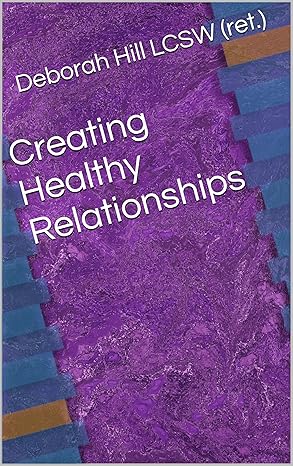
Healthy relationships don’t just happen—they’re built. Creating Healthy Relationships is your guide to understanding what makes relationships thrive. Drawing from decades of counseling experience and grounded in Choice Theory and Cognitive Behavioral principles, this book offers practical insights into forming and sustaining meaningful connections.
Adapted from a popular blog series, this collection reads like a mini-instruction manual, exploring topics such as:
Spotting and avoiding relationship “killers”
Repurposing your life after loss or change
Finding the right partner (and knowing when to keep fishing)
Learning to live with yourself
Navigating life with adult children returning home
Whether you’re starting fresh, redefining boundaries, or simply trying to connect more deeply, this book provides the tools to help you grow healthier, more fulfilling relationships in every area of life.
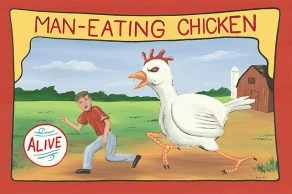
A sign in an amusement park says; look in peep hole to see a man eating chicken. Now, if you saw that sign what image do you think you’d see through the hole? Is it a man munching out on a piece of chicken? Or is it a large chicken eating a man?
What about these sentences? The man saw the boy with the binoculars. Did the man have the binoculars or the boy? Or, how about, hole found in changing room wall; police are looking into it. Are they investigating the incident or looking in the hole?
These are called syntactic ambiguities. Why am I telling you all this? Because it is a good demonstration of how our brains perceive the world around us. For every person who sees a man eating a piece of chicken there are probably equal number who see a large chicken eating a man.
If we want to understand and navigate our behaviors we have to grasp the way our brains see our world.
All around us is the Real World. This is everything that exists; no matter if we realize it or not. The real world contains trillions of pieces of information bombarding us constantly. Our brains are not equipped to handle all this so it selects what is most important and screens out the rest.
It is generally accepted that there are three filters used to screen select Real World information for our use. They are called: Knowledge, Values, and Perceptions.
Whatever information remaining after screening is now evaluated and a decision is made. Either, this information is in-line with our wants and needs and we feel good. This information is neutral and does not matter to us. Or this information is not in-line and may threaten our wants and needs and we feel bad.
If we decide that the information is in-line and we feel good, we keep our filters screening the same way, and continue to behave based on this information. The system is working well. However, if the opposite is true, we feel out of balance and our system goes into red-alert. Depending on how far off balance we feel determines how much drastic action we take.
For example, let’s say you are watching your child on the swing-set at a local playground. The weather is good, the park is not crowded, and your child is having fun. You feel good. All of the sudden, the swing chain brakes and endangers your child. Chances are at this point in time, your brain could care less what the weather is like or how crowded the park is. Instead information such as speed and what angle to leap in order to catch the falling child would be more practical.
Problems pop-up when we feel bad or out-of-balance and the adjustments we make are not the best. Our actions could make things worse. They could fix things in the short-run but not long term. Or the adjustments solve what we think is the real issue making us feel out-of -balance when it is another issue deeper down we have not addressed.
When we feel out-of –balance, we think, feel or do something different to feel better. The next step is, did it work? If not or it did not work the way we hoped, then a change in the information screened through the filters or an adjustment to the filters might be in order.
The filtering system is one of the easiest ways to get from out-of- balance to in-balance.
Knowledge Filter: This is a filter that contains pieces of information we already learned. I don’t think all information learned is actually in this filter. I think we have the ability to alter this. For example, I learned my ABCs in pre-school. This is always in my filter because I read and write daily. I learned to fish when I was four-years-old but never fish. I really don’t think this is in my knowledge filter. But if I pushed myself, I could remember some memory of fishing and probably some terms from hearing others talk of fishing.
If the information we are using to filter Real World information prevents us from acting in a way to feel good, get our needs met and be in-balance, we need to search for new knowledge. We can also reassess knowledge we already have and decide what needs to be added or subtracted.
This is as easy as someone saying, “Hey, remember back when and you had this happen. You did such-and-such and it worked out. Maybe you should try that now.”
Your reply, “Oh, I’d forgotten that. I’ll have to re-pull that knowledge and see how it changes my options.” Now you have added old information to your active knowledge filter.
Values Filter: This is the, how important is this information to me, filter. When information enters this filter a value is placed on it. Is it positive information? Information that helps us become balanced, meets our needs? Or is it negative, something that has the potential to prevent or hinder getting our needs met? Some information is neither and we don’t give it a value.
Perception Filter: This filter is the very selective, how we see the world based on everything that is us. This includes our gender, culture, experience, sexual orientation, parents, age, race, etc. The amount of inclusions in here can be astronomical. Because no one is the same as anyone else, each person’s Perception is different. Like the other filters, it can change. Perspective might be another good word for this area. To change our perspective is to change our perception filter.
All of the above is then evaluated against what Dr. William Glassier called the Quality World. The QW is sort of like the answer to the magic wand question many therapists ask. If you had a magic wand, what would life be like? In the Quality World we have pictures of how we think we can get our needs met in the most satisfying way. All our filters are balanced to provide the Real World information the system needs to best get to our Quality World picture.
For example: If I have a high need for love and a low need for power (see prior posting for more details), my Quality World might have a picture of me being adored by family and friends. There is never conflict. I do volunteer work and always put others ahead of my needs.
It is probably more specific than this. Maybe, I’m a stay-at-home mother with three adorable, cherub-like kids and a dog named Elmo. My husband, who looks like George Clooney, works as a Podiatrist and I go to the Sisters of Perpetual Mercy Church three times a week. I make an amazing meat-loaf. It’s to die for.
That picture is what my brain will use to set my filters and gather information from the Real World. It is through that information, evaluated against my Quality World picture that I will use to behave. I will use it to think, feel and act a certain way. My way, may not be your way.
That is why some of us see a man eating a chicken while others see a chicken eating a man!
Setting out to find a life partner is like fishing. Fishermen have to know what kind of fish they are fishing for and where that type of fish is likely to be found. If they are after tuna, hopefully, you wouldn’t see them fishing in a river. They have to know what kind of bait to use to entice the fish. They have to know their own abilities and have good skills in fishing. Knowing all this, they go to their favorite fishing place and throw in their line and wait. If they are lucky a fish shows interest. Skill is in the length of time and reel play needed to keep the fish interested and not bored. Hopefully, the fisherman gets his fish.
Okay, dating is not quite like fishing. There are some differences but the basics are the same. The person looking needs to know the type of person that holds their interest. Next, they have to know where to best find that type of person. The fisher of a life partner has to assess if they have the correct personal characteristics to attract this type of person. They have to be confident that what they have to legitimately offer and be sincere in offering. This is where the analogy stops.
People are not fish and the idea of baiting someone sounds horrid. However, I find using this fishing analogy works well in getting people to realize some of the behaviors they chose to find a mate are as wacky as fishing for tuna in a river. Two reasons for dating disasters and the destruction of the beginning relationships are: One or both people have minimal ideas on what they really want in a relationship. One or both people don’t know what their needs are and the ways they have learned to get those needs met. One or both parties do not realize that everyone in the world processes and sees the world somewhat differently. When you add the hormonal component involved with sexual attraction and the chemical reaction we call falling in love, is it any wonder new relationships have a high turn-over rate?
To be a fisherman in good form and help prevent fishing disasters, it is best for the fisherman to know his/herself before those hormones kick in. I’m going to review some ideas then look at an example.
Review: All choices in life revolve around the same basic questions and concerns. What is it I really want and need? What am I doing to get it?Is it working? If not, reassess what you are doing?
Our choices must also include two very important pieces of information: ALL BEHAVIOR IS PURPOSEFUL (Everything you think, feel and do is for a purpose – always). THE ONLY PERSON YOU CAN CHANGE IS YOU.
All our behaviors are based on our needs. Everyone has the same needs, only in different degrees. Universal needs are: Love and belonging (feeling connected to a bigger whole), Power, Freedom, Fun, Survival, Purpose in life (spiritual).
How we get these needs met depends on several factors: Our total knowledge (learning and experience), Our values. Our perceptions (how we choose to see the world around us).
OUR EXAMPLE:
Let’s look at Joe (not a real person) for an example of this in action.
Joe has a high NEED for LOVE and a low need for POWER. His goal (WANT) is to find someone to marry who will love him unconditionally the way he wants to love them.
Joe’s TOTAL KNOWLEDGE comes from:
His divorced parents:
Mom said. “Your father never loved me. I know this because he never helped me with the chores.”
Joe heard: to show a woman you love them, help with the chores.
Dad said. “We loved one another but she let herself go and well I have needs. Your mom turned out to be a total dog. Son, marry a younger beautiful woman and you will always be content.”
Joe heard: Stay in shape, dress sharp and marry a younger, beautiful woman to keep love alive.
Joe has read all about love and relationships in books and magazines and has learned:
Love takes a lot of work
There are stages of love in a relationship
Couples who make it, communicate well and have date nights
Money is the number one reason couples split up
Joe loves to listen to country music, watch TV and go to the movies. He has learned:
Relationships break up all the time
No matter what men do in a relationship, it’s usually wrong
Men have a very hard time staying with one woman
If you work hard enough you can get someone to fall in love with you
If someone steals your girl, you can work hard and win her back
Women want a tender man who is good in bed, has a good job, makes good money, is handsome, maybe a bit quirky and can take care of them
Romance and love hit fast and hard. Go with it.
Joe has friends. All of them are divorced and some remarried. He hears them say things like:
She left me for her tennis instructor.
My secretary is better in the sack.
She just doesn’t get me.
We grew apart.
She was a nagging bitch anyway.
Joe hears:
Stay in shape or you’ll lose her to some athletic guy.
Don’t look at other women, it’s too tempting.
Keep an open communication so you don’t grow apart.
Remember there are stages of love, stick with it.
There are reasons people complain. Find out and correct problems if needed.
Now Joe is ready to find the girl of his dreams. He is at an art gallery opening and spots the young and beautiful Sally. He knows she is the one and there is no turning back. He can feel it. The fact he does not know her is of no consequence. He had everything he needs to make this work. So he thinks.
PROBLEM
Joe has not looked at the most important piece of information needed to make this relationship work. Sally has her own TOTAL KNOWLEDGE independent of Joe! Because Joe decided, based on his knowledge, values and perceptions that they were destined to be together, he inadvertently placed his heart on the line. He fell romantically in love and it ended up looking like this.
Joe: Tries to be attentive. Sally: Thinks he is smothering.
Joe: Brings her flowers and writes her romantic poetry. Sally: Thinks flowers are a waste of money and only for funerals or for saying I’m sorry. She hates poetry.
Joe: Wants to spend intimate evenings at home watching TV together. Sally: Wants to belong to various up and coming professional and social groups. These keep her out of the house most nights.
Joe: Reminds her of his good, high paying job and income. But he doesn’t stop there. He also reminds her that he is there to take care of her. Hinting she can stay home and take care of the kids when they come along.
Sally: Thinks he is a male chauvinist. There is no way in hell she would consider staying home. She is one of the up and coming, not trying to gain a homemaker of the year award.
Who is in the wrong? Neither! Joe has a strong need for love and a low power need. Sally has a low need for love and a strong need for power. The relationship fails and Joe is devastated. He has no clue why it did not work.
Because of Joe’s total knowledge and values, he chose to only see the things in his world that agreed with them. Those were his perceptions. It all went together and it never occurred to him Sally saw things differently. Joe had TUNNEL VISION.
Joe’s tunnel vision prevented him from seeing Kelly at the gallery the night he fell in love with Sally. Kelly had introduced herself to Joe but he hadn’t really seen her after seeing Sally. She was not as stunning in his eyes.
Kelly was looking for someone just like Joe to fall in love and get married. She would have been thrilled with poetry, romance, nights home together and a long committed relationship with family.
Joe missed it! This was probably not the first or the last time Joe’s tunnel vision would blind him to getting his needs and wants met.
FISHING LESSON FOR THE DAY
Know your needs and wants (the real ones, not the superficial ones).
Have a handle on how you are thinking, feeling, behaving and how you are screening your reality to get those needs and wants met.
When you met someone REMEMBER – they have their own needs and wants. They have their own ways of thinking, feeling, behaving and screening their reality.
Slow down and reassess yourself and the situation often. If needed, make changes in your thinking, feeling or behaving.
** Now I know someone is going to ask, why would Sally continue to go out with Joe?
Let’s look at Sally a little closer.
Sally has a strong power need. Her goal (want) is to find a man with enough money, connections and good looks to wine/dine and help elevate her and her career. She wants to live the way her parents did without the commitment to marriage.
Sally’s parents are married.
Mom says. “Your father and I love one another, I suppose. But he’s a lawyer. I’ve got the country club. Marry someone rich, someone who will get you into the upper crust of society.” Sally heard: Men are your ticket to the rich and powerful of society. Love is not important, prestige is.
Dad says. “I’m a powerful attorney. I don’t have time for trivialities of marriage. I got married because it is what I was supposed to. It looks good for politics and moving ahead in life.” Sally heard: Marriage if anything is for convenience and if you don’t have to, don’t do it.
Sally does not like to read books on relationships. Occasionally she reads magazines on high fashion and celebrities. She has learned:
The more men you have experience with the better
Men are a great spring board for a woman to succeed
Men can be thrown away when a better opportunity arises
Men’s feelings are not as deep or important as a woman’s
Women have been oppressed too long. It’s your turn, baby.
Sally does not watch TV. She listens to Indie and World music but never notices any relationship issues implied in them. If she goes to a movie, it is only to see an Indie film specific about world concerns and oppressed people getting ahead. She has learned:
You have to be tough in this world
You are truly on your own
Make sacrifices to better yourself
Think global not home based
Sally’s friends have never married nor do they want to. They have all gone through many men all propelling them further in their own pursuits. They all think their moms were naive and or dumb.
Sally hears:
Don’t get married
Date only men with money who can help propel your career
It’s all for me to help me so I can help the world
I’m not going to be a pasty fool like my mom.
Sally meets Joe. His money and continuous attempts to convince her of his great and powerful job tell her he meets her criteria. She can use this even if the rest of him is old fashioned and a bit of a bore. Only his old fashioned ways and smothering behaviors make him too much of a liability for her needs and wants. She dumps him for Kevin who has more of a power need similar to her own.
Sometimes the Joe’s do find the Kelly’s in the world and there are still problems that arise. Why would this happen?
Remember Joe gives flowers and poetry to show love? It could be as easy as Kelly was raised that a man shows love by doing more family events and activities with kids and extended family. Only she never told him. Joe thinks he is doing everything right to show his love. In Kelly’s mind, she loves the flowers and poetry. But they are not demonstrating the deep love she needs from him. Kelly needs for Joe to volunteer to do things with the family.
If both of them know what their needs and wants are AND WHAT THAT LOOKS LIKE (What behaviors a person would see as testimony of meeting that need or desire. i.e. flowers mean I love you vs. time spent with family means I love you). The next step is to TALK about it. Neither of these people is more right or wrong, only different!
Once they each have more information they can chose to change their behaviors or keep things the way they are accepting the possible unhappy or disastrous results.
So, if you are having relationship issues or are fishing for that special someone –
GIVE YOURSELF A GIFT
Know your real true wants and needs
Know what they look like in action
Remember everyone is different
Give yourself time to explore and grow
Get more information if things are not making sense or you feel out of balance
Self evaluate often
Communicate always
Remember you can only change you. You are ultimately responsible for you, your feelings, thinking and behaviors. Happy fishing!
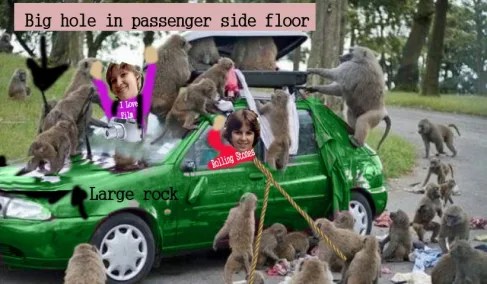
What do you get when you mix a lime green Datsun with floor portholes, a trunk full of Twinkies, and an angry mob of monkeys? A safari detour gone spectacularly wrong—and a car barely held together by granite and hope. Hang on tight for this laugh-out-loud road trip through chaos, feathers, and fur. (Reading time about 8 minutes)
It was a two door, 1971, lime green Datsun B-210 with a black vinyl roof. Custom detailed with dual, on-the-floor, port holes for your road viewing pleasure. An additional emergency pull-rope release added onto the driver-side door for times when it’s not cool to use a handle. And a specially designed hood bent into the majestic shape of a steep mountain. Perfect for quick engine checks and radiator ventilation without having to fool with antiquated, interior, hood releases. The five pound Massachusetts’ granite, air-filter and cover-attachment-system fit perfectly under the shape of the hood.
Roach clips, never used, with hot pink feathers are swinging to the riffs of Keith Richards’ bass guitar and Mick Jagger’s edgy vocals. It’s Sue’s car. To the world, I am a Lennon/McCartney girl. Behind closed doors, I’m a Richards/Jagger mistress. I have a Sweet Pollyanna Purebred reputation to uphold.
We’re in New Jersey on a sweltering hot, July morning after a heavy rain. The smell of evaporating water on asphalt whiffs through my passenger side, floor porthole. I watch the macadam and occasional puddle fly by my feet straddling the hole.
“Let’s go see the monkeys at the drive-thru safari,” I suggest. I’d seen a sign just outside of New York City. “We’re only twenty miles away.”
“Sure, why not.” Sue replies. Sue is a tomboy. Something she readily embraces. This is evidenced by her grungy rock band tee-shirts, faded jeans, cowboy boots, and hat, slightly greasy dirty blonde hair, and automotive grease under her fingernails. She was always tinkering with the car.
I used to be a tomboy but exchanged it for grace, poise and the showmanship my performance persona demanded. I envy Susan’s grunge while I sit here in a crisp white pair of shorts, turquoise and white spaghetti strap tank top, with appropriately and pain staking matched jewelry. My white Jack Purcells are as spotless as my fingernails which have never touched motor oil.
The car wheel hits a puddle, splashing muddy water into my floor porthole. My crisp, clean whiteness is now a muddy, drenched mess. Water is running off the end of my pampered, Maybelline, light beige covered nose. It took me fifteen minutes trying to find my reflection in a campground mirror this morning to get this nose well blended!
Susan looks over at me and asks. “What the hell? How did you get all wet and muddy?”
“Oh I don’t know. Something about a hole in the floor that needs fixed.” At least my Nikon camera and accessories didn’t get wet. I look around for something to use as a towel but only find our mildewed tent, sleeping bags, duffle bags, firewood, a half empty bag of potato chips and an unopened box of Twinkies.
“Serve’s you right for wearing white!” She laughs, pulls the 8 track tape out of the dashboard, shakes it and puts it back in. I have no idea what this ritual does but this will be the sixth time I’ll hear the song, I Can’t Get No Satisfaction, in the past two days.
A kid with pimples greets us at the safari gate. He announces to no one, “Twenty dollars, stay in your car, the windows can be down except in the monkey enclosure, don’t feed the animals, the animals have the right a way, don’t stop in the monkey enclosure, take all the pictures you want, have a nice day.” He takes a breath. We drive on to join a long line of slow moving vehicles.
Our windows are down so I can take pictures without a glare. I tend to see everything through a camera lens. I go almost everywhere with my gear ready for that opportune moment. Several cars ahead, I see two mammoth gray ostriches weaving between them. Occasionally they case a car, seemingly looking for trouble. This could be that moment.
“Hey look.” Susan says as she points to the birds. “They’re getting really close. You might actually get a good picture.”
The birds are now several car lengths away. I look at my camera and realize I don’t need the telephoto lens so I bend down to get the 50 mm.
“Um,” Sue says. Her voice sounds a bit distressed but not enough for me to sit up. “Um, don’t, okay, just don’t get, um, I think we might have a problem.” I cock my head toward her to figure out why she suddenly forgot how to formulate sentences. Her face is oddly drained of color. “Right now,” she continues in a near whisper. “Don’t move, Debbie. We have a serious problem happening.”
I slowly turn my head to face the largest beak I’ve ever seen followed by two, large, black eyes on a face covered by prickly hairs. I definitely remember the animals have the right of way.
The beak, eyes and prickly hairs jolt past me heading for the back seat. It’s followed by an incredibly powerful, prickly haired, neck and a body of varying shades of musky smelling, gray plumage that completely covers my window opening. I’m pretty sure the 50 mm lens is the wrong one. What I really need is an extreme wide angle lens. But that‘s okay because I don’t think the ostrich is in the mood.
The gray plumage and powerful, prickly haired neck whip back out my window with the half-eaten bag of potato chips covering its eyes and beak. It’s really very stunning. The red and white of the family size, chip bag, against the increasingly frantic varying shades of musky smelling, gray plumage now in full regalia is so avant-garde. I can’t decide what strength and angle of flash to use on all this gray plumage with the very overcast, gray sky in the background. This would be a great shot in subtle shades of grays, blacks and white in the style of Ansel Adams.
“Put the window up!” Susan yells. “You’re gonna get in so much trouble for feeding the animals!” I really didn’t need to get into anymore trouble. I nervously try to push strands of my honey blonde hair behind my ear without success. It’s cut too short.
I look over at Sue’s white knuckles wrapped around the steering wheel. Her breathing is labored but is curiously in rhythm with her head shaking left to right and back again. It’s not my fault the damn bird likes chips. Not that it matters. I glance around the back seat for damages. Except for a few remaining terrified chips scattered hither and dither, all seems normal. The chips were destined for consumption anyway. What’s the problem?
“Well,” I tell her, “at least they didn’t get the Twinkies.” I can see from Sue’s expression there are no words to express her feelings on the topic. We start moving forward again.
The monkey enclosure looms ahead with its two-story cement walls topped in high voltage wire. Cars are only allowed through the massive wood and steal double doors at select intervals. Two armed animal control wardens monitor the opening diligently.
“They did say this is a monkey enclosure, right?” I ask. Sue nods yes and pulls the car up to the stop line before the immense, fortified doors. I recheck the settings on my camera.
A warden steps up to Sue’s window and says, “Door’s locked, windows up, don’t stop, no exceptions – got it?”
The massive doors open wide enough to swallow us and no wider. We pull through and they close quickly behind us. I look around expecting to see a cross between Godzilla and King Kong. I see nothing but the road we’re on and a well manicured lawn with lots of low shrubby trees. There is a red car about three hundred feet ahead of us moving slowly..
A large, gray-brown male macaque steps out from behind a tree onto the road ahead of us and sits down. Sue stops the car. His steal, green eyes watch us, the animals in the cage. He’s in no hurry to move. Peripherally, I see movement and turn to my right to see macaque mother’s with their babies.
“Check it out!” I tell Sue. “ Aren’t they cute?” I want to shoot a picture but my window has animal slobber all over the exterior. “What does it look like out your window?” She doesn’t answer and I turn to find out why.
On her side of the car, the one with the convenient, emergency, pull-rope door release, a line of fidgety, gray-brown fury bodies with green eyes watch us.
“This can’t be good,” Sue says. She turns the tape player off and we wait in silence.
The large, gray-brown, male macaque responsible for stopping the car jumps onto our mountain shaped car hood. He yawns, shakes his head and urinates all over the window.
“That’s something you don’t see every day,” I say and take a picture.
“This isn’t gonna to be good. I think we might have a problem,” Sue whispers.
Urine-monkey stands, flaps his arms, and opens his mouth displaying sharp incisors and screeches like a banshee. Suddenly, al I see out any window is a gray-brown, fury, moving carpet. The car shakes and bounces reminding me of an amusement park ride. I struggle to turn and look out the back window and see black ash rain.
“Sue, is that your black vinyl roof?” I ask. Thousands of pieces of black vinyl roof slide down the back window. I brace the camera against the rocking car seat and shoot a couple shots of the storm.
“Oh hell! No!” Sue yells. I spin around, jostled off balance as I go. “ They’ve got the rope!”
I lean over to assess the situation. Five monkeys are in a line pulling on the convenient, emergency, pull-rope release. It’s the exterior part with the knot we untie to release the door. Sue has the other shorter, interior end in hand. It’s obvious they have more leverage then we do. I can’t grab the rope. Sue is in the way. So, I move back to my side of the car. Counter balance, I figure.
My side of the window is now void of fur and I have a clear, abet smudged shot of the baby monkeys with their mothers. What the hell? I shoot a couple shots at different focal lengths and apertures, trying to adjust for the rocking motion of the tug of war occurring on the driver side of the car.
“What the hell are you doing?” Sue yells at me. I spin and look at her.
“I’m taking pictures.” I say and notice her eyes. Their size and her panic enhance their green and brown color making them look wickedly, earthy in this light. I shoot a picture.
“They’re going to kill us, you know.” She struggles to wrap the small section of rope around her arm like she was wrapping a garden hose.
“I suppose this is not a good time to tell you I think disassembling and reassembling the car door last night was a bad idea on your part?”
A blue mini-van filled with kids passes. My window is once again covered in fur but I see camera flashes. I realize the mini-van has a better point-of-view then I do. What good is expensive camera equipment if your point of view is wrong?
I’m distracted by the sensation that my shoe is moving on its own accord. I look down. Little hominid fingers have hold of my muddy, Jack Purcell shoe laces. Crap, I forgot the porthole. I yank my foot up but quickly halt. There is an arm and a shoulder attached to the hand and I’m pulling them inside the porthole. This would make one hell of a short video if I had a camcorder with me.
“Do something!” Susan yells. “Now! Put the damn camera down and kick that beast back to hell! I listen and obey.
The car stops rocking and the windows are fur free. The porthole is empty and the rope release on the door is limp. It’s no longer raining black ash. I take a picture of the empty, now larger porthole between my feet. I look up to see a warden in a bright yellow jeep beside us. He looks perturbed. The monkeys act aloof and I don’t know what I look like, but Susan looks like hell. He motions for us to follow him and we do.
“Go to the clerk,” he says. “She’ll take care of the damages.”
We park the car; examine all the thin, side, metal trim now jutting out at odd angles, the driver’s side door no longer sitting flush with the frame and the hole in the black vinyl roof.
“My poor car,” Susan says.
I look at the misshaped hood, the remains of the rope hanging off the broken door and my muddy Jack Purcells, complimentary of the floor porthole. “Yeah, it’s a shame.”
“There is no way the clerk is going to believe this,” Susan says. “Well, we might as well find out.”
We walk over to an office and I proceed to gingerly, almost embarrassingly explain our situation. I know they are going to look at Sue’s car and think we’re idiots.
“Damn monkeys,” the clerk says. “I bet your car is green. There is something about green cars. Take your car over to the park police. They have to make a report and photograph the evidence.”
We drive the car over to the police station. A pudgy, black officer steps out with an antiquated Polaroid camera in hand. “The monkeys did all this?” He asks while circling the car, stopping to look at the Massachusetts’ granite under the bent hood and the missing car floor from my open window. He looks directly at me.
I’m horrible at lying. Ever since I can remember people have told me, don’t play poker! “No.” I tell him.
“So, what damage did they do?” He’s still looking at me. I shoot a look over at Susan who’s shuffling her feet nervously.
“The roof and the metal, jutting out thingies,” I say.
“Thought so,” he says. He takes a couple Polaroid shots and waits for them to develop. “Are you two far from home?”
“Five hours, maybe,” I reply. Not sure why this is important.
“This car is a death trap. You know that?” He’s still looking at me. It’s not my car. I keep quiet.
He comes over to my side and shows me a very tiny, poorly exposed picture of Sue’s car. “This doesn’t quite do the car justice, does it? I bet if you used your camera, we could really see the damage.” He pauses, looks at me, Sue and then the car. He sighs, pulls out a pocket knife and slashes the monkey made hole in the roof and pulls it back exposing the metal. He snaps another picture and looks at me. “I think this might get the point across.” What am I supposed to say?
He takes Susan into the station to fill out paperwork while I stand guard over the car. I’m not sure how we’re going to get the car home with all that metal hanging off the sides. Sue comes out with a smile on her face. They paid her twice the amount of money she originally paid for the car – six hundred dollars.
“Ready to go home?” She asks.
I look over at the metal protrusions. “What about these?”
“That’s not a problem.” She pulls the metal completely off each side of the car and shoves them in the back seat with the moldy tent and Twinkies.
We drive back to Maryland in silence. I know my pictures will all be blurry and I’m bummed. We pull into the driveway, and as we unload the car, it hits me, and I stop moving.
“What?” Sue asks.
I turn and look at her. “I should have put the camera on automatic instead of manual.” I can see from her expression there are no words to express her feelings on the topic.



 Deborah Sickle Hill