Tag: mental-health

  • When Life is not what you Dreamed

    @Deborah Hill

    When Life Isn’t What You Dreamed: How to Reconnect with Your True Needs and Wants

    Deborah Hill LCSW (Ret.)

    (3-minute read)

    At some point, nearly everyone looks back on life and wonders, How did I get here?
    What happened to the dreams, the plans, the “could have beens” and “should have beens”?

    The answer is simple to say—but often hard to accept:
    For the most part, we made choices that brought us to where we are now.

    That’s not to say we chose the traumas, losses, or catastrophes that blindsided us. No one chooses to be hurt, abused, abandoned, or thrown into crisis. But the choices we make afterward—the way we respond, the paths we follow—those decisions shape our journey.

    And when our choices take us further from the dreams we once had, we start to feel unbalanced, unsatisfied, or even angry.


    Why Do We Make the Choices We Do?

    Most of us choose what we think is best at the time. A child throws a tantrum to get candy, believing it will work. An adult gives the silent treatment over forgotten flowers, hoping to “teach a lesson” and feel valued next time.

    Sometimes we make reactive choices. Other times, we simply lack the information or emotional tools to choose differently.

    Take the example of a teen from a broken home who joins a gang. From the outside, it’s clearly not in his best interest. But with the limited knowledge and options he sees, it’s the closest thing to a family—offering belonging, respect, and protection.


    The “Quality World” We All Carry

    As we grow, we create a personal picture of what our ideal life looks like—our Quality World. In this internal landscape, all our needs and wants are met. We feel safe, loved, successful, joyful.

    Ideally, we spend our lives making choices that move us closer to that picture. But if we don’t fully understand our needs and wants—or the options available to us—we may veer off course.

    And here’s the truth:
    Your ideal picture is probably a fantasy. But beneath that fantasy lies something very real—your core needs and desires.


    A Practical Example

    Let’s say your Quality World includes owning a Maserati. But in reality, you’re driving a rusty old Ford.

    You probably can’t buy the Maserati—but ask yourself why you want it.
    Maybe it symbolizes success, admiration, adventure, freedom.
    Maybe what you really want is to feel noticed, valued, alive.

    When we understand the why beneath the fantasy, we can start finding real-world ways to fulfill those needs—without waiting on an impossible dream.


    How to Align Your Life with What You Truly Need

    Step 1: Discover the “why” behind your fantasy.
    Use your imagination. If there were no limits—what would your life look like? What does that dream say about what you truly want?
    (Example: “I want to be on a football team” → “I want belonging, excitement, shared purpose.”)

    Step 2: Explore realistic substitutes.
    You may not become a surgeon—but can you volunteer with the Red Cross? Become a first aid officer? Help people in ways that still honor your deeper needs?

    Step 3: Examine your current choices.
    Are they aligned with your needs and wants—or taking you further away from them?

    Step 4: (Corrected numbering)
    Take small steps toward a better fit.
    Set short- and long-term goals. Think of these goals as your rudders—they help steer your ship, even when waters are rough.

    Step 5: Evaluate regularly.
    Ask yourself:

    • What do I truly want and need?
    • What am I doing to get it?
    • Is it working?
    • What could I do differently?

    Final Thoughts

    You may never have the exact life you imagined—but you can build a life that meets your real needs, a life that feels meaningful, grounded, and authentic.

    It’s never too late to rewrite your story, one intentional choice at a time.
  • You’re Fine China–Not a Crushed Solo Cup

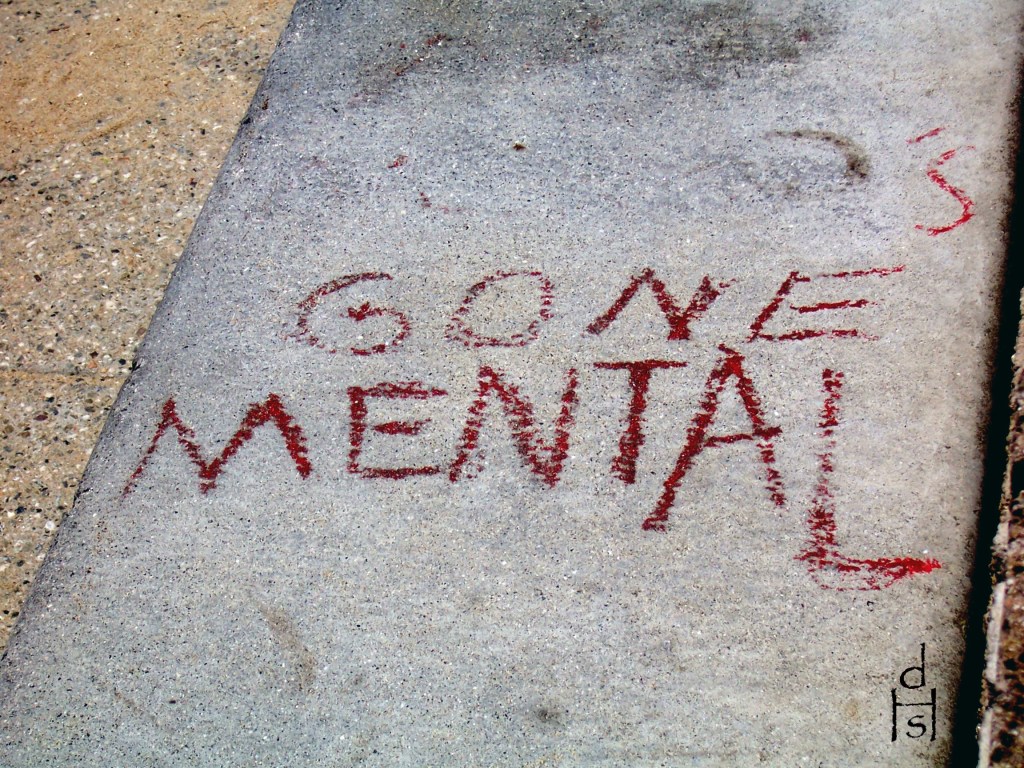
    Gone Mental ©Deborah HIll

    You’re Fine China—Not a Crushed Solo Cup

    by: Deborah Hill LCSW (Ret.)

    Many people live with chronic mental health conditions—depression, anxiety, ADHD, PTSD, and more. These are real, brain-changing diagnoses that often require medication and therapy just to maintain a sense of “normal.” For some, the illness is severe enough that the old normal no longer applies. They’re left to build a new one from scratch.

    The same is true for those facing chronic or life-altering physical illness. They too must learn how to cope, adapt, and find a new way forward.

    I live with CPTSD, depression, and anxiety. Over the years—both personally and professionally—I’ve seen a pattern: we often see ourselves as broken pieces of china, trying desperately to glue the fragments back together. But at the same time, we treat ourselves like disposable red Solo cups—crushed under the weight of perceived failure, the loss of a “normal” life, self-blame, and anger toward ourselves, others, the universe, even God.

    It doesn’t have to be this way.

    We deserve better from ourselves. Healing is hard enough. Beating yourself up will only make it harder.

    If life has chipped or cracked your fine china, you have every right to grieve. You have every right to mend. But stop letting yourself—or others—treat you like a crushed plastic cup.

    Here are some ways to start reclaiming your worth:

    • Know your limitations—and respect them. Boundaries aren’t weakness; they’re wisdom.
    • Create a safe space. Whether physical or emotional, make a place where you’re untouchable.
    • Practice stress reduction. Listen to music. Meditate. Read. Walk in nature. Do what calms your nervous system.
    • Pay attention to your self-talk. Are you your own worst enemy? Are you constantly angry, hopeless, or stuck in shame?
    • Spend time with supportive people. Seek out those who lift you up, not tear you down.
    • Explore a spiritual practice. Remind yourself that you are more than this moment, this diagnosis, or this body. There is a bigger picture—and you are a meaningful part of it, even if you don’t fully see it yet.

    You are not broken.
    You are fine china—fragile, perhaps, but still beautiful. Still valuable. Still worth protecting.

  • The Show Must Go On: Children Using Perfectionism & Performance to Cope with Trauma (Revised 2025)

    The Show Must Go On: Children Using Perfectionism & Performance to Cope with Trauma.

    by: Deborah Hill LCSW (Ret.)

    Anna, age four, and Michael, age two (children’s names and ages were changed), were found in their home surrounded by blood and the dead bodies of their parents. At first, everyone understood the devastation these children experienced. Then there came a point where the notoriety wore off, and they were expected to act and feel like they behaved before—only they didn’t. They became super-kids—children who use perfection and performance to cope with trauma.

    (I need to make two caveats. Trauma can be from a messy divorce, a close death in the family, or severe illness of the child or a parent, or a terrible car accident. The list can go on and on.  The second, not everyone who becomes a performer or perfectionist has trauma in their background.)

    Super-kids are children who try to be overly helpful, compliant, or high-achieving to avoid upsetting someone, attempt to gain control of a situation, or feel safe and valued. They tend to take on adult roles or act older than their age, often described as having an old soul. They hide their emotions, appearing fine when inside they are struggling.

    How does using perfectionism and performing help the child cope?

     1. It offers control in a chaotic world, rather than feeling helpless.

    2. In many environments, love and safety feel conditional. A child may learn that being good, impressive, or entertaining earns approval or protection.

    3. Performance and perfectionism can provide a powerful distraction from pain.

    4. Instead of feeling inherently unworthy, they learn to find value in performance. 

    5. They give the impression that the child can prevent anything from going wrong by staying ahead of the potential threat.

    6. They give the child the feeling that they can control how others perceive them.

    I want to emphasize that a child does not consciously choose which skills are necessary to survive. And the behaviors may not initially appear to be performance or perfection coping skills.

    What a child wants is to feel safe, protected, and loved. They will do what they need to do, be it perfectionism or performance, to achieve that. The super-kid, is the one nobody expects to be ravaged with internal turmoil.

    Important note: Trauma affects each child differently based on age, personality, support system, and type/duration of trauma. One child might act out aggressively; another might become extremely quiet and withdrawn. All trauma responses are adaptations—they made sense at the time the trauma occurred.

    References for this blog:

    Bessel van der Kolk, The Body Keeps the Score, Diane Poole Heller, The Power of Attachment, Richard C. Schwartz, No Bad Parts, Pete Walker, Complex PTSD: From Surviving to Thriving, Judith Herman, Trauma and Recovery

  • Finding Happiness in an Uncertain World

    Deborah Hill LCSW (Ret.)

    Estimated reading time: 3–4 minutes

    The world right now feels unpredictable. We’re flooded daily with news—some real, some not—that stirs up anger, helplessness, depression, and anxiety. At the same time, life marches on. We celebrate birthdays, plan weddings, cherish family moments, and get promotions—while wars rage, politics divide, and personal struggles like job loss or divorce quietly unfold behind the scenes.

    It may seem counterintuitive, but finding happiness amid turmoil isn’t denial—it’s survival. It’s not forgetting what’s happening or pretending to be unaffected. It’s more like holding an umbrella in a storm or finding the strength to lift your hand above rising waters.

    Happiness, in times like these, becomes a quiet act of resistance. Here are 15 ways to cultivate it—even when the world feels heavy:

    1. Smile more. Find joy in simple moments and the people around you.
    2. Take breaks from the news and social media. Constant exposure fuels stress and fear.
    3. Stay connected. Nurture relationships and activities that uplift you.
    4. Give generously. Compliments, kindness, and small gestures go a long way.
    5. Acknowledge your feelings. Journal, move your body, or channel your emotions into purpose.
    6. Challenge negative self-talk. When your inner critic speaks up, reframe the message.
    7. Let go of hate. Hatred solves nothing—it only poisons the vessel that carries it.
    8. Stop living in the past. Release the “should haves” and “what ifs.”
    9. Immerse yourself in music. Let it lift, heal, or energize you.
    10. Nourish your spirit. Whatever your beliefs, cultivate a deep spiritual life.
    11. Don’t assume or judge. You can’t read minds, and you never know someone else’s story.
    12. Prioritize self-care. You can’t pour from an empty cup.
    13. Declutter your space. A clear environment helps create a clearer mind.
    14. Get good sleep. Rest isn’t a luxury—it’s a necessity.
    15. Step into nature. Even a brief walk can reset your soul.

    Life is complicated, but within the chaos, we can choose moments of peace, joy, and connection. The goal isn’t to ignore what’s hard—it’s to find the light that helps us move through it.

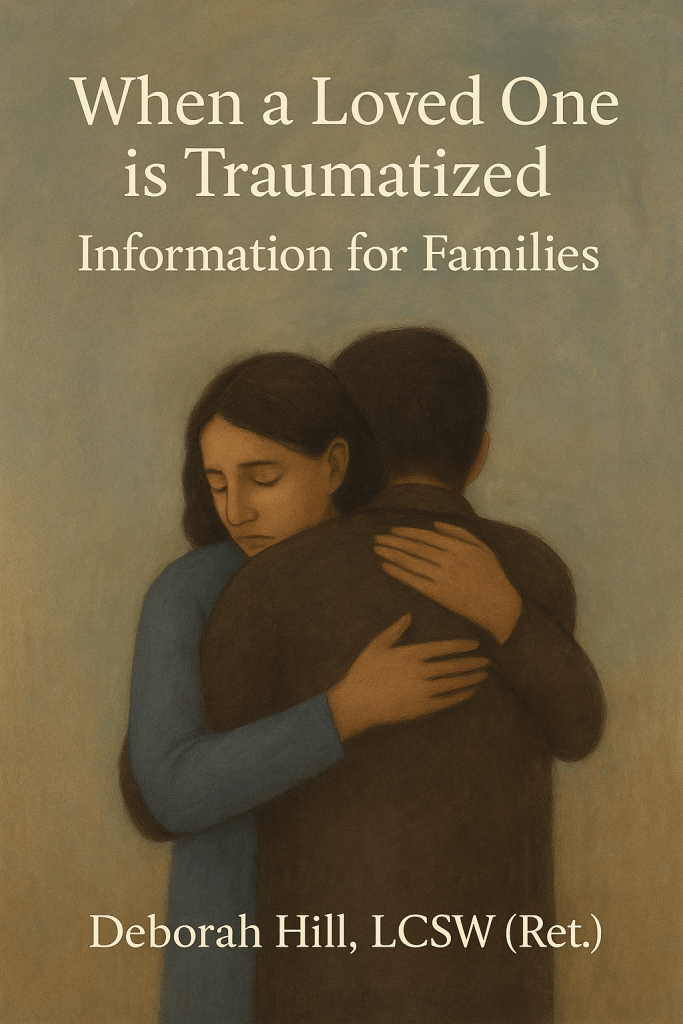
  • WHEN A LOVED ONE IS TRAUMATIZED – is now out!

    Trauma doesn’t just affect one person—it ripples through families.
    When a Loved One is Traumatized: Information for Families is a supportive and accessible guide for those who care for someone living with PTSD. Traumatic events can strike anyone, anytime, leaving lasting impacts on the mind, body, and spirit—not just of the survivor, but of everyone around them.

    This book offers clear, compassionate explanations of what trauma is, how it manifests, and what loved ones can do to support healing. From understanding triggers to navigating emotional responses, it answers the what, when, and why of life after trauma.

    Whether you’re a family member, partner, or friend—or a survivor seeking insight—this guide offers reassurance, clarity, and hope on the path to recovery.

    Available in Kindle e-book and paperback

    ISBN 979-8645316655

    https://amzn.to/3TBbStr E-book

    https://amzn.to/45TB2Lx Paperback

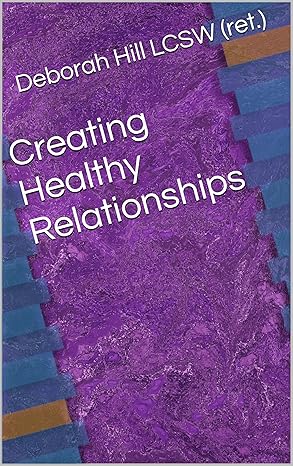
  • CREATING HEALTHY RELATIONSHIPS is in Print!!!!

    CREATING HEALTHY RELATIONSHIPS

    Healthy relationships don’t just happen—they’re built.
    Creating Healthy Relationships is your guide to understanding what makes relationships thrive. Drawing from decades of counseling experience and grounded in Choice Theory and Cognitive Behavioral principles, this book offers practical insights into forming and sustaining meaningful connections.

    Adapted from a popular blog series, this collection reads like a mini-instruction manual, exploring topics such as:

    • Spotting and avoiding relationship “killers”
    • Repurposing your life after loss or change
    • Finding the right partner (and knowing when to keep fishing)
    • Learning to live with yourself
    • Navigating life with adult children returning home

    Whether you’re starting fresh, redefining boundaries, or simply trying to connect more deeply, this book provides the tools to help you grow healthier, more fulfilling relationships in every area of life.

    Available in Kindle e-book and Amazon paperback.

    https://amzn.to/4njLnqg E-book

    https://amzn.to/4liRg5a Paperback

    ISBN: 9798666189337

  • OPEN THE THERAPIST IS IN: 101 Mental Health and Wellness Counseling Insights– THE WORKBOOK — is in publication!

    Open: The Therapist Is In, 101 Mental Health and Wellness Counseling Insights, The WORKBOOK

    Step into the therapy room—on your own terms.
    Drawing from nearly 30 years of counseling experience, this easy-to-use WORKBOOK offers a practical and insightful collection of mental health and wellness idioms. Designed for quick reference and deep reflection, each entry invites you to explore the powerful connections between your thoughts, emotions, actions, and body.

    Whether you’re looking to build resilience, navigate stress, or strengthen relationships, this workbook gives you tools to better understand yourself—and grow. With thoughtful prompts and exercises, you’ll put what you learn into action, creating a personalized path toward greater well-being.

    Perfect for anyone ready to pause, reflect, and take meaningful steps toward a healthier life.

    Available in Kindle e-book and paperback form.

    https://amzn.to/4lnSwEi E-Book

    https://amzn.to/43TtK90 Paperback

    ISBN:9798644311682

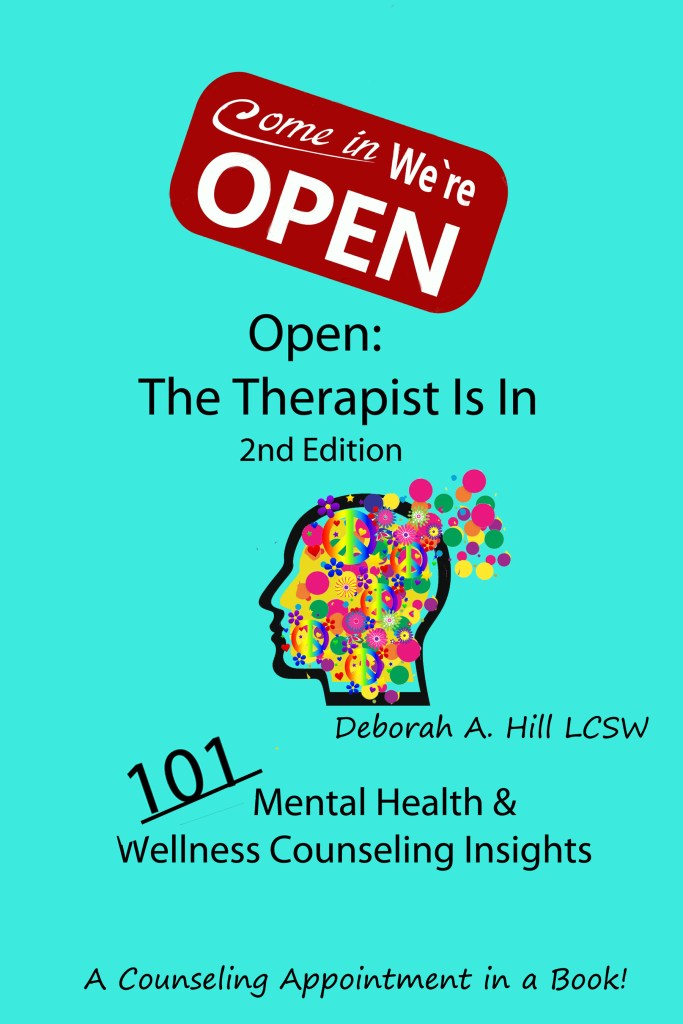
  • OPEN: THE THERAPIST IS IN,101 Mental Health & Wellness Counseling Insights, is in Publication.

    Open: The Therapist Is In, 101 Mental Health and Wellness Counseling Insights

    Step into the therapy room—on your own terms.
    Drawing from nearly 30 years of counseling experience, this easy-to-use book, a condensed version of the WORKBOOK by the same name, offers a practical and insightful collection of mental health and wellness idioms. Designed for quick reference and deep reflection, each entry invites you to explore the powerful connections between your thoughts, emotions, actions, and body.

    Whether you’re looking to build resilience, navigate stress, or strengthen relationships, book gives you tools to better understand yourself—and grow. With thoughtful prompts and exercises, you’ll put what you learn into action, creating a personalized path toward greater well-being.

    Perfect for anyone ready to pause, reflect, and take meaningful steps toward a healthier life.

    Available in Kindle e-book and paperback form.

    ISBN:979-8620992256

    https://amzn.to/3ZHV0oz E-Book

    https://amzn.to/466ga3s Paperback

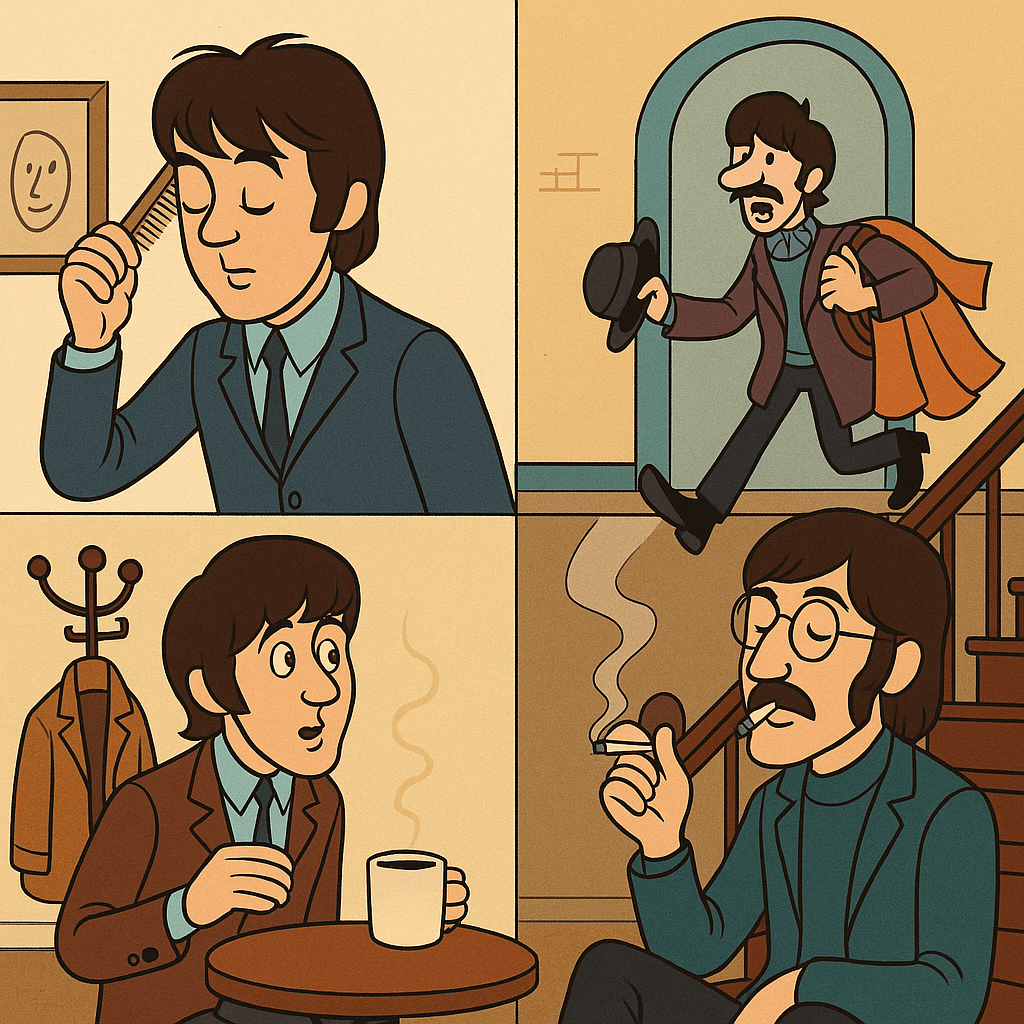
  • A Day in the Life: Finding Stillness in a World on Hyper-Speed

    A Day in the Life: Finding Stillness in a World on Hyper-Speed
    Estimated Reading Time: 5–6 minutes

    By: Deborah Hill LCSW (Ret.)

    Found my coat and grabbed my hat, Made the bus in seconds flat.
    The Beatles, “A Day in the Life”

    Even in 1967, Lennon and McCartney captured the frantic pulse of modern life. If that was fast forward, today we live in hyper-speed.

    People are burning out. Relationships are strained. Families falter. And for some, their most consistent companion is a phone, tablet, or video game.

    As a therapist, I’m often asked how to navigate this constant rush—too many responsibilities, too many places to be, and never enough time. Any crisis or transition throws the entire system into chaos. The answer I offer, tailored slightly per person, always returns to the same foundation. It’s simple to say—but practicing it is where the shift begins.

    Pay Attention. Be Aware. Have Acceptance, Be Mindful.

    Pay attention—to you. What are you doing and why? What drives your schedule, your responsibilities, your pace? Are you someone who can’t say no? Are you trying to impress someone—a parent, a boss, a partner? Are you afraid of what will happen if you slow down? Are you overcompensating for something, giving your kids everything you didn’t have, believing more is better?

    What drives you? What behaviors are rooted in that drive? Are they healthy—or are they draining the life out of you?

    Be aware. Notice the patterns that keep failing you. Staying up too late and feeling terrible in the morning? Grabbing a double espresso and then snapping at your coworkers? Signing your kids up for everything and ending up exhausted in a carpool circuit? Maybe you’re a creative soul forcing yourself into a rigid, linear mold without the tools to cope.

    We all have mindless behaviors—habits that keep us spinning. Take a few quiet moments each day. You don’t need an hour. Just enough to notice what you do on autopilot. Ask yourself: Is there a better way?

    And then, own your thoughts, your choices, your life. Blaming someone else for your reactions only prolongs the cycle. Your inner world belongs to you.

    Have acceptance. This is your life, as it is today. Maybe it’s messy. Maybe it’s far from what you planned. But it’s yours.

    Even if tragedy or trauma shaped it, what you do with that shape is up to you. Accept the parts you cannot change. Let go of gossip, comparison, chronic complaining—none of these lighten the load. They only muddy the mind.

    Drop the self-judgment. Words like should, must, bad, stupid, failure—they weigh more than you think. They don’t motivate, they demoralize. When something isn’t working, accept it. Then do what you can with what you have, right now. This moment is all you’re guaranteed.

    Angry at the driver going slow in front of you? That’s your problem, not theirs. Maybe your own rush caused the tight squeeze in the first place. Breathe. Let it go.

    Be mindful, not mindless. Find meaning in small things. Even in hardship, there’s often one thing worth noticing—worth being present for.

    Take five minutes today. Sit somewhere quiet—preferably in nature. Listen. Smell. Feel. See. Let stillness enter the storm. Know that peace is available, but it begins within.

    Ask yourself: What do I truly want? Is there a gap between that and what I’m doing? Then, gently begin to close the gap.

    This is your life. No one else can live it. Own it. Shape it. Live it.

    (If you are having life concerns and need help, I suggest you find a therapist in your area to help)

  • A Demon Named They

    By: Deborah Hill LCSW (Ret.)

    I have a demon that sits on my shoulder. Its name is They.
    I didn’t realize it was there for years, but it’s been whispering to me all along—
    They won’t like that. They think you’ll fail. They said it can’t be done.
    It’s insidious, cunning, even charming. And it’s a liar.

    Perhaps, you’ve encountered this demon as well. I’ve seen it cling to friends, family, and clients. I often recognize its voice in others before I hear it in myself. It’s sneaky like that.

    The demon “They” is a master of disguise. It whispers through the voices of others:
    “You’re wrong. You’re worthless. Everyone thinks you’re a joke.”
    It can play pitcher and batter in the same game—stirring conflict, self-doubt, and shame.

    But here’s the truth: there is no demon. It’s your inner voice telling you these things, and if you are not careful, that voice will convince you to think, say, or do just about anything.

    So how do you fight back?

    1. Identify the voice within. Notice when thoughts shift, when shame creeps in, when lies feel like truth. It may have started out as someone else telling you these things, but now it’s you.
    2. Refuse to obey. You have a choice. Don’t swallow every voice that speaks.
    3. Replace the lies. Speak truth aloud. Write it on notes. Practice love toward yourself. Do it daily. Do it loudly.
    4. Choose your people. If others live by their demons, either strengthen your armor—or walk away.

    Because in the end, the demon They only wins if we forget the source.