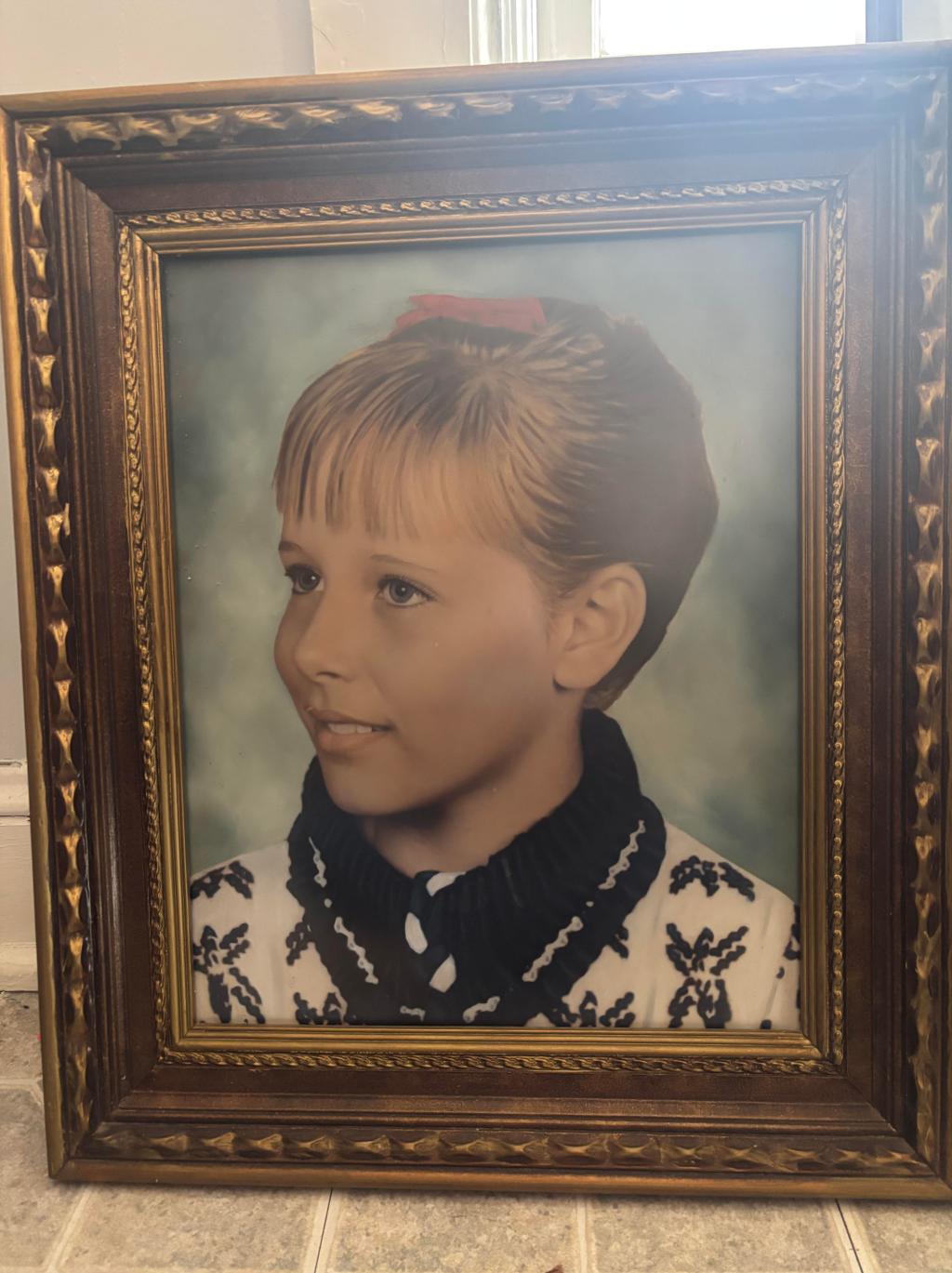
It’s been fifty-seven years since she passed. I keep mementos around my office and bedroom, so she’s never far from my thoughts. About fifteen years ago, I realized I could talk about her and see pictures of her without losing my mind. Our long book of grief was finally closed and set on the shelf. Then I was given the portrait.
A huge school picture, the kind meant for hanging over a fireplace. I’d stared at this picture and longed for it most of my life. Now it sits in my office, still without a place on the wall. Part of me wants to hang it prominently in the living room—but she means nothing to my family. My office? Would that be hiding her away—or finally putting her where she belongs?
Last night, she sat in my living room while we watched TV. I think I spent as much time watching her as I did the screen. Remembering words I never got to say. I was probably much too young to speak them then. Not that I haven’t talked with her over the years—countless hours lying by her grave, telling her about my day, playing our music, and getting lost in our past. My portrait. Her face.
I always thought I should have been the one to pass on, me being the sickly one. Irrational, but a part of me still carries that guilt. Growing up, I wanted to be perfect so I’d get to heaven and see her again. I wanted to be the best to fill the hole her absence left. I was just a kid—I’ve had plenty of therapy since then.
So why am I sitting here now, lightly sobbing? It’s only a portrait that needs a home. But I wonder if I ever told her I loved her—not after the fact, but in the moment, when she could answer back.
It’s been fifty-seven years since she passed, fifteen since I stopped punishing myself. And now this portrait sits here, reminding me that maybe grief isn’t a closed book after all—it’s a story that keeps finding its way back into my hands.
Wouldn’t it be nice if people came with instruction manuals? Better yet—what if we came with our own?
Imagine how much easier relationships would be—both with ourselves and with others—if we had a clear set of directions to follow. You might be surprised to learn: you don’t need a 200-page manual. A couple of index cards would do.
That’s because the basics are simple. Unfortunately, most people never get taught them. So we end up walking through life with blinders on, trying one approach after another, hoping something sticks.
Take this example: Someone gets angry and gives the silent treatment. Why? Because they believe the other person should know what they did wrong. The problem is—it solves nothing, gains nothing, and slowly chips away at the relationship. The more chips, the more dysfunction. Yet the behavior continues, often with confusion and surprise when the relationship sours.
Why do we do this? Because no one gave us the index cards.
Here’s the first card:
1. People can only act and react (thinking, feeling, doing) based on what they know.
Sounds obvious, right? But if it were, we’d all be a lot gentler with each other. Instead, we regularly expect others to respond the way we would, based on our experiences, our knowledge, and our perceptions (meanings).
Let’s look at a few examples:
Expectation: “If you loved me, you’d bring me chocolate donuts with sprinkles.” Reaction: “I brought you flowers. I thought that meant I loved you. How was I supposed to know donuts meant love?”
Expectation: “You should know better than to leave the oven in clean mode when leaving the house! Everyone knows that’s a fire risk!” Reaction: “I didn’t know that. I’ve never cleaned an oven before. How would I know it could catch fire?”
Expectation: “Can’t you do anything right? You can’t even load the dishwasher correctly!” Reaction: “Is there a right way? I was just trying to help. You know what—next time, you do it.”
Want to be shocked? Try this:
Spend one full day paying attention to how often you expect someone to act or respond based on your knowledge. Count how many times you assume someone “should just know.”
Then, spend another day observing how you feel when others make the same assumption about you—expecting you to read their minds, meet their needs, or act in a way that makes sense only in their world.
You’ll start to see just how much of our conflict stems from this silent mismatch of expectations.
And one last thought: Even if you’ve known someone your whole life, don’t assume they know what you know—or that they’ll process things the same way. We’re all working without manuals.
I see books all the time about the five types of relationship killers. It’s ashamed we stop at five because naming the top five may not hit on the bumps in a relationship. If you look at a lot of the social and psychological data on relationships, the list looks more like this. (Note these are not in order of most damaging to least. There is no way to do that as each entry has its own dimensions and they differ couple to couple).
Communication issues
Dependency vs independence
Money
Ineffective problem solving or arguments
Changes in sexual desire
Affairs/one night stands/porn/excessive flirting
Friends/family/in-laws
Life Stress: job/unemployment/death/chronic illness/sudden illness/mental illness/increase in responsibilities/aging/moving/life style changes
Habits/vices/addictions
Taking the other for granted
Rushing into a phase in the relationship too quickly: weddings/babies/retirement
Lack of trust
Lack of Intimacy: feeling like you have to hide who you are due to fear of being unlovable/ no physical intimacy (touching)/ feeling like you have to be someone else to be loved
Lack of care: feeling like you are not cared about or your partner does not understand you
Judgementalism: feeling like you are always scrutinized, you can’t do anything right or being perfectionist and believing you can’t do anything right.
Tests: partner sets up little tests to see if you pass and are worthy of trust/love
Unrealistic expectations: if this is love, why am I so miserable – expecting partner to meet or fix your inner emptiness or meet unrealistic expectations or fantasies
Lack of contributions in household, family responsibilities
Raising kids
Respect
Comfort levels
Different goals in life
Step parenting
Mistakes: shutting down due to fear of making a mistake, making things worse
Living in the past
What is important to know is that while these can range in metaphor as a splinter, dagger or serial stabbing.
What one couple sees as a serial stabbing another might see as a splinter. Why the difference and which couple is going to ride the wave and come out feeling connected? The quick and easy answer is in fluidity and commitment to the relationship.
Fluidity means the ability to bend and not brake, to see the whole picture and not hyper-focus on one detail. Think about your relationship as a porcelain bowl, for example. If you drop the bowl into a swimming pool full of water, it will get wet, but most likely will stay intact. If you drop it in the sand, depending on the height you drop it; it might stay intact or crack. If you drop it on concrete – it’s shattered – almost every time.
There are ways to make you more mindful – more fluid. Keep in mind, however, that you are only one person in a relationship. The strongest relationships have fluidity in both partners.
The Show Must Go On: Children Using Perfectionism & Performance to Cope with Trauma.
by: Deborah Hill LCSW (Ret.)
Anna, age four, and Michael, age two (children’s names and ages were changed), were found in their home surrounded by blood and the dead bodies of their parents. At first, everyone understood the devastation these children experienced. Then there came a point where the notoriety wore off, and they were expected to act and feel like they behaved before—only they didn’t. They became super-kids—children who use perfection and performance to cope with trauma.
(I need to make two caveats. Trauma can be from a messy divorce, a close death in the family, or severe illness of the child or a parent, or a terrible car accident. The list can go on and on. The second, not everyone who becomes a performer or perfectionist has trauma in their background.)
Super-kids are children who try to be overly helpful, compliant, or high-achieving to avoid upsetting someone, attempt to gain control of a situation, or feel safe and valued. They tend to take on adult roles or act older than their age, often described as having an old soul. They hide their emotions, appearing fine when inside they are struggling.
How does using perfectionism and performing help the child cope?
1. It offers control in a chaotic world, rather than feeling helpless.
2. In many environments, love and safety feel conditional. A child may learn that being good, impressive, or entertaining earns approval or protection.
3. Performance and perfectionism can provide a powerful distraction from pain.
4. Instead of feeling inherently unworthy, they learn to find value in performance.
5. They give the impression that the child can prevent anything from going wrong by staying ahead of the potential threat.
6. They give the child the feeling that they can control how others perceive them.
I want to emphasize that a child does not consciously choose which skills are necessary to survive. And the behaviors may not initially appear to be performance or perfection coping skills.
What a child wants is to feel safe, protected, and loved. They will do what they need to do, be it perfectionism or performance, to achieve that. The super-kid, is the one nobody expects to be ravaged with internal turmoil.
Important note: Trauma affects each child differently based on age, personality, support system, and type/duration of trauma. One child might act out aggressively; another might become extremely quiet and withdrawn. All trauma responses are adaptations—they made sense at the time the trauma occurred.
References for this blog:
Bessel van der Kolk, The Body Keeps the Score, Diane Poole Heller, The Power of Attachment, Richard C. Schwartz, No Bad Parts, Pete Walker, Complex PTSD: From Surviving to Thriving, Judith Herman, Trauma and Recovery
Have you ever wondered if people in developing countries spend time dreaming about “something better”? Or is this constant questioning—this hunger for more—a distinctly Western habit, born of comfort, choice, and relentless comparison?
I first learned to long for something more when I saw Cinderella as a child. The girl in rags, waiting to be rescued from misery, dreaming of a love that would change everything. Or Casper—the lonely ghost who just wanted to be accepted and loved. If I really thought about it, I could name a hundred stories with the same core message: there must be something better out there.
But how do we decide when “what we have” isn’t enough? In my work as a therapist, I’ve seen people thrive in hardship and suffer in abundance. It seems happiness isn’t about circumstances—it’s about mindset.
We hear sayings like, “When life gives you lemons, make lemonade.” But what if you don’t want lemonade? What if you want mangoes or chocolate cake or something no one ever offered you? Is the quest for more a refusal to settle—or an inability to accept?
Maybe it’s not about choosing between reaching for more and embracing what is. Maybe the real trick is balancing both.
I’ve met people living with far fewer material resources—like in North Africa or Haiti—who radiate joy. Is that joy selective, performative, or real? Maybe they’ve learned to be content while still holding hope. Maybe they’ve mastered the paradox that trips so many of us up.
Because the truth is, some people will always chase “what’s next,” and others will find deep satisfaction in the present. The happiest lives may not be the ones that had the most—but the ones that struck a balance between striving and surrender.
So if you’ve ever been told, Sorry, the life you wanted is out of stock, you still have choices. You can keep hoping, keep growing. You can pour your dreams into the life you already have. Maybe that’s not settling. Maybe that’s the truest form of freedom.
I’m at the Wal-Mart waiting for prescriptions and decided this would be a great opportunity to pick up father’s day cards. The Wal-Mart in my area has two rows of cards about fifteen feet long devoted to father’s day. The store is not crowded and I have the entire father’s day card ensemble at my viewing pleasure.
Picking out a card for my dad was a breeze. He’s the sentimental type and I easily found a card depicting a little blonde haired girl smiling and laughing with her dad. Ah, I thought, boy does that bring back memories. If it brings a tear to my eye, which it did, I knew it would get him too. I put it in my cart.
Then there is my hubby who can be described in many ways, but sentimental and romantic are not among them. I don’t know if it was genetics, environment or he just likes to hide his softer, mushy sentimental bent, but he is more like Sheldon Cooper (Big Bank Theory) then Romeo (Romeo and Juliet). Sentimental father’s day cards are not an option.
I have a choice. I can get him a card about drinking beer, being lazy, forgetful, being over occupied with cars or sports, being in the bathroom too long, reading in the bathroom, staying in bed with a beer, over-eating or farting. There are eight different cards about father’s farting. Four cards on being in the bathroom. Three cards on offering new and improved reading material for being in the bathroom. This would combine being in the bathroom too long and reading in the bathroom. In case you are keeping track.
There are a couple cards for older kids to give their fathers. Things like, you embarrass me, I’m just as moronic as you, give me money, where are the keys to the car. I have to add that in the pre-school – kindergarten age cards for fathers are; I love you, you play with me, you take care of me, things like this.
My question is, what the hell happened from I love you to Happy Farters Day? Granted, I’m not in the Hallmark store. I’m in Wal-Mart. Does that make a difference? If I was on the east side of town would I find less fart and toilet related father’s day cards and more, thanks for going fishing with me cards, you taught me lots? With the card picture showing two guys in a boat, one younger than the other, all tangled up in a fishing net.
My hubby has said on numerous occasions that men, especially white, middle class men, are one of the only populations of people where it is acceptable to berate, tease and stereotype. He uses American television shows as his evidential media trail to prove his point.
I think about this as I’m standing in the card aisle trying to force some of these cards to change so I can find something suitable. You know, humorous but intelligent and with style. My magic genie is not working. I find another toilet card depicting a gorilla on the toilet reading the newspaper. Really?
I’ve been standing in this aisle for twenty minutes and it’s obvious nothing is going to change. So, I’m going to find a somewhat acceptable, humorous father’s day card, cross out what does not apply and with sharpie in hand, make it fit. I search again for the ultimate card and come up empty handed.
Is it that our stereotyping of fathers is so out-of-hand that no one can remember what their dad is (was) really like? Why stereotype fathers with the attributes of dysfunctionality and think it’s funny? Is this really what our current society feels about fathers or men? Maybe, hubby is right. Maybe this is another evidential trail.
Has the role of father changed that much in main-stream America that we resort to fart and toilet cards to express our hostility? As a social worker, I know that the percentage of fatherless families is staggering. The last statistic I saw was fifteen million children live in a household without a father. (The Washington Post) In Baltimore, where I am from, 38% of children live in fatherless homes. The domino effect is horrendous for children and society. The numbers continue to rise.
Is this the reason I can’t find a decent father’s day card? Will there come a day when we won’t have father’s day? Maybe the people who wish to express honor and appreciation for their fathers are declining. If this is the trend and it continues, there will be no need for a day to celebrate and honor half of the genetic gene pool that brought all of us here.
Maybe it’s the type of humor involved. I accept that. There are too many degrading, hello, I’m a dysfunctional dad and it’s my day, cards verses I’m a great dad, not perfect but I love you and you know it cards. There is no balance, at least not in these aisles.
So what’s with happy farters day? Lack of responsible dads, lack of respect for dads, a disconnect between who dad’s are and how they relate to their families? Or is it something I haven’t thought of?
My hubby does not like sports so that cuts out about an eighth of the selection. He does not drink and that cuts out a fourth. I’ll be damned if I’m going to give him anything that has to do with bodily functioning to celebrate his fatherhood. That cuts out another half. The last percentages are the sentimental and pre-school cards. Where this does led me?
I bought hubby a birthday card. I have a sharpie at home. Maybe, this is a sign I need to go into the greeting card industry. I certainly can’t do any worse then what I’ve seen today.
So if you are a father and you get a father’s day card that does not have drinking, laziness, or jokes about bodily functions, give your family an extra hug. They obviously went the extra mile to find that special card just for you. Happy up and coming father’s day!
I’ve been asked if there are any axioms I use to ground me when life tries to blow me away. Yes, there are. I use the below axioms all the time when life is sunny. When life gets blustery, I sometimes have to remind myself that they exist. If I remember and fall back on these axioms, things always turn out for the best. It might not be the best I would have wanted, but I find myself relatively unscathed or able to bounce back quickly. Kind of like the wizard in the Oz, The Great and Powerful or another well known film, The Wizard of Oz.
Restlesswanderer61’s axioms for surviving and thriving:
1. The only person I can change is me.
2. No matter what life hands me, ultimately I choose how it effects me long term.
3. Everyone has the same basic needs, only in different degrees. Love people including myself, even the ones hardest to love.
4. Everyone’s behavior is purposeful. They are the best choices I use or have used (whether healthy or regrettable, knowingly or subconsciously) to find balance. Don’t judge others or myself.
5. I am energy at my deepest level and a spiritual being that can connect with anyone and is only limited to the constraints I place around me. Even if I doubt or don’t believe, I can’t be disconnected from the creator or all of creation. It is no more possible then living without taking in oxygen.
6. My brain is a creative and amazing devise. I will strive to develop what is not and prevent my thoughts from running amok.
7. People have the most amazing resilience and overcome the incredible horrors. So do I.
8. I am not perfect and never will be. There is no such thing as perfect.
9. The answers to my problems will ultimately come from me even if I can’t see them currently.
10. I have an amazing talent and gift, even when I don’t think so. Everyone has a talent or gift to be tapped to fulfill themselves and the world around them. Let others shine, take the back seat and clap thunderously at other’s accomplishments no matter how big or small whether I know them or not.
11. Never lose my childlike wonder, imagination and desire for play.
12. Resistance to issues is futile. Deal with it, don’t repress or pretend it does not exist.
13. It’s okay to reach beyond my comfort zone. In fact, I will grow from doing so.
14. Strike a balance between being self-absorbed and other-focused.
15. There is usually no such thing as the no win scenario. It’s only how to win and what “to win” really means.
16. I don’t have to be correct all the time. Pick my disagreements for when it really matters and let the rest go.
17. Everyone has baggage and crap. Mine is no better or worse than someone else’s, only different. Accept it.
18. Treat others the way I want them to treat me, even if they don’t.
19. Unless I have no food, shelter or loved ones, I have nothing to seriously complain about. My life is fine, no matter what is happening. Be grateful for every person, everything I have and everything that happens to me.
20. Be amazed by little things, joyful, laugh often and hard.
21. I can make a difference in everyone’s life I meet. Even if it is a small one.
22. Have patience. There is a reason things or people are as they are. Watch it unfold and learn.
23. Dream big, make goals, explore, learn and strive to make those dreams a reality.
24. Be proactive not reactive. This is my life, the only one I have, don’t get to the end and have regrets. Make each moment count.
Do you have a list of axioms you follow? If you don’t or are not sure, it might be something to think about. If you have a code you follow that is true, there is no telling the wonderful places it will take you. You are your best and worst enemy. Find balance and find peace not only in times of sun but when the tornado’s in life blows your balloon off course.

 Deborah Sickle Hill