Have you ever heard the saying, “Don’t throw out the baby with the bathwater”?
A friend and I have both survived near-death experiences—events that altered us permanently. On long drives, we often dive deep into conversations about spirit, soul, God, and nature. We’ve walked away from rigid dogmas—those rules imposed by religion that demand your belief to belong—and instead, we’ve chased after truth. Real truth. The kind you feel in your bones.
Hence, throwing out the bathwater and keeping the baby.
That mindset often leads us to places charged with meaning. On this particular day, we felt called to Gettysburg National Battlefield.
We took the Taneytown exit just before sunset. As we approached the old Cyclorama, my friend said quietly,
“I feel something pulling me here. Something important.”
“Tell me when to stop,” I said.
“Stop.”
We parked beside an older man and his massive Irish Wolfhound, Tanner. He greeted us kindly and shared that he was a local who came to the battlefield seeking meaningful encounters. Usually, he sat at Little Round Top. But tonight, he’d felt drawn here instead.
He’d had a near-death experience—just like us.
For over an hour, the three of us stood and talked. About life. About death. About energy, God, and the battlefield itself. “This place is alive with spirit,” he said. “Something here vibrates because of the hell that happened.”
And I understood exactly what he meant.
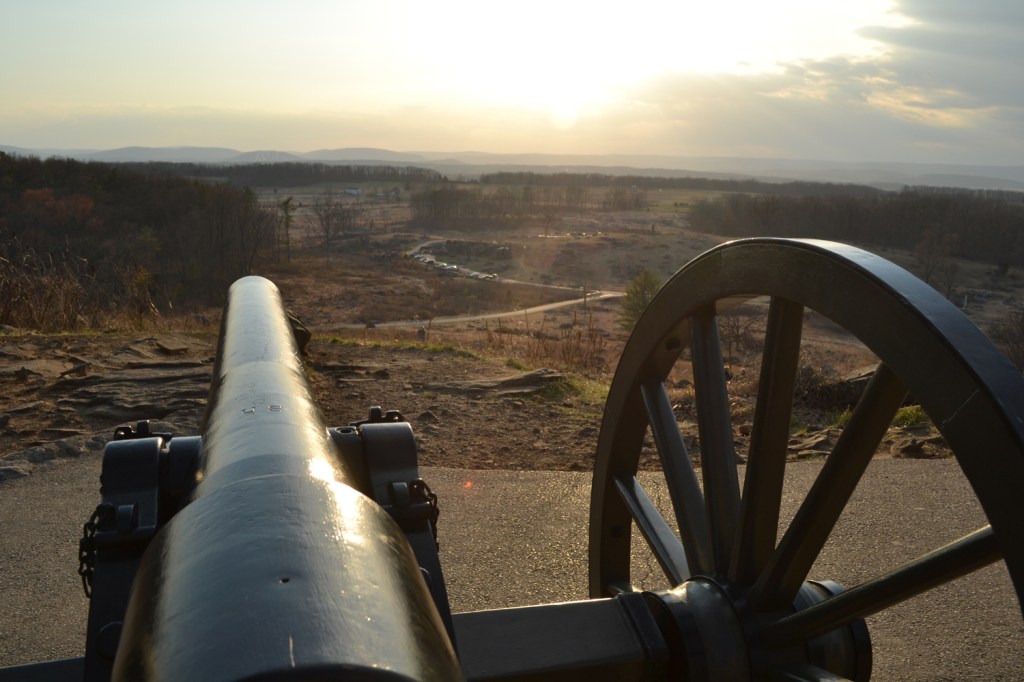
We looked around at the silent cannons—posed and waiting, like sentinels. Witnesses to the deadliest battle of the Civil War. I shivered.
We are sensitives—whether born or trauma-made. Drawn like moths to flame. To trauma. To death. To sacred, ruptured ground.
“It’s the energy,” my friend said. “Spiritual energy.”
I couldn’t disagree. What is spirit, if not supernatural energy? The Shekinah. The Holy Spirit. Energy.
She seeks to understand it. Me? I feel it. Especially trauma. It lights something up in me.
You don’t need a wild imagination to be humbled by Gettysburg. The place speaks for itself.
As the sun set (the park remains open until 10:00), we parted ways with the man—three strangers connected through invisible threads. Before he left, he said, “Be careful.”
We drove slowly through the darkening park and passed the Wheatfield. Suddenly, we both felt it—tingling skin, tight throats, nausea. The air felt electric, charged with something unseen. Then, as soon as we passed the bend, it disappeared.
“You felt that?” she asked.
We described it the same way. Yes, I had.
At Devil’s Den, we got out and wandered behind the granite boulders. A low rumble echoed nearby—maybe thunder, maybe phantom cannon fire. That’s not unheard of here.
My friend led me to a tall tree and stood still.
“There’s peace here,” she said.
But I felt dizzy. Nauseous. Unbalanced. “Stand next to me,” I told her. She did—and immediately felt the same. The air smelled metallic.
Blood, I thought, but didn’t say. I know that smell.
Maybe it was the dark. The uneven ground. But we didn’t feel normal again until we walked away.
Later, as we drove past Little Round Top, I was hit by sudden chest pain, nausea, and a sharp pain behind my eye.
For a split second, I thought I’d been shot.
I swerved and pulled over. The sensation vanished.
“Do you still feel peace?” I asked. “No,” she said. “It feels horrible now. So much death. I’m ready to leave.”
As we exited the park, we passed the same cannons we’d seen earlier—but I saw them differently this time. They were more than relics. They were keepers—of sorrow, of pain, of history we can’t possibly comprehend.
They reminded me of my own inner wounds. Silent. Unnoticed by most. But always there.
Not everything in life can be explained. But we’re not alone.
There are hundreds of thousands of us—like Tanner’s owner, like me and my friend—living on the fringe between the seen and unseen. We’ve experienced too much. We’ve been changed. And we’ve been given a gift: vision born from trauma.
A gift that lets us throw out the bathwater—and still keep the baby.
Maybe that’s why we keep returning to places like Gettysburg. Not just to understand the past.
I’m in my office working on another novel, and my palm started itching. I thought, good, it’s my left hand–money is coming my way. And then I laughed–silly old superstitions.
I needed a break, so I thought, how many superstitions or old wives’ tales do I carry around with me? How about you? Do any of these ring true for you? If you have one not on the list, add it in the comments.
Left palm itches, money is coming. Right hand, kiss it goodbye.
Bird flies into a window it means death will follow.
If a person’s picture falls over, it’s an omen they need help.
Throw salt over your shoulder for good luck.
Black cat crosses your path, bad luck is coming.
Crickets in your house is good luck–unless you kill them!
People can throw you the evil eye and make you sick.
It’s bad luck to stumble upon a funeral.
Make a wish on a four-leaf clover.
Friday the 13th is a day horrible things happen.
Don’t open an umbrella inside, bad luck will rain on you.
Don’t walk under a ladder.
Don’t pick up a penny unless it’s heads up.
Horseshoes turned up, are good luck. Turned down, your luck runs out.
Bad things happen in threes.
The size and number of the brown bands on a woolly caterpillar indicate the snowfall for the winter.
You must eat pork on New Year’s Day.
Laying hands on someone can cure them.
If a groundhog sees his shadow, we have 6 weeks of winter (or is it the opposite)
Craving Connection in a World of Instant Gratification
By: Deborah Hill LCSW (Ret.)
I like to unwind with reruns of The Colbert Report and The Daily Show. No matter what kind of day I’ve had, that satirical hour somehow makes everything feel a little better.
One episode featured a spoof on black-market Canadian maple syrup, comparing it to a drug cartel. The mock reporter—adamantly syrup-free—feared one taste would spiral him into addiction, crime, and sticky ruin. Naturally, he caved. The next thing you know: endless pancakes, missed work, shady street deals, and a full-blown syrup bender.
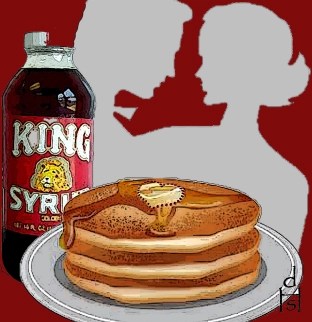
I laughed out loud—then turned to my dog and said, “Damn, I wouldn’t mind some pancakes with syrup. Do we have any King Syrup?”
King Syrup is the good stuff—thick, rich, slow to pour. My dad used to beg me to smuggle bottles down to Florida. You can’t get it there. He gets it. I get it. We’re syrup people.
That night, I resisted. I had toast with peanut butter and milk in a blue Solo cup. Later, I played a few rounds of Bubble Mania, freeing kittens from bubbles (usually gratifying). But not that night. My mind was stuck on syrup.
At 6:00 a.m., I woke up with one clear thought: Pancakes.
I made a stack—instant mix, just add water. Three golden-brown discs with butter, warm and waiting. I pushed my work aside and gave them my full attention.
With reverence, I poured the King Syrup (not Canadian, but Fredonia, NY—close enough?) and let it soak in. Not too long—you don’t want soggy regret. Then I ate, slowly, trying to channel the reporter’s syrup high.
It didn’t work.
What I got was 1,000 empty calories and the gnawing feeling that this wasn’t it. Not really.
And then it hit me: What I wanted wasn’t pancakes or syrup. I wanted joy. I wanted connection. To feel loved, valued, seen. Maybe even touched. Perhaps even… sex. Or intimacy. Or something that told me I mattered.
Sometimes, we crave comfort and reach for what’s easy—food, TV, a distraction—because it almost satisfies. It promises to fill the hole but leaves us emptier than before. We make choices that don’t serve us, not because we’re broken, but because we’re human and hungry for something deeper.
The mind is tricky. Needs unfulfilled will find a workaround, even a ridiculous one. That Colbert sketch planted a seed. Logically, I knew pancakes weren’t the answer. But that night, syrup made sense.
Is it any wonder our behavior can get a little wacky? That we gravitate toward something—or someone—that offers relief, even when we know better?
What if we could pause in those moments and ask, “Is this really what I need?”
What if we could yell STOP before that instant gratification derails something deeper?
If you find yourself elbow-deep in pancakes and still feeling empty, it might be time to ask what you’re really craving. And maybe—just maybe—you’ll find a healthier, richer, more lasting way to feed that hunger.
The Pink Elephant in the Pews: Christianity and the Supernatural
Reading time: ~4 minutes
“The supernatural is the manifestation of events attributed to forces beyond scientific understanding or the laws of nature.” — New Oxford American Dictionary
What does the supernatural have to do with Christianity?
Everything.
Without the supernatural, there is no God. No miracles. No answered prayers. No angels or demons. No resurrection. No afterlife. No parting of the Red Sea or plagues in Egypt. Remove the supernatural, and you’re left with a shell of spiritual tradition—fairy tales dressed in Sunday clothes.
So why do so many Christians hesitate to say they believe in it?
It’s like caring for a beloved pink elephant and then denying it exists the minute someone asks. “What pink elephant? I don’t believe in pink elephants. That’s absurd!”
But supernatural experiences didn’t end thousands of years ago, did they?
Some argue, “The age of prophets is over.” Others say, “Only Jesus could perform miracles.” Still others cite Scripture’s warnings against sorcery, divination, and necromancy—as if these verses deny supernatural reality. In fact, they confirm it. You can’t be warned about something that doesn’t exist.
Remember when Saul summoned the spirit of Samuel from the dead? He didn’t imagine it. Samuel appeared and spoke. That’s not symbolism. That’s a ghost. It’s right there in the Bible.
So why the discomfort?
Why do some Christians shut down when the supernatural is brought up—as if faith in the unseen doesn’t require belief in the unexplainable?
Here’s the truth: If you don’t believe in the supernatural, you can’t fully believe in Christianity.
Spirituality and the supernatural are intertwined. Without one, the other crumbles. The Bible isn’t just a collection of moral stories. It’s a chronicle of the extraordinary breaking into the ordinary. A burning bush. A virgin birth. Water turned to wine. A man raised from the dead.
In fact, the more literally you take the Bible, the more you must embrace the supernatural. It’s not just the foundation of the faith. It is the faith.
U.S. Catholic magazine affirms this in Tim Townsend’s article, “Paranormal Activity: Do Catholics Believe in Ghosts?” It states:
“Ghosts confirm, rather than refute or disturb, Catholic theology of the afterlife.” Belief in the seen and the unseen isn’t optional—it’s essential.
And yet, in conversations, I’ve heard this:
“Of course I’m a Christian. Jesus died and rose again for my sins.”
“So you believe in the supernatural?”
“No, absolutely not. You don’t really believe in that stuff, do you?”
Sigh.
Why are we hiding our light under a bushel? Is it fear of judgment? Of being called foolish or irrational?
It can’t be fear of God—because without the supernatural, there is no God to fear.
If we deny the supernatural, we deny the very core of our faith. No resurrections. No divine interventions. No hope for eternal life. No visions, no visitations, no burning hearts stirred by an unseen presence.
Without it, there is no mystery. No wonder. No awe.
In the same article, theologian John Newton reflects on those who claim to see ghosts:
“I certainly see no good reason, all other factors being equal, to deny that someone who claims to have seen a ghost has not had a genuine experience of some sort. The question then is: what sort of experience has occurred?”
Exactly.
Should Christians run from the supernatural? If we did, we’d have to throw out half the Bible and all of our hope.
Without it, there’s no revival. No being born again. No faith healing. No dreams or visions. No heaven. No hell. No divine purpose. Just Sunday routines, stripped of spirit.
And if we deny it out of fear or pride, are we not like Peter when the rooster crowed?
So I’ll ask you plainly: Do you believe in the supernatural?
Maybe the language feels uncomfortable. Maybe it’s easier to say “God” than “spirits” or “angels” or “miracles.” But that doesn’t make them any less real. We’re ants trying to comprehend the foot that built the stars. And if God could create the laws of nature, DNA, time, and consciousness itself—how arrogant are we to say what can’t be?
We don’t have to understand the supernatural. But we do have to acknowledge that it’s always been part of the story.
Call to Action: If this stirred something in you, share it. Start a conversation. Acknowledge the pink elephant. And most importantly—don’t be afraid to believe in what you cannot see. 🕊️ Faith lives there.
Miracles happen when you least expect them—or maybe it’s luck, or fate?
It was an ordinary Tuesday, except the dryer was on the fritz. So, the jeans were strung across a rope from the dining room buffet to the living room bookcase. I should also mention that a gallon of Country Pink paint was sitting—lid half-on—on a stack of newspapers atop the buffet. (I’d been painting before the dryer died.)
And then there was Frodo—a York Fair goldfish—swimming peacefully in his bowl, completely unaware that things were about to go terribly wrong.
As usual, I was dancing around the living room, music loud, getting in my daily “exercise.” The second verse of Ghost Dance by Robbie Robertson was playing when all hell broke loose.
The top of the buffet collapsed.
The paint can launched into the air.
The jeans came crashing down.
And Frodo—poor Frodo—soared skyward, caught midair in a rain of pink. I watched, helpless, as he splashed down into the tangled denim, disappearing into a puddle of Country Pink on the carpet.
“Help me!” I yelled into the phone at my husband.
“What do you want me to do?” he asked, calm as ever.
“Frodo is in there somewhere!” I cried. (Forget the jeans, the broken buffet, the ruined carpet. I had a fish to save.)
“Well, if the fall didn’t kill him, the paint probably did. Start looking.”
I hung up and began frantically sifting through the wreckage. Five minutes passed. Then ten. Frodo was nowhere to be found.
And then—I spotted him. A small, motionless blob in a deep pink puddle. He wasn’t moving. I’d killed him.
Panicked, I picked up his slimy, paint-covered body and rushed him to the sink. I knew chlorine could kill a fish—but figured you can’t kill a fish twice. I rinsed him gently under running water, laid him on a paper towel, and stared at his lifeless body.
What was I going to tell the kids?
Then I saw the bowl—miraculously unbroken. I cleaned it, filled it with water, and—though it felt absurd—I dropped Frodo in.
He floated.
I walked away, too heartbroken to do anything else, and started the monumental task of cleaning up the mess.
Thirty minutes passed.
At some point, between loading the washer and mopping the floor, I passed the sink—and stopped. Frodo was swimming.
He was alive.
We renamed him Lazareth. He lived for years after that in a bigger, better aquarium, in a much safer spot.
So how do I explain it?
I don’t know. Was it a miracle? Maybe. Does the creator of all things get involved at that level? Perhaps. Was it luck? Fate?
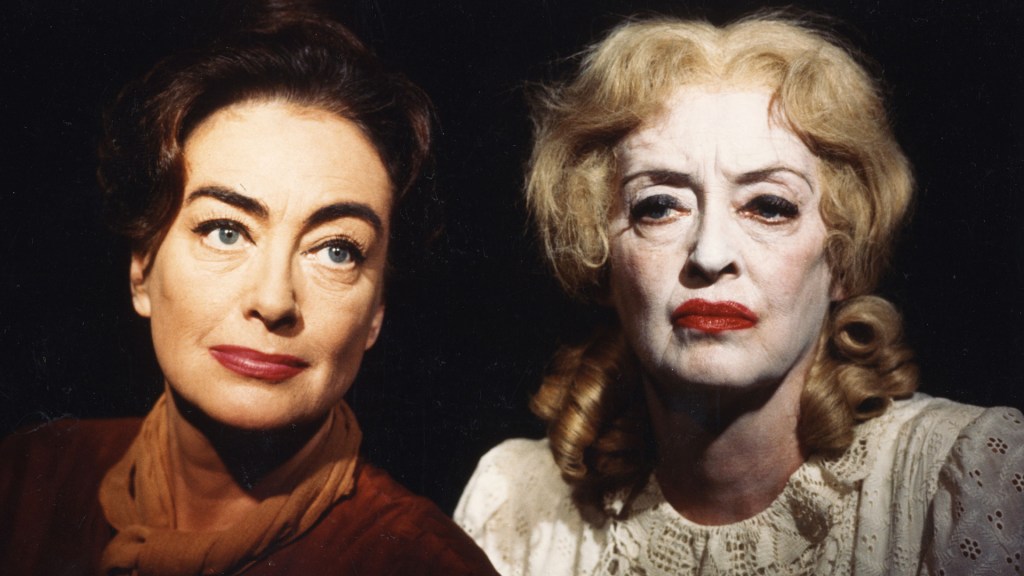
Whatever Happened to Baby Jane was an excellent 1962 psychological horror thriller starring Bette Davis and Joan Crawford. They were two very prominent, award-winning actors of their time. Both gained celebrity in their acting and later in the pop music of 1981. She’s got Bette Davis’ Eyes by Kim Carnes, and Joan Crawford has Risen from the Grave by Blue Öyster Cult. Why am I telling you this?
It was Saturday night, my birthday, and the extended family decided to take me to a smorgasbord called Shady Maple. It is noted to be the largest smorgasbord in the nation. As any respectable largest smorgasbord in the nation would be, it was crowded. Dining room after dining room of people smashed together at their seats and vying for food at the buffet.
That was when I saw her—the splitting image of Bette Davis in the role of Baby Jane. She looked about seventyish at least. Her hair was dry, tangled, and bleached out with pin curls cascading down the sides of her neck. Her makeup was white, with exaggerated red lips, dark lines around her eyes, and heavy mascara.
I tried not to stare, but I had to; there was really no option. I was staring at the very dead, Bette Davis—or more to the point—the madness of Baby Jane as she tortured and kept prisoner, her wheelchair-bound sister, played by Joan Crawford.
I told my mother, “You have to turn around, look at this woman, and tell me who you see.”
It was strategic, as suddenly turning around and facing this woman would look awkward. My 86-year-old mother, almost always up for a challenge, accomplished her goal. She turned around and said to me. “That’s Baby Jane.”
Why would anyone, on purpose, make themselves up like a mentally unstable movie character unless they were going to a Comic-con or some other fan convention?
Well, you can’t run up to someone and say, “You are the spitting image of a deranged woman in a movie. Did you plan it that way? If so, you pulled it off!”
We continued eating, I, my surf and turf, and my mother, her beets and chicken. Occasionally, I looked over to see how this woman acted. I love a good character study, but this character was already well-written and acted out. Still, I was obsessed.
I lost sight of her somewhere around getting garbanzo beans on my salad. Maybe it was a good thing. Did I mention that from the profile, her significant other looked a lot like Stephen King? Just slightly. Just enough to go, ah, I wonder.
I highly recommend seeing Whatever Happened to Baby Jane. If you don’t mind the crowd, I’d recommend the smorgasbord, too. Stay spooky, my friends.
“You have quite the internet presence,” said the woman on the phone who interviewed me six months ago for a part time position. “Well, this is complicated,” she continued. “I think you are exactly what we are looking for, but I’m not sure what I think of what you write. The topics you write about, you know? Granted, it’s not fair to judge you based on your writing vs not having the same criteria for all the other applicants. It’s just I’m more comfortable hiring someone whose beliefs and ideas are unknown to me.”
I put down the phone in stunned silence. I told my hubby what happened. He said, “Well, you obviously are not getting that job.” And he was right. “Just let it go,” he said. That was six months ago.
I did think, well, if she thought the content of my blog and web sites were controversial ( I don’t see the controversy), wait till she reads my novel. They would have fired me for sure, if I’d been hired.
Yes, I do have the internet presence, but hey, I’m out there trying to connect, trying to get my writing out, trying to share my inner sanctum with others who might benefit. I think it’s altruistic, in some respects. Does it make me vulnerable to scrutiny? Yes, and I knew this when I finally got the courage to write and put it out there. So what is the problem?
The problem is… this is the first thing I have written in six months. All editing, plotting, character development, research and blog writing came to a crashing halt. You don’t want to see me when I’m not writing. It’s not pretty. This is devastating to me and I am the one who is keeping me stuck!
“Do you stand by your writing?” hubby asks on the one hundredth conversation about the same topic. Of course I do. “Then this is a no-brainer, just start writing again and don’t let anyone slow you down.” God love him, he doesn’t get it.
I walk around in this state of malaise, passing by the proof of my novel on the desk, the dust covered storyboard of the next novel in the works, and think – is this what life is all about? That’s when I know I’m in deep doo-doo, when I realize my daily writing has become a once in a six month event and I’m contemplating the meaning of life – again.
It’s easy to tell my clients to do reality checks on those insidious thoughts and hidden emotions. It’s even easier to help my expressive writing clients work through their writing blocks and put their life on the page. Oh, therapist, heal thy self. It’s not like I don’t have the skills.
This is where the nude writing comes in. I thought my problem is that I felt vulnerable and exposed as a result of that ridiculous phone call six months ago. Even though I was already willingly vulnerable and exposed, having it brought to my attention somehow changed things.
Hmm, I often tell my clients to embrace that which causes us pain instead of hiding or running. So, I’m embracing feeling vulnerable and exposed. The next step is called flooding. It’s where you find a situation where you feel really uncomfortable with what ails you and work your way through. I can’t currently think of any situation other than writing this blog naked to feel totally exposed and vulnerable. So here I am writing again!
Am I naked? Hell no! Its sixty-four degrees in this house and the heater is not on! Do you think I’m insane? Which brings me to my last point, the imagination is an amazing tool. In a world of pure imagination you can conquer just about anything – and you get to keep your clothes on.
We decided to take the family on a trip to Disney World. It was the first time for our five- and seven-year-old granddaughters. The drive? About 18 hours. We pulled out of the driveway at 5:30 a.m. No problems.
The seven-year-old had been learning about states in school, so as we crossed each state line, we’d shout its name and everyone would cheer. One state down—so many more to go.
Somewhere in our third state, the five-year-old sighed and said, “I’m tired of all these little states. Just tell me when we get to the state of Japan.” No problem.
The day rolled on smoothly. The kids napped between viewings of Cinderella for the thousandth time. Before we knew it, the giant, gaudy South of the Border sign appeared on the horizon. If you’ve never seen it, it’s a long-standing tourist trap-slash-rest stop sitting right on the North/South Carolina border. Bright lights, oversized cement animals, buildings painted in every color of the rainbow. It’s been around since the 1950s, and for us, it’s almost a mandatory stop on the way to Florida.
We pulled into the lot. “Everybody up!” I called. “Time to stretch!”
The five-year-old popped up, looked out the van window, and gasped. “We made it! Oh my gosh, we’re really at Disney World! I can’t believe it!”
Without missing a beat, my husband said, “Yep! We made it to Disney World! I think I just saw a princess go around the corner!” I gave him a look. He leaned in and whispered, “Just think of all the time and money we’d save if they really believe this is Disney.” He’s smiling. I’m not.
Meanwhile, the seven-year-old had leapt from the van and planted herself in front of her twirling little sister.
“This is NOT DISNEY!” she shouted, her voice rising with each sentence. “Do you see any CASTLES? Do you see any PRINCESSES? Do you see MICKEY MOUSE!?”
The five-year-old stopped twirling and looked crushed. “Rats. I thought this was Disney.” She crossed her arms and added, “Well… at least tell me we’re as far as Japan.”
My husband and I just stared at each other. I said, “Well, I suppose we could take her to Epcot. They do have a Japan.”
He shook his head. “No, no. All we have to do is tell her the Georgia Welcome Center is the entrance to Japan. She’ll never know the difference.”
It’s almost Halloween time! You may not realize this because it’s only September 12th… but that’s beside the point. I saw my first woolly caterpillar and a yellow leaf. The county fair is in town. That can only mean one thing: Halloween is almost here.
Since moving to our current home—a little house right on a main road—Halloween has become an event. It reminds me of my childhood, when neighborhoods came alive with decorations, and every porch was lit up with spooky fun. Around here, we’re still one of the only houses that decorates the way we do—but that’s okay. I’m convinced it’ll catch on.
Year One: The Great Candy Shortage
We didn’t know what to expect our first Halloween here. I bought a couple of bags of candy, and we all sat on the front porch, excited. An hour in, we were out of candy. Out of individual snack bags. Out of school lunch cookies and chips. Out of cup-a-soup. Out of oatmeal packets. We even gave away extra pens, hotel shampoos, and those little soap pellets you put in dishwashers. I sent my husband to the corner store for reinforcements. When he came back, we were greeting kids with a smile and the only thing left: encouragement.
Year Two: Enter the Pirates
That’s when I realized—no, I may not be Walt Disney, and no, I don’t have Disney’s budget, but I do have creativity, cardboard, and a glue gun. I created a theme: Pirates of the Caribbean: Bohemian Chic. Everything was repurposed. I sewed, stuffed, sawed, glued, painted, and dyed my way through old curtains, coat racks, and clearance bins. Neighbors gathered to watch the madness unfold.
And then—of course—a hurricane hit. Everything was in shambles. But I wasn’t deterred. I rebuilt it all, piece by soggy piece.
Halloween night arrived with full sound effects, lighting, and family members dressed as pirates mingling with life-size figures. And then it snowed. I looked at my husband and said, “Well, I guess we’ve left the Caribbean and landed in the Aleutian Islands.”
We figured no one would show up. He secretly hoped they wouldn’t (we’d bought a lot of candy). But they came—cars lining the road, families taking pictures with our set. Parents told me they couldn’t afford to take their kids to places like Disney, and this—this little yard of foam and fabric—was the closest they’d ever get. I was humbled. It wasn’t about perfection. It was about joy.
Year Three: Cancelled but Not Defeated
I had big plans. The storyline, the moving parts, the upgraded pirates. But another hurricane hit. Halloween was officially canceled. Still, we dressed in costume, set up what we could, and greeted the brave 20 kids who ventured out. That small turnout meant the world. And it set my heart on fire for the next year—this year.
Year Four: Pirates Meet the Haunted Mansion
This year, I’m combining my two favorite Disney rides: Pirates of the Caribbean and The Haunted Mansion—with a dash of absurdity thrown in for fun. Think ghostly pirates, DIY tombstones, and dollar-store elegance.
So far, I’ve created a Grim Reaper from old Goodwill sheets, a coat rack, my daughter’s head (molded in plastic wrap), crack filler, and truck-liner spray paint. Cost: $15.00.
My tombstones are crafted from warped shelving, ruined ceiling tiles (thanks again, hurricane), accessories from old costumes, Dollar Store treasures, caulking, and—my beloved duct tape. Still to be painted, but they’re coming along.
I’ve also upgraded my pirate hands. No more stuffed gloves! Now they have bendable wire skeletons so I can actually pose their fingers. (Small victories matter.)
If folks are interested, I’ll keep posting updates on my DIY adventure as we countdown to Halloween. The display might not be Disney-level, but it’s real, it’s ridiculous, and it brings people joy.
Now, quick question— Has anyone checked the forecast for October 31st? Hurricane… yes or no?
It’s Friday morning, exactly one week from my uncle’s funeral. Family is headed back to Florida and for the first time since the death, the house is quiet and the stillness overpowering.
It’s a surreal morning. I had set the alarm on my cell phone for a seven o’clock wake up but forgot to turn up the volume. I hear pounding on the door and shoot out of bed confused.
“We need to leave in ten minutes!” My daughter yells through the door. This morning is the first in a series of physical therapy appointments she has, post-back surgery. “We can stop at Dunkin’ Donuts on the way. They have great breakfasts and awesome coffee.” This is a dig against her brother, my son who lives and breathes Starbucks.
I brush my teeth; throw on some clothes and stumble, still half-asleep into the hallway. She is standing by the front door with my purse in one hand and my keys in the other. I find my shoes and struggle to get them on my feet. She ushers me out the door.
We get into my mini-van and I’m seated in the driver’s seat. A revelation hits me, I’m awake and going somewhere. I slap my face a time of two and turn up the radio. Something has to wake me up. I’m driving for goodness sake!
“Dunkin’ Donuts is right around the corner. You can get a large coffee,” daughter tells me.
Before her surgery, my daughter was a three times a week Dunkin’ Donuts regular. We enter the coffee shop. She waves at the staff and rattles off what she calls her regular order. The counter person puts this into the register and looks at me.
I don’t have a clue what I want. Daughter and counter person spit out several adjectives describing food and beverage choices; eggs with bacon and toast, no toast, no egg, cheese, no cheese, bagels, coffee, iced, hot, latte, espresso, creamer, no creamer, mocha, mint, raspberry.
“Well?” Daughter asks.
I think I heard one of them say coffee, hot. I remember, the other day after daughter’s post neurology appointment we stopped at Sheetz, a regional gas, restaurant, and convenience store for coffee. That coffee, ordered for me by daughter, I really liked. “What was that?” I ask her.
“Iced, white-chocolate, raspberry with soy creamer,” daughter replies but for some reason I can’t wrap my head around all the words.
“Raspberry, chocolate,” I say. Miraculously, a breakfast and hot drink are handed to me and we head back to the car. I drop daughter at physical therapy and head back home.
Walking in the front door, I smell something dead and rotting. I check for the dog and cat. They are both accounted for and alive. Down on my hands and knees, I sniff the carpet, the couches and the afghans. Everything smells like it is supposed to. I’m stumped and tell myself I’ll deal with it later.
It’s been two weeks since I opened my mail or answered my business phone. Life literally has been at a stand-still. I leave the smell of the living room and head upstairs to my office. It’s a business disaster. Piles of paper and files have shifted around so many times in making room for extra, visiting family that I no longer know where anything is located.
I fire up the computer and find over three-hundred e-mails needing my attention. My office phone is blinking, ten missed messages. I’m so overwhelmed and exhausted I don’t know where to start or how to prioritize. This is grief and stress, I tell myself.
I sit in my office chair, close my eyes and do some deep breathing. I tell myself an altered mantra I learned at an acupressure seminar months ago. I have all the energy I need. My body is taking in the energy around me, re-filling where I am depleted. I refuse to let things or people take away my power or energy.
I open my eyes and see five minutes have gone by. That’s okay; I feel refreshed and know what direction to take with the clutter. The dog and cat get into a spit and I need to intervene. I can feel my energy draining and have to fall onto my office couch before I collapse. So much for the mantra working, I tell myself and cry.
Cried out, I lay there watching spider-webbing cracks in the ceiling paint. The house is so quiet. I didn’t realize how much the family being all-together helped keep each of us afloat through the past two weeks. I push myself to go back downstairs; I’ll deal with the office chaos later. I quickly move past the smell of death in the living room and back to the bedroom.
There are several beds we’d assembled for extended family. I decide there’s no time like the present to strip the sheets and start reversing the process I started two weeks ago. The beds come apart fairly easily and I’ve stowed them, for now, in the dining room next to the left-over paper plates, cups, napkins and plastic ware from the post-funeral get-together. I can’t deal with the things in this room right now. I’ll get to it later.
I have enough time to shower before returning to pick up my daughter. I grab some clothes from the laundry basket in the living room still waiting to be put away. What the hell is causing that smell?
I shower, pick up my daughter and head home. “There’s a smell,” I tell her. “When I open the front door, find it.”
We open the door and the smell is obnoxious. Again, I get on my hands and knees and feel more like a police dog looking for illegal contraband.
“This would be a good time for a picture,” daughter says. “Did you smell the fireplace? The other day we heard birds in there.”
Birds: Our chimney does not have an enclosed top. Every year starlings nest on top of our flue. When the eggs hatch, we have our own bird sanctuary. We can hear the parents fluttering up and down the chimney, baby birds chirping, singing and screeching. We can tell when a parent bird is bringing food back to the nest by the excitement coming from the behind the bricks. Eventually, the babies learn to fly and everything goes quiet until next spring. I don’t know why there would be a dead bird in our chimney in July.
I lean in the direction of the fireplace and don’t have to go any further. Sh-t, it is a dead bird in the fireplace above the flue. I open and close the flue several times hoping the bird body will fall and I can dispose it. Nothing happens.
A crazy thought, maybe I can smoke or incinerate the body with a fire. Okay, I know its July, but it is cool enough outside that I can turn off the air conditioner. I open the flue, turn off the air and toss a Duraflame log in the fireplace and set it ablaze.
My daughter and I sit on couches watching the dancing flames and my son comes in to join us.
“Reminds me of camping,” he says.
“Reminds me of my step-mom raising and killing her own chickens for food,” daughter replies.
“They’re making a new product called Soylent,” my son says. “It has all the nutrition anyone needs. Soon we won’t have to worry about food.”
Conversation lulls with the flames and both kids leave the room to live their lives. I’m alone with the cat nestled up beside me. The Duraflame log is half its original size but continues to deliver a calliope of blue, green, yellow and orange flames. The house is so quiet.
I realize what I’m really doing is cremating the bird and flash back two weeks ago. Corner’s reports, probable causes of death, cremation and internment paperwork, planning a get-together for everyone post funeral, setting up beds, buying and making food for everyone, military send-off with Taps and a tri-folded flag while we stare at Uncle’s portrait and the urn containing his ashes. It was almost one-hundred degrees that day and with high humidity. Everyone was drenched in a mixture of sweat and tears.
The fire is nearly out now. I don’t smell death anymore but it’s all around me. Every room in my house has at least a small remnant of the past two weeks. I can walk here or there and hear snippets of conversations between family members. I can smell the scent of various shampoos and soaps everyone used. My brother left some cigarette butts behind on the front porch. My mom left her ice pack in the freezer. Aunt Mary left her socks and my dad forgot his belated father’s day card. My uncle’s picture is on the mantel of my fireplace. He is smiling.
Maybe, death is not all around me but snippets of life. Sure, my alarm didn’t wake me up but I got up. I got to see my daughter blossom, knowing she is finally getting well enough to join society. Her car which has been dead since surgery, is going to be fixed free of charge. The smell in the chimney is gone and the method I used got two of my kids together for a nice conversation. I have remnants of the past two weeks all over my house but I got two weeks with people I love more than anything. We had a death to attend to, but in his passing, I reconnected with very close cousins I lost touch with over the years. We laughed, smiled, sang, told jokes and reminisced about my uncle and our entire family. I had expected people to stay maybe two hours at the get-together. Most stayed at least five.
My house is very quiet and I’m crying. But I realize, this is not the ending. This is just the beginning of a new chapter for all of us. I should- will embrace finding the how and where we go from here.



 Deborah Sickle Hill