The driveway to our house was a mile-long tunnel, hand-cut by men long forgotten. In daylight, sunlight danced like fairies through the trees. But at night, shadows twisted into monsters that chased our old ’66 Chevy. I was five years old, safest tucked on the car floor before seat belts were a thing.
The first time I saw him, it was a warm afternoon. I was wandering the woods around our house when I spotted an old man mowing a lawn I hadn’t seen before. He wore baggy grey pants, suspenders, and an off-white t-shirt. His hair was short and grey, his face clean-shaven. The lawnmower made no sound. Neither did the birds. The air chilled, and my skin tingled.
He felt different, but I didn’t understand how.
I returned often that summer. Sometimes, only trees and rubble remained. Other times, I saw him pushing that silent mower again, a small stone house behind him—only visible on certain days. When the air thickened and sounds warped, I knew I was close.
I decided to talk to him.
One day, I pushed through the invisible wall of static, stepped onto his lawn—and he stopped mowing. He looked at me, smiled, and in that moment my head throbbed, my breath caught, and I fell backward. He—and the world he came from—vanished.
Later, he began appearing closer to home, sitting silently in one of our colorful metal lawn chairs. I’d tell him about my dog. He’d never speak, but I could feel his presence. I wanted him to acknowledge me. One day at lunch, he arrived. I jumped and danced in front of him. He smiled—then faded away.
When I told my grandmother, she became angry. She called me a liar. “That man is dead. That house was torn down long before you were born.” My mother tried to explain it away as an “imaginary friend.”
Desperate, I led them through the woods. But the house was gone.
I was no longer allowed to wander alone, and he never came back.
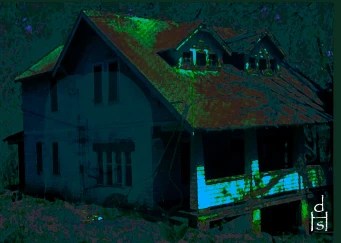
Years later, as an adult with a child of my own, I returned. Our old house was decaying—windows broken, graffiti on the walls, squatters likely nearby. The air felt wrong. We left.
Even more years passed, and I returned again. The land was gone, replaced by townhouses. But I found what remained of our swing set and doghouse in the woods, took home a rusted piece of the past.
Still haunted, I dug through property records. There it was: our home and his, built in the 1870s by a man named S. Disney (I’ll keep his full name private). His house sat exactly where I remembered.
I never found a photo. But I found enough.
Was he a ghost? My imaginary friend? A child’s dream or something more? I don’t know. All I know is I met a man who mowed a lawn that doesn’t exist anymore.
They say zombies are the living-dead—soulless husks roaming the earth in search of flesh to satisfy an unholy hunger.
But I say zombies are the dead-living—those still breathing, still walking, yet hollowed by pain, wandering this world and beyond in search of something to quiet an unrelenting restlessness.
We think hauntings happen only in places touched by death—houses, graveyards, battlefields. But hauntings happen in the mind, too.
Some people haunt themselves. Others are haunted by their everyday reality. And then there are those whose haunting was born in unspeakable terror—one that doesn’t fade with the light, but grows stronger after dark, when the vulnerability of sleep sets in.
This isn’t just restlessness of the body. It’s a soul-deep disturbance. It whispers at the edges of consciousness, like a ghost speaking through a medium. No one else sees it—only the aftershocks etched across a person’s face, voice, choices.
It’s tempting to run. I’ve run. I’ve searched shadows, scoured dark corners, tried to flee from the thing inside me. But here’s the truth:
Listening to the Sounds of Nothing ~ Approx. 4–5 min read
Monument Valley
Monument Valley National Park spans the corners of Utah, New Mexico, Arizona, and Colorado, and rests within the Navajo Nation. I’d never been, but something about that red earth called to me. I wasn’t interested in the usual dirt drive tourists take. I needed more. I needed connection.
My husband and I hired a Navajo (Diné) guide and climbed into his jeep. He took us to parts of the valley off the beaten path. About two-thirds through our tour, nearly axle-deep in rich orange sand, he stopped the engine.
“What do you hear?” he asked.
“Nothing,” I said. I had never heard nothing before. My heart beat faster.
“Exactly.”
He grinned, turned the key, and we continued through the quiet, swerving toward a towering sandstone alcove. Once parked, he motioned for us to follow.
Inside the alcove, the temperature dropped twenty degrees. He told us to lean against the stone wall, and we did. The rock was smooth, cool, grounding. I closed my eyes. I didn’t want to leave.
Again, he asked, “What do you hear?”
This time, I heard our breathing echoing in the stillness. Then he began to sing. Words I didn’t understand in a rhythm that seeped deep into my bones. His voice reverberated across the alcove in a way that felt like a secret between the rock and my soul.
He stopped. “Isn’t that something?”
I couldn’t answer. My body felt full and hollow at the same time. He nodded, understanding.
“We have to go back,” he said.
I didn’t want to. This encounter changed me, inspired me, and saddened me as well. What did it mean?
The Gift
Later,we detoured to a cliffside overlook where you can view ancient dwellings carved into the stone. As I walked the path, an elderly Native woman and a teenage girl approached me. The woman held a necklace—glass beads and juniper berries with a wire dreamcatcher pendant.
She said something I didn’t understand. The girl smiled. “It’s a gift,” she said. “From my grandmother.”
I hesitated. Was this a tourist trap? A silent exchange of expectation?
Maybe I looked wary because they grew more insistent. So, I took the necklace and said thank you. They both smiled, then disappeared up the path.
After taking my photos, I returned to find a tin can on a folded blanket with a few bills and coins inside. I dropped in a twenty, unsure if I’d just honored or violated something sacred.
And that’s the word that felt right–sacred. I felt at one with the universe, hearing something most people will never hear—nothing. And it was powerful.
The necklace hangs on my wall, a quiet reminder that in stillness, we touch the sacred.
What do you get when you mix a lime green Datsun with floor portholes, a trunk full of Twinkies, and an angry mob of monkeys? A safari detour gone spectacularly wrong—and a car barely held together by granite and hope. Hang on tight for this laugh-out-loud road trip through chaos, feathers, and fur. (Reading time about 8 minutes)
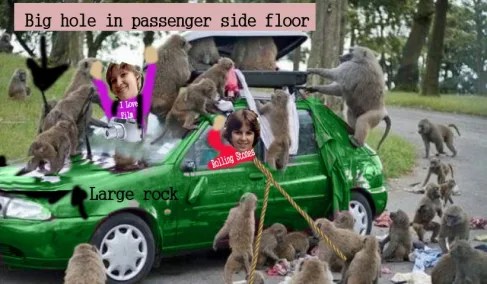
It was a two door, 1971, lime green Datsun B-210 with a black vinyl roof. Custom detailed with dual, on-the-floor, port holes for your road viewing pleasure. An additional emergency pull-rope release added onto the driver-side door for times when it’s not cool to use a handle. And a specially designed hood bent into the majestic shape of a steep mountain. Perfect for quick engine checks and radiator ventilation without having to fool with antiquated, interior, hood releases. The five pound Massachusetts’ granite, air-filter and cover-attachment-system fit perfectly under the shape of the hood.
Roach clips, never used, with hot pink feathers are swinging to the riffs of Keith Richards’ bass guitar and Mick Jagger’s edgy vocals. It’s Sue’s car. To the world, I am a Lennon/McCartney girl. Behind closed doors, I’m a Richards/Jagger mistress. I have a Sweet Pollyanna Purebred reputation to uphold.
We’re in New Jersey on a sweltering hot, July morning after a heavy rain. The smell of evaporating water on asphalt whiffs through my passenger side, floor porthole. I watch the macadam and occasional puddle fly by my feet straddling the hole.
“Let’s go see the monkeys at the drive-thru safari,” I suggest. I’d seen a sign just outside of New York City. “We’re only twenty miles away.”
“Sure, why not.” Sue replies. Sue is a tomboy. Something she readily embraces. This is evidenced by her grungy rock band tee-shirts, faded jeans, cowboy boots, and hat, slightly greasy dirty blonde hair, and automotive grease under her fingernails. She was always tinkering with the car.
I used to be a tomboy but exchanged it for grace, poise and the showmanship my performance persona demanded. I envy Susan’s grunge while I sit here in a crisp white pair of shorts, turquoise and white spaghetti strap tank top, with appropriately and pain staking matched jewelry. My white Jack Purcells are as spotless as my fingernails which have never touched motor oil.
The car wheel hits a puddle, splashing muddy water into my floor porthole. My crisp, clean whiteness is now a muddy, drenched mess. Water is running off the end of my pampered, Maybelline, light beige covered nose. It took me fifteen minutes trying to find my reflection in a campground mirror this morning to get this nose well blended!
Susan looks over at me and asks. “What the hell? How did you get all wet and muddy?”
“Oh I don’t know. Something about a hole in the floor that needs fixed.” At least my Nikon camera and accessories didn’t get wet. I look around for something to use as a towel but only find our mildewed tent, sleeping bags, duffle bags, firewood, a half empty bag of potato chips and an unopened box of Twinkies.
“Serve’s you right for wearing white!” She laughs, pulls the 8 track tape out of the dashboard, shakes it and puts it back in. I have no idea what this ritual does but this will be the sixth time I’ll hear the song, I Can’t Get No Satisfaction, in the past two days.
A kid with pimples greets us at the safari gate. He announces to no one, “Twenty dollars, stay in your car, the windows can be down except in the monkey enclosure, don’t feed the animals, the animals have the right a way, don’t stop in the monkey enclosure, take all the pictures you want, have a nice day.” He takes a breath. We drive on to join a long line of slow moving vehicles.
Our windows are down so I can take pictures without a glare. I tend to see everything through a camera lens. I go almost everywhere with my gear ready for that opportune moment. Several cars ahead, I see two mammoth gray ostriches weaving between them. Occasionally they case a car, seemingly looking for trouble. This could be that moment.
“Hey look.” Susan says as she points to the birds. “They’re getting really close. You might actually get a good picture.”
The birds are now several car lengths away. I look at my camera and realize I don’t need the telephoto lens so I bend down to get the 50 mm.
“Um,” Sue says. Her voice sounds a bit distressed but not enough for me to sit up. “Um, don’t, okay, just don’t get, um, I think we might have a problem.” I cock my head toward her to figure out why she suddenly forgot how to formulate sentences. Her face is oddly drained of color. “Right now,” she continues in a near whisper. “Don’t move, Debbie. We have a serious problem happening.”
I slowly turn my head to face the largest beak I’ve ever seen followed by two, large, black eyes on a face covered by prickly hairs. I definitely remember the animals have the right of way.
The beak, eyes and prickly hairs jolt past me heading for the back seat. It’s followed by an incredibly powerful, prickly haired, neck and a body of varying shades of musky smelling, gray plumage that completely covers my window opening. I’m pretty sure the 50 mm lens is the wrong one. What I really need is an extreme wide angle lens. But that‘s okay because I don’t think the ostrich is in the mood.
The gray plumage and powerful, prickly haired neck whip back out my window with the half-eaten bag of potato chips covering its eyes and beak. It’s really very stunning. The red and white of the family size, chip bag, against the increasingly frantic varying shades of musky smelling, gray plumage now in full regalia is so avant-garde. I can’t decide what strength and angle of flash to use on all this gray plumage with the very overcast, gray sky in the background. This would be a great shot in subtle shades of grays, blacks and white in the style of Ansel Adams.
“Put the window up!” Susan yells. “You’re gonna get in so much trouble for feeding the animals!” I really didn’t need to get into anymore trouble. I nervously try to push strands of my honey blonde hair behind my ear without success. It’s cut too short.
I look over at Sue’s white knuckles wrapped around the steering wheel. Her breathing is labored but is curiously in rhythm with her head shaking left to right and back again. It’s not my fault the damn bird likes chips. Not that it matters. I glance around the back seat for damages. Except for a few remaining terrified chips scattered hither and dither, all seems normal. The chips were destined for consumption anyway. What’s the problem?
“Well,” I tell her, “at least they didn’t get the Twinkies.” I can see from Sue’s expression there are no words to express her feelings on the topic. We start moving forward again.
The monkey enclosure looms ahead with its two-story cement walls topped in high voltage wire. Cars are only allowed through the massive wood and steal double doors at select intervals. Two armed animal control wardens monitor the opening diligently.
“They did say this is a monkey enclosure, right?” I ask. Sue nods yes and pulls the car up to the stop line before the immense, fortified doors. I recheck the settings on my camera.
A warden steps up to Sue’s window and says, “Door’s locked, windows up, don’t stop, no exceptions – got it?”
The massive doors open wide enough to swallow us and no wider. We pull through and they close quickly behind us. I look around expecting to see a cross between Godzilla and King Kong. I see nothing but the road we’re on and a well manicured lawn with lots of low shrubby trees. There is a red car about three hundred feet ahead of us moving slowly..
A large, gray-brown male macaque steps out from behind a tree onto the road ahead of us and sits down. Sue stops the car. His steal, green eyes watch us, the animals in the cage. He’s in no hurry to move. Peripherally, I see movement and turn to my right to see macaque mother’s with their babies.
“Check it out!” I tell Sue. “ Aren’t they cute?” I want to shoot a picture but my window has animal slobber all over the exterior. “What does it look like out your window?” She doesn’t answer and I turn to find out why.
On her side of the car, the one with the convenient, emergency, pull-rope door release, a line of fidgety, gray-brown fury bodies with green eyes watch us.
“This can’t be good,” Sue says. She turns the tape player off and we wait in silence.
The large, gray-brown, male macaque responsible for stopping the car jumps onto our mountain shaped car hood. He yawns, shakes his head and urinates all over the window.
“That’s something you don’t see every day,” I say and take a picture.
“This isn’t gonna to be good. I think we might have a problem,” Sue whispers.
Urine-monkey stands, flaps his arms, and opens his mouth displaying sharp incisors and screeches like a banshee. Suddenly, al I see out any window is a gray-brown, fury, moving carpet. The car shakes and bounces reminding me of an amusement park ride. I struggle to turn and look out the back window and see black ash rain.
“Sue, is that your black vinyl roof?” I ask. Thousands of pieces of black vinyl roof slide down the back window. I brace the camera against the rocking car seat and shoot a couple shots of the storm.
“Oh hell! No!” Sue yells. I spin around, jostled off balance as I go. “ They’ve got the rope!”
I lean over to assess the situation. Five monkeys are in a line pulling on the convenient, emergency, pull-rope release. It’s the exterior part with the knot we untie to release the door. Sue has the other shorter, interior end in hand. It’s obvious they have more leverage then we do. I can’t grab the rope. Sue is in the way. So, I move back to my side of the car. Counter balance, I figure.
My side of the window is now void of fur and I have a clear, abet smudged shot of the baby monkeys with their mothers. What the hell? I shoot a couple shots at different focal lengths and apertures, trying to adjust for the rocking motion of the tug of war occurring on the driver side of the car.
“What the hell are you doing?” Sue yells at me. I spin and look at her.
“I’m taking pictures.” I say and notice her eyes. Their size and her panic enhance their green and brown color making them look wickedly, earthy in this light. I shoot a picture.
“They’re going to kill us, you know.” She struggles to wrap the small section of rope around her arm like she was wrapping a garden hose.
“I suppose this is not a good time to tell you I think disassembling and reassembling the car door last night was a bad idea on your part?”
A blue mini-van filled with kids passes. My window is once again covered in fur but I see camera flashes. I realize the mini-van has a better point-of-view then I do. What good is expensive camera equipment if your point of view is wrong?
I’m distracted by the sensation that my shoe is moving on its own accord. I look down. Little hominid fingers have hold of my muddy, Jack Purcell shoe laces. Crap, I forgot the porthole. I yank my foot up but quickly halt. There is an arm and a shoulder attached to the hand and I’m pulling them inside the porthole. This would make one hell of a short video if I had a camcorder with me.
“Do something!” Susan yells. “Now! Put the damn camera down and kick that beast back to hell! I listen and obey.
The car stops rocking and the windows are fur free. The porthole is empty and the rope release on the door is limp. It’s no longer raining black ash. I take a picture of the empty, now larger porthole between my feet. I look up to see a warden in a bright yellow jeep beside us. He looks perturbed. The monkeys act aloof and I don’t know what I look like, but Susan looks like hell. He motions for us to follow him and we do.
“Go to the clerk,” he says. “She’ll take care of the damages.”
We park the car; examine all the thin, side, metal trim now jutting out at odd angles, the driver’s side door no longer sitting flush with the frame and the hole in the black vinyl roof.
“My poor car,” Susan says.
I look at the misshaped hood, the remains of the rope hanging off the broken door and my muddy Jack Purcells, complimentary of the floor porthole. “Yeah, it’s a shame.”
“There is no way the clerk is going to believe this,” Susan says. “Well, we might as well find out.”
We walk over to an office and I proceed to gingerly, almost embarrassingly explain our situation. I know they are going to look at Sue’s car and think we’re idiots.
“Damn monkeys,” the clerk says. “I bet your car is green. There is something about green cars. Take your car over to the park police. They have to make a report and photograph the evidence.”
We drive the car over to the police station. A pudgy, black officer steps out with an antiquated Polaroid camera in hand. “The monkeys did all this?” He asks while circling the car, stopping to look at the Massachusetts’ granite under the bent hood and the missing car floor from my open window. He looks directly at me.
I’m horrible at lying. Ever since I can remember people have told me, don’t play poker! “No.” I tell him.
“So, what damage did they do?” He’s still looking at me. I shoot a look over at Susan who’s shuffling her feet nervously.
“The roof and the metal, jutting out thingies,” I say.
“Thought so,” he says. He takes a couple Polaroid shots and waits for them to develop. “Are you two far from home?”
“Five hours, maybe,” I reply. Not sure why this is important.
“This car is a death trap. You know that?” He’s still looking at me. It’s not my car. I keep quiet.
He comes over to my side and shows me a very tiny, poorly exposed picture of Sue’s car. “This doesn’t quite do the car justice, does it? I bet if you used your camera, we could really see the damage.” He pauses, looks at me, Sue and then the car. He sighs, pulls out a pocket knife and slashes the monkey made hole in the roof and pulls it back exposing the metal. He snaps another picture and looks at me. “I think this might get the point across.” What am I supposed to say?
He takes Susan into the station to fill out paperwork while I stand guard over the car. I’m not sure how we’re going to get the car home with all that metal hanging off the sides. Sue comes out with a smile on her face. They paid her twice the amount of money she originally paid for the car – six hundred dollars.
“Ready to go home?” She asks.
I look over at the metal protrusions. “What about these?”
“That’s not a problem.” She pulls the metal completely off each side of the car and shoves them in the back seat with the moldy tent and Twinkies.
We drive back to Maryland in silence. I know my pictures will all be blurry and I’m bummed. We pull into the driveway, and as we unload the car, it hits me, and I stop moving.
“What?” Sue asks.
I turn and look at her. “I should have put the camera on automatic instead of manual.” I can see from her expression there are no words to express her feelings on the topic.
When Grown Kids Come Home Again Estimated reading time: 6–7 minutes
What happens when your empty nest suddenly fills back up—with adult children, grandchildren, pets, and all the baggage (literal and emotional) they bring? This humorous and heartfelt post shares our family’s journey from semi-retirement dreams to boomerang reality, complete with ghosts, minivans, and lessons learned the hard way. If you’re navigating the new norm of multigenerational living, these 10 tips just might save your sanity.
Had I known ten years ago what I know now, I could have saved the cost of seven boxes of tissues and taken a trip around the world instead. It never occurred to me that my three wonderful kids would graduate high school, launch into the world, and then circle back to the parental nest.
I watched each child proudly—and a little sadly—march down the graduation aisle to “Pomp and Circumstance.” College, marriage, big dreams—duly blessed and applauded. I called it semi-retirement. It didn’t last.
Daughter #1 came home first, with two toddlers, a dog, and half of the marital assets after her husband went fishing in different waters. Our small house quickly overflowed with boxes, furniture, and baby gear.
“We have to move,” I told my husband.
“We raised three kids here. It’s just the two grandkids and Daughter #1. We’ll be fine,” he insisted. Apparently, the hallway squeeze and the blocked dining table didn’t register.
Two weeks later, the house was for sale. When the Realtor asked what we were looking for, the responses were—predictably—very different.
Me: Five bedrooms, two bathrooms, big kitchen, fenced yard, family room, porch, maybe a koi pond. Hubby: Three bedrooms, one bathroom is fine, small yard, no need for fancy extras.
The Realtor smiled. “I think I have just the place.”
“What are you thinking?” my husband hissed. “We’re not made of money.”
“I have a feeling the other two are coming back, too,” I replied.
He looked unconvinced. “No babies. No puppies. No more.”
Fast forward: We moved into a 110-year-old house with five bedrooms, three bathrooms, a first-floor master suite, a screened-in porch, a fish pond, a fireplace, and a ghost (who eventually left due to overcrowding).
We also upgraded to a minivan. Hubby protested: “This is my red Corvette era!”
“It’s a mutant Jeep,” I replied, taking the little red car to work.
Soon after, Daughter #2 moved back with two cats. Another broken marriage. She had no winter coat, no job, and no medical insurance. Daughter #1 decided to go to college, which we agreed was a good long-term move.
Then our son returned from Boston. His funding fell through and he had to leave Berklee. He came back with a drum set, guitars, keyboards, amps, furniture, and dreams deferred.
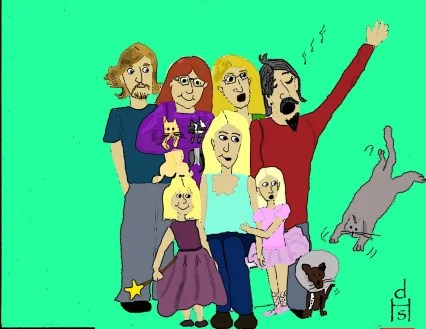
Seven people, three cats, two dogs, and a cast of extras: friends, dates, stray pets, and visiting students. It was beautiful chaos.
Along the way, we discovered some survival tips. Here are:
10 Tidbits to Curb the Insanity of Boomerang Families:
Update Your Relationship Status: They are adults now. That dynamic shift requires mutual respect and negotiation.
Rules: It’s still your house. Adjust outdated rules, but set clear expectations.
Logical Consequences: Make consequences fair, logical, and agreed upon. Contracts help.
Future Goals: Ensure they have direction—school, work, or saving for independence.
Money and Responsibility: Tailor rent based on income. Consider savings plans. Decide what’s an emergency. Use contracts for loans.
Boundaries: From food to bathroom schedules, set and communicate clear boundaries. Label food!
Grandkids & Pets: Clarify roles. Don’t parent the grandkids unless explicitly agreed upon. Support without overstepping.
Communicate, Don’t Argue: Choose dialogue over drama. Use central messaging. Humor helps.
Avoid Their Drama: Offer wisdom when asked, but resist solving their problems.
Take Care of You: Eat well, sleep, enjoy a life outside the home. Reconnect with your partner or a trusted friend.
Boomeranging is stressful but rewarding. You may rediscover deeper relationships and shared joy. And when it’s time, you can shout upstairs, “Hey adult-child, Ghost Hunters is on—I’m off duty!”
“Have you ever watched a turtle?” an Oneida woman asked me from behind the counter at the Shako:wi Cultural Center in Oneida, New York.
“Not really,” I admitted—but told her the subject of turtles kept coming up in my life.
She smiled. “Turtles are slow, steady, and strong.”
As she gave me a tour of the center, I mentioned I was looking for a book about Deganawidah and Hiawatha—figures I admired from Travels in a Stone Canoe. I also picked up one on the Oneida creation story.
“It’s the turtle that grows and becomes the island of North America,” she said.
Months later, I found myself at a Lenape inter-tribal Winter Solstice gathering in Pennsylvania, deep into the night as we sang the Walam Olum, the Lenape creation story. As I read along, the words jumped out: and the turtle became the foundation of the earth.
Turtles again.
Overheated and restless, I stepped outside into the cold. A man wrapped in a wool blanket joined me by the fire. “I’m Walking Bear,” he said. “You looked cold. Drum too loud?”
“I just needed a break,” I told him.
He studied me. “What do you know about turtles?”
“Not a lot,” I replied.
“I saw you inside,” he said. “Sometimes, you reminded me of a turtle. Other times, it looked like you forgot how to be one.”
“Turtles are slow, steady, and strong,” I offered.
He nodded. “Turtles carry the horrors of the world and remain connected to the Creator. You have a turtle shell. I see it.”
Then, pausing, he asked: “You’ve seen the Creator, haven’t you?”
He didn’t know me, didn’t know about my near-death experience, my years of service to others, or the guilt-driven urgency I carried. I said nothing. He was called back inside. I never saw him again.
But I couldn’t stop thinking about turtles.
I researched turtle totems, animal behavior, legends—driving my friends nuts. Everyone told me to slow down. I didn’t listen.
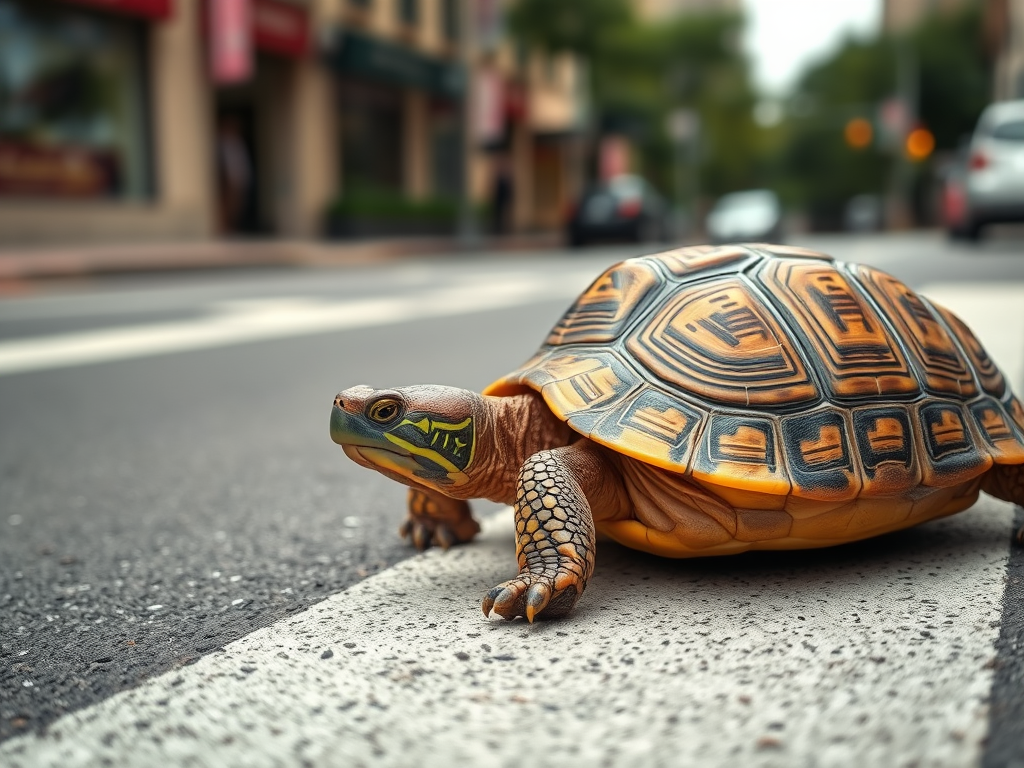
Then one summer in Oriskany, a large turtle stopped in front of our RV and stared us down. I jumped out, laid on the road, face-to-face, and begged it: What does this mean?
No answer. It eventually turned and walked away—slow, deliberate, unbothered. I watched until it was safe, mildly disappointed.
Weeks later, before a major presentation—my first in 25 years—I was spiraling. Panicked. My friend, sharing the hotel room, finally snapped: “Go splash your face. You’re driving me crazy.”
In the bathroom, a silver turtle charm fell out of the washcloth.
Tears welled in my eyes. I rushed out. “Look! The Creator sent me a turtle!”
My friend sighed, picked up a pillow, and whacked me. “I put it there, genius. Maybe I’m the miracle. Ever think of that?”
She was right. I calmed down. The presentation went beautifully. Had I been rushing, I would’ve missed that moment entirely.
Months later, burned out, sick, and disconnected, I knew I couldn’t keep living that way. I began training my replacement—an ex-priest who, somehow, knew what I needed better than I did. On my last day, he handed me two gifts: a stitched saying, To help another person is to touch the heart of God—and an Oneida creation story print.
Of the turtle.
“You’ve got the shell,” he said. “You just need to live like it.”
I didn’t get it then. Not fully. It took four more years, a chronic illness, and finally crashing from overdrive to understand. I’d been trying so hard to prove I was worth the second chance I’d been given, I forgot how to live it.
Now, forced to slow down, I hear more: in doctor’s offices, waiting rooms, quiet walks. I catch moments I used to miss.
“Slow down,” the man said. The turtle says it too.