Tag: spirituality

  • THE LONG GOODBYE, THEN THE SILENCE

    THE LONG GOODBYE, THEN THE SILENCE

    My uncle was dying in a Florida hospital, a thousand miles away. The call came early: Expect the inevitable. Keep your phone close.

    He wasn’t just an uncle—he was a second father. But I was home with my daughter, helping her recover from major spine surgery. She needed me. I couldn’t leave.

    All day, I juggled logistics, wondering if I could fly down. My mother said, “Let us visit the hospital, then we’ll talk tonight.” But the call never came.

    By midnight, my imagination took over. Maybe he’d already passed. Maybe they were too distraught to tell me—like when my sister died when I was seven and I couldn’t say goodbye.

    At 12:30 a.m., I half-joked to my daughter, “Maybe he’ll come say goodbye.” I thought of my grandmother’s rocker that moved by itself after she died. Surely my uncle could find a way.

    Unable to sleep, I crept downstairs for Lucky Charms, passing my late sister’s Chatty Cathy doll. I pulled out my uncle’s old camera, set it on the table, and cried until empty. Then—a shadow at my feet. I screamed. The milk went flying.

    “Meow.” Just the cat.

    The phone rang—he was still alive. Instead of relief, I felt emptiness. The next night, the real call came: my uncle was gone. I went numb, then collapsed into wailing.

    I’ve seen a lot of grief in my practice, and I know: do whatever healthy thing you need to survive. I let my thoughts spiral. I isolated. Days later, I picked up his camera and started shooting stills while playing childhood music.

    My office door swung open. A warm, healing feeling washed over me—comforting, not frightening. I like to think my uncle came to give me a hug. It was what I needed to begin the long, twisting road of healing. Who are you to tell me it was anything different?

    IF YOU ARE GRIEVING, KNOW THESE THINGS:

    • No one grieves the same.
    • Don’t let anyone tell you you’re taking too long.
    • Use your support system.
    • Keep a treasured object.
    • Write letters to your loved one.
    • Join a support group when ready.
    • Seek counseling if you’re struggling—or simply to talk.
    • Pray, meditate, or find your own way to connect.

    If you’re grieving, my condolences. I hope my experience helps you on your journey. —Debbie
  • Spiritual Detours – Gettysburg

    ©Deborah Hill

    (This is NOT FICTION)

    Have you ever heard the saying, “Don’t throw out the baby with the bathwater”?

    A friend and I have both survived near-death experiences—events that altered us permanently. On long drives, we often dive deep into conversations about spirit, soul, God, and nature. We’ve walked away from rigid dogmas—those rules imposed by religion that demand your belief to belong—and instead, we’ve chased after truth. Real truth. The kind you feel in your bones.

    Hence, throwing out the bathwater and keeping the baby.

    That mindset often leads us to places charged with meaning. On this particular day, we felt called to Gettysburg National Battlefield.

    We took the Taneytown exit just before sunset. As we approached the old Cyclorama, my friend said quietly,

    “I feel something pulling me here. Something important.”

    “Tell me when to stop,” I said.

    “Stop.”

    We parked beside an older man and his massive Irish Wolfhound, Tanner. He greeted us kindly and shared that he was a local who came to the battlefield seeking meaningful encounters. Usually, he sat at Little Round Top. But tonight, he’d felt drawn here instead.

    He’d had a near-death experience—just like us.

    For over an hour, the three of us stood and talked. About life. About death. About energy, God, and the battlefield itself. “This place is alive with spirit,” he said. “Something here vibrates because of the hell that happened.”

    And I understood exactly what he meant.

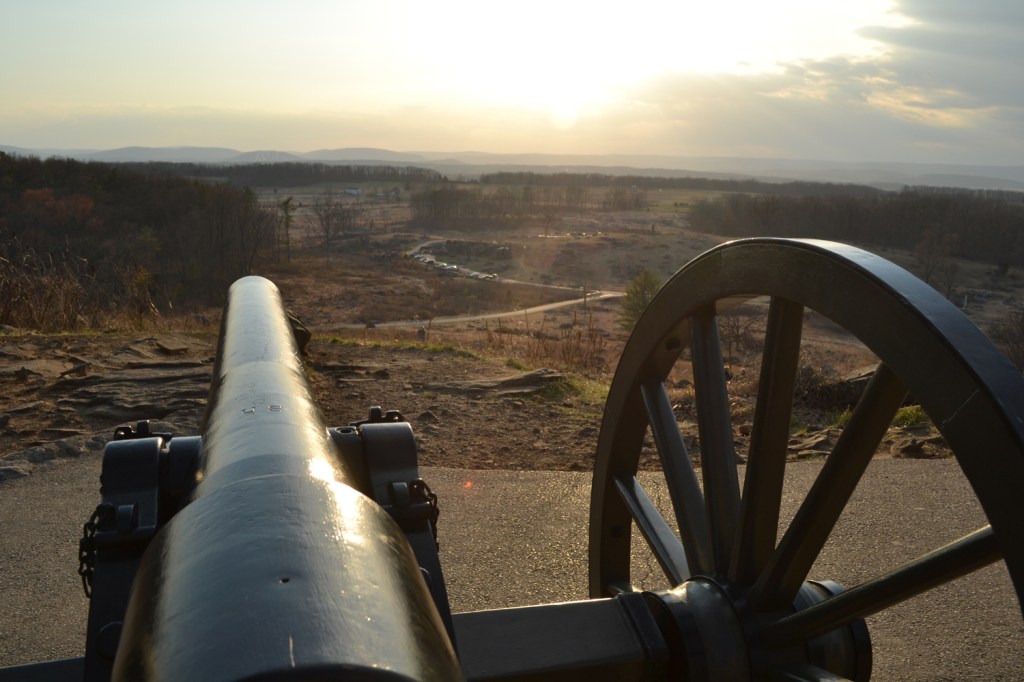
    We looked around at the silent cannons—posed and waiting, like sentinels. Witnesses to the deadliest battle of the Civil War. I shivered.

    We are sensitives—whether born or trauma-made. Drawn like moths to flame. To trauma. To death. To sacred, ruptured ground.

    “It’s the energy,” my friend said. “Spiritual energy.”

    I couldn’t disagree. What is spirit, if not supernatural energy? The Shekinah. The Holy Spirit. Energy.

    She seeks to understand it. Me? I feel it. Especially trauma. It lights something up in me.

    You don’t need a wild imagination to be humbled by Gettysburg. The place speaks for itself.

    As the sun set (the park remains open until 10:00), we parted ways with the man—three strangers connected through invisible threads. Before he left, he said, “Be careful.”

    We drove slowly through the darkening park and passed the Wheatfield. Suddenly, we both felt it—tingling skin, tight throats, nausea. The air felt electric, charged with something unseen. Then, as soon as we passed the bend, it disappeared.

    “You felt that?” she asked.

    We described it the same way.
    Yes, I had.

    At Devil’s Den, we got out and wandered behind the granite boulders. A low rumble echoed nearby—maybe thunder, maybe phantom cannon fire. That’s not unheard of here.

    My friend led me to a tall tree and stood still.

    “There’s peace here,” she said.

    But I felt dizzy. Nauseous. Unbalanced.
    “Stand next to me,” I told her.
    She did—and immediately felt the same.
    The air smelled metallic.

    Blood, I thought, but didn’t say.
    I know that smell.

    Maybe it was the dark. The uneven ground.
    But we didn’t feel normal again until we walked away.

    Later, as we drove past Little Round Top, I was hit by sudden chest pain, nausea, and a sharp pain behind my eye.

    For a split second, I thought I’d been shot.

    I swerved and pulled over.
    The sensation vanished.

    “Do you still feel peace?” I asked.
    “No,” she said. “It feels horrible now. So much death. I’m ready to leave.”

    As we exited the park, we passed the same cannons we’d seen earlier—but I saw them differently this time. They were more than relics.
    They were keepers—of sorrow, of pain, of history we can’t possibly comprehend.

    They reminded me of my own inner wounds.
    Silent. Unnoticed by most. But always there.

    Not everything in life can be explained.
    But we’re not alone.

    There are hundreds of thousands of us—like Tanner’s owner, like me and my friend—living on the fringe between the seen and unseen.
    We’ve experienced too much.
    We’ve been changed.
    And we’ve been given a gift: vision born from trauma.

    A gift that lets us throw out the bathwater—and still keep the baby.

    Maybe that’s why we keep returning to places like Gettysburg.
    Not just to understand the past.

    But to connect with a world we can’t always see.

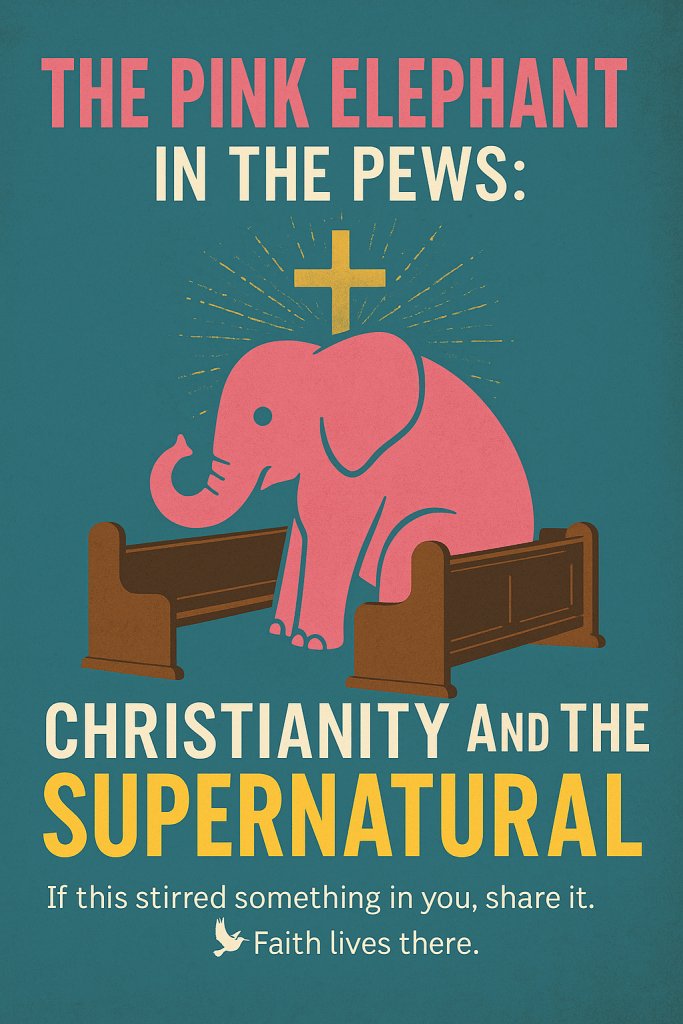
  • The Pink Elephant in the Pews: Christianity & the Supernatural

    The Pink Elephant in the Pews: Christianity and the Supernatural

    Reading time: ~4 minutes

    “The supernatural is the manifestation of events attributed to forces beyond scientific understanding or the laws of nature.”
    New Oxford American Dictionary

    What does the supernatural have to do with Christianity?

    Everything.

    Without the supernatural, there is no God. No miracles. No answered prayers. No angels or demons. No resurrection. No afterlife. No parting of the Red Sea or plagues in Egypt. Remove the supernatural, and you’re left with a shell of spiritual tradition—fairy tales dressed in Sunday clothes.

    So why do so many Christians hesitate to say they believe in it?

    It’s like caring for a beloved pink elephant and then denying it exists the minute someone asks.
    “What pink elephant? I don’t believe in pink elephants. That’s absurd!”

    But supernatural experiences didn’t end thousands of years ago, did they?

    Some argue, “The age of prophets is over.”
    Others say, “Only Jesus could perform miracles.”
    Still others cite Scripture’s warnings against sorcery, divination, and necromancy—as if these verses deny supernatural reality. In fact, they confirm it. You can’t be warned about something that doesn’t exist.

    Remember when Saul summoned the spirit of Samuel from the dead? He didn’t imagine it. Samuel appeared and spoke. That’s not symbolism. That’s a ghost. It’s right there in the Bible.

    So why the discomfort?

    Why do some Christians shut down when the supernatural is brought up—as if faith in the unseen doesn’t require belief in the unexplainable?

    Here’s the truth: If you don’t believe in the supernatural, you can’t fully believe in Christianity.

    Spirituality and the supernatural are intertwined. Without one, the other crumbles. The Bible isn’t just a collection of moral stories. It’s a chronicle of the extraordinary breaking into the ordinary. A burning bush. A virgin birth. Water turned to wine. A man raised from the dead.

    In fact, the more literally you take the Bible, the more you must embrace the supernatural. It’s not just the foundation of the faith. It is the faith.

    U.S. Catholic magazine affirms this in Tim Townsend’s article, “Paranormal Activity: Do Catholics Believe in Ghosts?” It states:

    “Ghosts confirm, rather than refute or disturb, Catholic theology of the afterlife.”
    Belief in the seen and the unseen isn’t optional—it’s essential.

    And yet, in conversations, I’ve heard this:

    “Of course I’m a Christian. Jesus died and rose again for my sins.”

    “So you believe in the supernatural?”

    “No, absolutely not. You don’t really believe in that stuff, do you?”

    Sigh.

    Why are we hiding our light under a bushel? Is it fear of judgment? Of being called foolish or irrational?

    It can’t be fear of God—because without the supernatural, there is no God to fear.

    If we deny the supernatural, we deny the very core of our faith. No resurrections. No divine interventions. No hope for eternal life. No visions, no visitations, no burning hearts stirred by an unseen presence.

    Without it, there is no mystery. No wonder. No awe.

    In the same article, theologian John Newton reflects on those who claim to see ghosts:

    “I certainly see no good reason, all other factors being equal, to deny that someone who claims to have seen a ghost has not had a genuine experience of some sort. The question then is: what sort of experience has occurred?”

    Exactly.

    Should Christians run from the supernatural? If we did, we’d have to throw out half the Bible and all of our hope.

    Without it, there’s no revival. No being born again. No faith healing. No dreams or visions. No heaven. No hell. No divine purpose. Just Sunday routines, stripped of spirit.

    And if we deny it out of fear or pride, are we not like Peter when the rooster crowed?

    So I’ll ask you plainly:
    Do you believe in the supernatural?

    Maybe the language feels uncomfortable. Maybe it’s easier to say “God” than “spirits” or “angels” or “miracles.” But that doesn’t make them any less real. We’re ants trying to comprehend the foot that built the stars. And if God could create the laws of nature, DNA, time, and consciousness itself—how arrogant are we to say what can’t be?

    We don’t have to understand the supernatural.
    But we do have to acknowledge that it’s always been part of the story.


    Call to Action:
    If this stirred something in you, share it. Start a conversation. Acknowledge the pink elephant. And most importantly—don’t be afraid to believe in what you cannot see.
    🕊️ Faith lives there.

  • Who Are You? Quiz Time!

    Everyone of us is need based:

    I’ve said before that ALL BEHAVIOR (Everything you think, feel, and do) is based on your experiences, perceptions, and your deepest needs.

    We all have the same needs, but in different degrees. Someone may have strong love and belonging needs while another has strong survivalist needs.

    To understand your behaviors, figure out which universal need is your strongest. In doing so, you can get an ah-ha about your thoughts, feelings, and actions. In doing this, you can open yourself up to new experiences and understanding to hopefully make healthy choices in your life to get your need(s) met. You can have more than one strong need.

    EVERYONE HAS THE SAME NEEDS IN DIFFERENT DEGREES

     Love and belonging

    Power

    Freedom

    Fun

    Survival

    Purpose in life (spiritual)

     Below are examples of behaviors you might see in someone with a high degree of need in a specific area.  See if you can find yourself. Beside each behavior, place a number based on whether it fits you. At the end of each section, count up the points and see in what order your universal needs stack up.  (These are ONLY SOME examples of typical behaviors)

      Scoring:

    1 = Not me at all

    2 = Maybe relates to me but very rarely

    3 = Relates to me but only under certain circumstances

    4 = I do this more often than not

    5 = This is me, no question

    LOVE AND BELONGING 
    Enjoys social activities 
    Cooperative with others 
    Likes to belong to clubs, groups, community events 
    Seeks out friendships 
    Family is very important 
    Craves intimacy 
    Self esteem derived from what others think of them 
    Feel lonely and/or depressed if not involved in a greater cause or group 
    Strives to please others 
    Puts others needs before their own 
    Has many friends 
    Teacher’s/boss’s pet 
    Tends to be affectionate 
    More likely to be a follower then leader 
    Strives to find others needs and to fill them 
    High need to be liked by others 
    Hard time saying NO 
    Purpose in life is in ability to help others 
    POWER 
    High achiever 
    Competitive 
    Desires recognition for achievements/ skills 
    Strong will for self-worth 
    Needs to win at games 
    Needs to feel correct 
    Pride in completing challenging goals 
    Enjoys being highly skilled 
    Need to dominate situations/and or people 
    Over achiever 
    Involvement in political/social activist activities 
    Aggression 
    Involvement in behaviors that make the person feel stronger/invincible (excessive drinking, fighting, risk taking behaviors)   
    Wants to be influential 
    Need to be affiliated with other people at the top of their game 
    Desires to gain higher education to feel better about self 
    Sexually aggressive 
    Gives up family/friends to climb their career ladder 
    Has a hard time being told they are wrong 
    Prefers independent sports as opposed to team sports 
    FREEDOM 
    Desire to make their own choices 
    Does not want responsibilities  to tie them down 
    Does not like to listen to people in authority 
    Strives to be their true selves regardless of consequence 
    Does not want to make commitments 
    Does not give in to peer pressure 
    Independent 
    Likes to choose their own path 
    Likes to be seen as outside the box 
    Likes to keep their opinions open and not make decisions 
    Craves spontaneity 
    Enjoy independent thinking and creativity 
    Not satisfied with other’s answers, needs to find things out on their own 
    Restrictions make them restless 
    Likes to be self-sufficient 
    Bores easy with daily routines 
    Relates to other’s needs for freedom 
    Creative expressionism 
    Does not do well maintaining or seeing need for planning 
         
     FUN 
    Likes to throw parties 
    Craves the energy of new/adventurous things 
    Likes to be around other people with common interests 
    Can be indiscriminate  
    Pleasure centered 
    Easily bored with daily routines 
    Does not take self/life too seriously 
    Enjoys playing but does not need to be competitive 
    Humorous 
    Willing to break tradition for fun, excitement, joy  
    Searches for humorous things/people/events 
    Can bore easily in long term relationships 
    Likes to travel to learn and experience new things 
    Creative for pleasure and not for completion of a project 
    Craves originality 
    Does not like confrontation 
    Enjoys learning in nontraditional ways 
    Can be seen as always on the go 
    Enjoyment of life is seen as most important 
    SURVIVAL 
    Fears for the future 
    Stores or hordes food/water/survival tools 
    Low trust of others/government 
    Fears losing their freedoms 
    Needs to feel prepared for anything 
    Typically very tense 
    Fears the unknown 
    Very observant 
    Instinctive 
    Self efficient 
    Can become impulsive, aggressive is threat of survival is challenged 
    Can be considered primitive in thinking/living (so busy concern about surviving all else is put to the side) 
    Strong ego, pits self against others 
    Can be seen as greedy 
    Needs things to be predictable to feel safe 
    Sees threats where others do not 
    Often intolerant of differences in other people or ways of living 
    Can have conspiracy based thinking 
    Feels insecure/anxious inside 
    PURPOSE DRIVEN (SPIRITUALITY) 
    Desires to be closer in relationship with higher being/power/element 
    Explores self/meaning of life 
    Needs purpose in life to feel whole 
    Can become judgmental and self-righteous 
    Can be religious/external doctrine focused 
    Can fears doing the wrong thing or for the wrong reason 
    Can  be existential and altruistic 
    May break from tradition to explore other cultural spiritual practices 
    Maybe willing to give up much to gain spiritual wisdom 
    May have complex rituals of behavior to feel closer to a higher power or their true being 
     May seek out paranormal experiences or classify experiences as miracles, demonic or other worldly 
    May refuse to conform to society norm of religious or doctrine related thoughts, dictates 
    Can be more tolerant of differences in people and cultures then average person 
    May have experienced one or more profound mystical, paranormal or other worldly event 
    May seek out others who share similar experiences or views of life and/or  a higher power 
    May seek and find spiritual values/meaning in life based on nature/science 
    May engage in experimental/chemical/risk taking behaviors to find a feelings of nirvana or out of body experience   
    Attempts to fill voids in life/past through higher thoughts/learning/spiritual education/practice 
    May extend need for meaning of  one’s life to reason and causation for universe and life in general 

     Total scores:

     Love and Belonging: _________

     Power: _________

     Freedom: __________

     Fun: ___________

     Survival: ____________

     Purpose of Life (Spirituality): __________

    Ask someone close to you to take the same quiz and compare the results. It may help explain why you gravitated toward them or why there are conflicts between the two of you.

    Let’s say you have a strong love and belonging and someone else has a strong freedom need. Can you see how these two people might have misunderstandings and conflicts? Once you know the needs, why the person chooses the behaviors they do, it gives an opportunity to communicate to find a common ground that meets both needs.

     ** Information based on the work of Dr. William Glasser

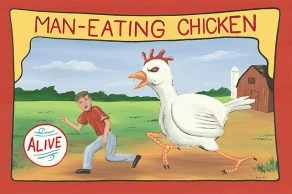
  • Man-Eating Chicken: The Healthy Relationship Vol 5

    A sign in an amusement park says; look in peep hole to see a man eating chicken. Now, if you saw that sign what image do you think you’d see through the hole? Is it a man munching out on a piece of chicken? Or is it a large chicken eating a man?

    What about these sentences? The man saw the boy with the binoculars.  Did the man have the binoculars or the boy? Or, how about, hole found in changing room wall; police are looking into it. Are they investigating the incident or looking in the hole?  

    These are called syntactic ambiguities. Why am I telling you all this? Because it is a good demonstration of how our brains perceive the world around us. For every person who sees a man eating a piece of chicken there are probably equal number who see a large chicken eating a man.

    If we want to understand and navigate our behaviors we have to grasp the way our brains see our world.

    Image

    All around us is the Real World. This is everything that exists; no matter if we realize it or not. The real world contains trillions of pieces of information bombarding us constantly. Our brains are not equipped to handle all this so it selects what is most important and screens out the rest. 

    It is generally accepted that there are three filters used to screen select Real World information for our use.  They are called: Knowledge, Values, and Perceptions.

    Whatever information remaining after screening is now evaluated and a decision is made. Either, this information is in-line with our wants and needs and we feel good. This information is neutral and does not matter to us. Or this information is not in-line and may threaten our wants and needs and we feel bad.

    If we decide that the information is in-line and we feel good, we keep our filters screening the same way, and continue to behave based on this information. The system is working well.  However, if the opposite is true, we feel out of balance and our system goes into red-alert. Depending on how far off balance we feel determines how much drastic action we take.  

    For example, let’s say you are watching your child on the swing-set at a local playground.  The weather is good, the park is not crowded, and your child is having fun. You feel good.  All of the sudden, the swing chain brakes and endangers your child. Chances are at this point in time, your brain could care less what the weather is like or how crowded the park is. Instead information such as speed and what angle to leap in order to catch the falling child would be more practical.

    Problems pop-up when we feel bad or out-of-balance and the adjustments we make are not the best.  Our actions could make things worse. They could fix things in the short-run but not long term. Or the adjustments solve what we think is the real issue making us feel out-of -balance when it is another issue deeper down we have not addressed.

    When we feel out-of –balance, we think, feel or do something different to feel better. The next step is, did it work? If not or it did not work the way we hoped, then a change in the information screened through the filters or an adjustment to the filters might be in order.

    The filtering system is one of the easiest ways to get from out-of- balance to in-balance.

    Knowledge Filter: This is a filter that contains pieces of information we already learned. I don’t think all information learned is actually in this filter. I think we have the ability to alter this. For example, I learned my ABCs in pre-school. This is always in my filter because I read and write daily.  I learned to fish when I was four-years-old but never fish. I really don’t think this is in my knowledge filter. But if I pushed myself, I could remember some memory of fishing and probably some terms from hearing others talk of fishing.   

    If the information we are using to filter Real World information prevents us from acting in a way to feel good, get our needs met and be in-balance, we need to search for new knowledge. We can also reassess knowledge we already have and decide what needs to be added or subtracted. 

    This is as easy as someone saying, “Hey, remember back when and you had this happen. You did such-and-such and it worked out. Maybe you should try that now.”

    Your reply, “Oh, I’d forgotten that. I’ll have to re-pull that knowledge and see how it changes my options.” Now you have added old information to your active knowledge filter.

    Values Filter:  This is the, how important is this information to me, filter.  When information enters this filter a value is placed on it. Is it positive information? Information that helps us become balanced, meets our needs? Or is it negative, something that has the potential to prevent or hinder getting our needs met? Some information is neither and we don’t give it a value.  

    Perception Filter: This filter is the very selective, how we see the world based on everything that is us. This includes our gender, culture, experience, sexual orientation, parents, age, race, etc. The amount of inclusions in here can be astronomical.  Because no one is the same as anyone else, each person’s Perception is different. Like the other filters, it can change.  Perspective might be another good word for this area. To change our perspective is to change our perception filter.

    All of the above is then evaluated against what Dr. William Glassier called the Quality World. The QW is sort of like the answer to the magic wand question many therapists ask. If you had a magic wand, what would life be like? In the Quality World we have pictures of how we think we can get our needs met in the most satisfying way. All our filters are balanced to provide the Real World information the system needs to best get to our Quality World picture.

    For example: If I have a high need for love and a low need for power (see prior posting for more details), my Quality World might have a picture of me being adored by family and friends. There is never conflict. I do volunteer work and always put others ahead of my needs. 

    It is probably more specific than this. Maybe, I’m a stay-at-home mother with three adorable, cherub-like kids and a dog named Elmo. My husband, who looks like George Clooney, works as a Podiatrist and I go to the Sisters of Perpetual Mercy Church three times a week.  I make an amazing meat-loaf. It’s to die for.

    That picture is what my brain will use to set my filters and gather information from the Real World. It is through that information, evaluated against my Quality World picture that I will use to behave. I will use it to think, feel and act a certain way. My way, may not be your way.

    Image

    That is why some of us see a man eating a chicken while others see a chicken eating a man!