Tag: personal-growth

  • Why We Do What We Do (Even When It Doesn’t Make Sense)

    ©AI Generated

    Let’s continue the conversation about how to build healthier relationships—with others and with yourself.

    Here’s a powerful truth to sit with:

    Everything we think, feel, or do is based on what we believe is in our best interest at the time.
    Even when it looks like the exact opposite.

    That’s a hard concept to swallow—especially when we think about someone staying in an abusive relationship, joining a gang, getting hooked on drugs, or constantly procrastinating. Even in these situations, the person believes—on some level—that their actions are helping them survive, cope, or meet a deep emotional need.

    We all do things that aren’t in our best interest sometimes. That’s human. (And if you think you never do, you may want to call a mental health provider. Just saying.)

    So why do we act against our own well-being?

    It comes down to how our brains are “programmed.”

    Think of your brain like a computer. It only works based on the data it’s been fed. You were born with some basic instincts—crying when hungry, searching for comfort—but most of your programming came from your parents, your environment, school, relationships, and everything you’ve experienced since birth.

    And the earlier that programming is installed, the deeper it runs.

    Let’s say Joe is a warm, affectionate guy who grew up in a cold, distant home. His inner radar is now tuned to search for love and connection—sometimes in all the wrong places. If his need is strong enough, he might even engage in risky or self-destructive behaviors just to feel loved or valued.

    Our brains are always scanning for ways to meet our needs, just like we search for a deal on ground beef or the right words to win an argument. Every choice we make—whether we eat a salad or grab a Big Mac—is based on our filters and beliefs about what will help us feel better, safer, happier, or more in control.

    So here’s your challenge:
    Pause today and ask yourself why you’re doing (or not doing) something.

    • Why did you hold the door for someone?
    • Why did you snap at your spouse?
    • Why are you running late again?
    • Why are you reading this blog?

    Every action has a deeper motivation, even if it’s buried.

    Let me give you an example:
    You’re late for work, exhausted, and have to give a big presentation. You know espresso makes you jittery, but you drink one anyway—and sure enough, you flub the presentation.

    Why did you drink it? Not just because you were tired.

    Dig deeper. Maybe you were desperate to impress, hoping for a promotion. Why? Because you want to be seen as a good provider. Why? Because you want your family to love and respect you. Boom. That’s the real reason.

    But here’s the twist: What if chasing that promotion makes you less available to your family? What if it leaves you feeling even less loved?

    It’s time to ask the bigger question: What does love really look like to me?
    And are my current actions bringing me closer to it—or pushing it away?

    You don’t have to have all the answers. But if you can recognize your deeper needs, question your beliefs, and stay open to new perspectives—you can begin to make healthier, more intentional choices.

    And always remember:
    Sometimes, the choice that seems irrational to others is the best a person can do in that moment—especially when survival is on the line.
  • When Life is not what you Dreamed

    @Deborah Hill

    When Life Isn’t What You Dreamed: How to Reconnect with Your True Needs and Wants

    Deborah Hill LCSW (Ret.)

    (3-minute read)

    At some point, nearly everyone looks back on life and wonders, How did I get here?
    What happened to the dreams, the plans, the “could have beens” and “should have beens”?

    The answer is simple to say—but often hard to accept:
    For the most part, we made choices that brought us to where we are now.

    That’s not to say we chose the traumas, losses, or catastrophes that blindsided us. No one chooses to be hurt, abused, abandoned, or thrown into crisis. But the choices we make afterward—the way we respond, the paths we follow—those decisions shape our journey.

    And when our choices take us further from the dreams we once had, we start to feel unbalanced, unsatisfied, or even angry.


    Why Do We Make the Choices We Do?

    Most of us choose what we think is best at the time. A child throws a tantrum to get candy, believing it will work. An adult gives the silent treatment over forgotten flowers, hoping to “teach a lesson” and feel valued next time.

    Sometimes we make reactive choices. Other times, we simply lack the information or emotional tools to choose differently.

    Take the example of a teen from a broken home who joins a gang. From the outside, it’s clearly not in his best interest. But with the limited knowledge and options he sees, it’s the closest thing to a family—offering belonging, respect, and protection.


    The “Quality World” We All Carry

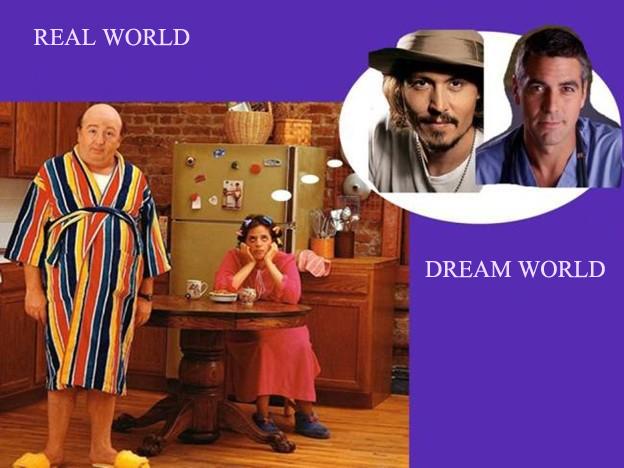
    As we grow, we create a personal picture of what our ideal life looks like—our Quality World. In this internal landscape, all our needs and wants are met. We feel safe, loved, successful, joyful.

    Ideally, we spend our lives making choices that move us closer to that picture. But if we don’t fully understand our needs and wants—or the options available to us—we may veer off course.

    And here’s the truth:
    Your ideal picture is probably a fantasy. But beneath that fantasy lies something very real—your core needs and desires.


    A Practical Example

    Let’s say your Quality World includes owning a Maserati. But in reality, you’re driving a rusty old Ford.

    You probably can’t buy the Maserati—but ask yourself why you want it.
    Maybe it symbolizes success, admiration, adventure, freedom.
    Maybe what you really want is to feel noticed, valued, alive.

    When we understand the why beneath the fantasy, we can start finding real-world ways to fulfill those needs—without waiting on an impossible dream.


    How to Align Your Life with What You Truly Need

    Step 1: Discover the “why” behind your fantasy.
    Use your imagination. If there were no limits—what would your life look like? What does that dream say about what you truly want?
    (Example: “I want to be on a football team” → “I want belonging, excitement, shared purpose.”)

    Step 2: Explore realistic substitutes.
    You may not become a surgeon—but can you volunteer with the Red Cross? Become a first aid officer? Help people in ways that still honor your deeper needs?

    Step 3: Examine your current choices.
    Are they aligned with your needs and wants—or taking you further away from them?

    Step 4: (Corrected numbering)
    Take small steps toward a better fit.
    Set short- and long-term goals. Think of these goals as your rudders—they help steer your ship, even when waters are rough.

    Step 5: Evaluate regularly.
    Ask yourself:

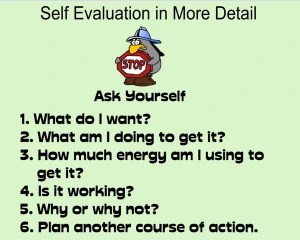
    • What do I truly want and need?
    • What am I doing to get it?
    • Is it working?
    • What could I do differently?

    Final Thoughts

    You may never have the exact life you imagined—but you can build a life that meets your real needs, a life that feels meaningful, grounded, and authentic.

    It’s never too late to rewrite your story, one intentional choice at a time.

  • The Healthy Relationship Part 4: What do I Really Want and How do I Get it?

    I’ve been breaking down basic rules for healthy relationships. In Part 3 we looked at identifying our NEEDS. Now we need to explore our WANTS.

     Ask someone what they want and often they can give you a very quick definitive answer.  But is that answer REALLY what they want?

    I can say, “I want chocolate chip cookies.”  This sounds simple enough; however, it really isn’t. In this particular case, I’m watching television and I’m anxious about a meeting I’m having in the morning. I’m not hungry or deprived of sweets but chocolate chip cookies are what hits me that I want.

    Knowing what I know about myself and human behavior, I know chocolate chip cookies are not really what I want. I don’t want the calories or the mess of making them. I’m not hungry. So, I start to dissect this WANT. Broken down, it looked like this:

    • I want chocolate chip cookies, more specifically
    • I want chocolate, more specifically
    • I want to stop feeling anxious, more specifically
    • I want to not go to this meeting tomorrow, more specifically
    • I want to feel I have more control over the outcome of tomorrow’s meeting, more specifically
    • I want to feel more confident in my ability to handle the unknown of tomorrow’s meeting

     Why is this important to me? Because I see myself as self-reliant, intelligent and due to my past, I have a strong need to feel in control.  When I get into situations where I can’t be or do these, I get anxious and feel out of balance. I need to do something to feel back into balance.

    As I’m watching TV, my brain jumps to the old stand-by, carbohydrates! They are the building blocks of changing the body chemistry for a short period of time. Will chocolate chip cookies help me feel self-reliant, intelligent and in control? NO! They will only make me feel fatter and give me more dishes to clean.  Making and eating chocolate chip cookies is a horrible plan to get my needs and wants met. It’s time to plan another strategy. Instead of cooking and eating chocolate chip cookies, I can take that energy and plan a healthier way to prepare for this meeting.

     When you know your real wants, you can better evaluate what behaviors you are choosing to accomplish your want.  So, step one is to EXPLORE what your REAL WANT is. Step two is to EVALUATE if the behaviors you are choosing will get you closer to that goal. Step three, if the answer to step two is no, INVESTIGATE other options. Get more information. Think about in the past, what you might have done that did work in a similar situation. Step four, make a PLAN and follow through.

    In my case, I had to address the demons in my thinking. I had to explore the negative images and thoughts I was allowing to run amok in my brain. My poor body was only reacting to my thoughts. The result was anxiety and the desire to feel better through food.  I also had to relax, journal and start saying a positive mantra.

    Patterns of behavior do not change overnight, but you have to start somewhere. I was still anxious, but much more in control of me, feeling more self-reliant because I took the steps and therefore feeling more intelligent and back in balance.

    If your behavior (thinking, feeling or acting) does not get a need met or a want achieved, a re-evaluation is in order. More than likely, what you think you want is only the surface-want or you are using the wrong behaviors to get you there.  Dig a little deeper and do the steps.

  • Finding the Land of Oz When Life Blows You Asunder

    I’ve been asked if there are any axioms I use to ground me when life tries to blow me away.  Yes, there are. I use the below axioms all the time when life is sunny. When life gets blustery, I sometimes have to remind myself that they exist.  If I remember and fall back on these axioms, things always turn out for the best.  It might not be the best I would have wanted, but I find myself relatively unscathed or able to bounce back quickly.  Kind of like the wizard in the Oz, The Great and Powerful or another well known film, The Wizard of Oz.

    Restlesswanderer61’s axioms for surviving and thriving:

     1.     The only person I can change is me.

    2.     No matter what life hands me, ultimately I choose how it effects me long term.

    3.     Everyone has the same basic needs, only in different degrees. Love people including myself, even the ones hardest to love.

    4.     Everyone’s behavior is purposeful.  They are the best choices I use or have used (whether healthy or regrettable, knowingly or subconsciously) to find balance. Don’t judge others or myself.

    5.     I am energy at my deepest level and a spiritual being that can connect with anyone and is only limited to the constraints I place around me.  Even if I doubt or don’t believe, I can’t be disconnected from the creator or all of creation. It is no more possible then living without taking in oxygen.

    6.     My brain is a creative and amazing devise. I will strive to develop what is not and prevent my thoughts from running amok.

    7.     People have the most amazing resilience and overcome the incredible horrors. So do I.

    8.     I am not perfect and never will be. There is no such thing as perfect.

    9.     The answers to my problems will ultimately come from me even if I can’t see them currently.

    10.   I have an amazing talent and gift, even when I don’t think so. Everyone has a talent or gift to be tapped to fulfill themselves and the world around them.  Let others shine, take the back seat and clap thunderously at other’s accomplishments no matter how big or small whether I know them or not.

    11.   Never lose my childlike wonder, imagination and desire for play.

    12.   Resistance to issues is futile. Deal with it, don’t repress or pretend it does not exist.

    13.   It’s okay to reach beyond my comfort zone. In fact, I will grow from doing so.

    14.   Strike a balance between being self-absorbed and other-focused.

    15.   There is usually no such thing as the no win scenario. It’s only how to win and what “to win” really means.

    16.   I don’t have to be correct all the time.  Pick my disagreements for when it really matters and let the rest go.

    17.   Everyone has baggage and crap. Mine is no better or worse than someone else’s, only different. Accept it.

    18.   Treat others the way I want them to treat me, even if they don’t.

    19.   Unless I have no food, shelter or loved ones, I have nothing to seriously complain about. My life is fine, no matter what is happening. Be grateful for every person, everything I have and everything that happens to me.

    20.   Be amazed by little things, joyful, laugh often and hard.

    21.   I can make a difference in everyone’s life I meet. Even if it is a small one.

    22.   Have patience. There is a reason things or people are as they are. Watch it unfold and learn.

    23.   Dream big, make goals, explore, learn and strive to make those dreams a reality.

    24.   Be proactive not reactive. This is my life, the only one I have, don’t get to the end and have regrets.  Make each moment count.

    Do you have a list of axioms you follow? If you don’t or are not sure, it might be something to think about. If you have a code you follow that is true, there is no telling the wonderful places it will take you. You are your best and worst enemy. Find balance and find peace not only in times of sun but when the tornado’s in life blows your balloon off course.

  • Repurposing Your Life: Becoming An Improved You!

    I went to the Goodwill store looking for a lamp to re-purpose.  I really enjoy combing through flea-markets and second-hand shops to find elements of objects discarded to make something new. Something I create to be meaningful or purposeful to me.

    I found a lamp, bought it. That afternoon I water colored the shade in hues of green. I realized, this object transformation was symbolic of my life and what I help others do – Re-purpose their lives. Life will always give reasons to step back and ask questions like: What the hell just happened? Why did this happen to me? What am I going to do now? Who am I as a result of this? Re-purposing helps bring answers to those questions.

    My journey with Post Traumatic Stress (PTSD) catapulted me into demanding answers to those questions. I didn’t think I could function without them. Luckily, a person does not have to endure severe traumas demanding immediate attention. Anyone can have a desire, a spark to find their authentic self and live a fuller, happier, more balanced life.

    People change slowly over time being enhanced or torn down by life’s challenges. Most appear to view this change as outside themselves. They don’t care or they fear looking inward and asking the hard questions. Finding the answers and stepping out into the great unknown. They accept life as it is. The result is often bitterness, anger and depression. This does not have to be. Life happens, yes, but what you do with it makes all the difference in the world – your world.

    Re-purposing takes time and usually happens in stages. As a person learns more about them self and the universe around them, there is an aha moment. My experience is that this is followed by a stewing process. The mind soaks in the information and applies it to everything it knows. The person acts on their new awareness and then it hits.

    New questions arise! Well, if that’s true, then what about this situation? Why did I act that way when I could have done this?  What else have I believed about life that suddenly is not true? What is truth?  The questions become less about the person and more about the world, the universe and the spiritual.

    It might be helpful to look at the journey in terms of cooking or food. At first, it probably seems similar to peeling off layers of an onion. I picked onion because pealing an onion can bring tears and at times not very pleasant. Thoughts and memories, who we have become over time has built around our core like the layers surrounding the core of the onion.  The larger the onion, the more changes, adaptations or layers a person has developed.

    There should come a time when a person can see beyond the onion metaphor and see layers as welcome opportunities for re-purposing, bringing enrichment to their lives.  Life’s journey now becomes more like layers of string cheese, baklava, lasagna, or some other pleasant concoction you can think of. Not as threatening or uncomfortable if done in moderation. It is good to note, that even with pleasant or desired elements of change, too much too soon can cause distress. I really would not recommend sitting down and eating en entire family size lasagna! All things should be done in moderation, which includes re-purposing.

    After a while, the person may no longer find total enrichment and the questions asked of the self changes again. Using the cooking metaphor, questions might revolve around the concern, how can I improve on this recipe? The types of questions are as vast as the grains of rice in a box of Minute Rice.

    Re-purposing time varies from person to person. Some only strive for feeling slightly better, like putting on a band-aid and waiting. Others, like me, spend a lifetime joyfully exploring, learning and becoming. At this point in my journey, the questions are no longer the ones stated above. Some of my current questions are: Where do I go from here? What does this say about me? How can I turn this into something good for myself and others?

    My lamp is now painted, trimmed and assembled. Another human-made element re-purposed for a new beginning, a new life. Aren’t all our experiences in some way, human-made? It’s up to us to do the re-purposing to make our lives the best they can be.

    I offer a challenge to you. Start re-purposing your life. The results are worth the journey. Below I offer some first steps to get you started. If you would like some help, you can check out my e-mail counseling/coaching services. If you are in the area, make an appointment or attend a class. Have a great journey!

    First Steps to Start Re-purposing Your Life:

    1. Get a notebook or journal.

    2. List as many qualities about yourself as you can think of. Ask others for their impute. What do you think/feel about your list?

    3. List things, people or events where you feel/felt: 1) happy: 2) accomplished: 3) loved: 4) experienced freedom: 5) had fun.  Are there any areas where you had a hard time listing things? Some needs that you are falling short in having fulfilled?

    4. What movies, characters, TV shows, music, artists, books do you relate to? Why?

    5. Make a timeline of your life – the goods, bads, neutrals, accomplishments, regrets. Why did you label these in the categories you placed them? Example: Why is difficulty in 3rd grade math a good thing?

    6. Answer the statement: If I had a magic wand, my life would look like… (be specific). Why would you want the elements you picked?

    7. List and evaluate areas of your life where you feel out of balance or unhappy. Why do feel this way about this area? (Try to be inward focused and not “because he made me…”)

    8. Ask yourself, what role do you play in number 7? We always play a role, even if it is not doing anything.

    9. Continue to ask yourself, what do I really want? (see my blog, Life’s Little Instruction Manual, Healthy Relationships Part 4)

    10. Review everything you have written. See if you are starting to understand who you really are, how you got here, the role you play, and where your life is unbalanced. You can’t formulate any goals on making improvements without this base-level structure.

    Congratulations on taking the first steps in re-purposing your life. Job well done! Drop me a comment and let me know how it’s going!

  • Man-Eating Chicken: The Healthy Relationship Vol 5

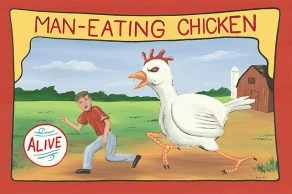
    A sign in an amusement park says; look in peep hole to see a man eating chicken. Now, if you saw that sign what image do you think you’d see through the hole? Is it a man munching out on a piece of chicken? Or is it a large chicken eating a man?

    What about these sentences? The man saw the boy with the binoculars.  Did the man have the binoculars or the boy? Or, how about, hole found in changing room wall; police are looking into it. Are they investigating the incident or looking in the hole?  

    These are called syntactic ambiguities. Why am I telling you all this? Because it is a good demonstration of how our brains perceive the world around us. For every person who sees a man eating a piece of chicken there are probably equal number who see a large chicken eating a man.

    If we want to understand and navigate our behaviors we have to grasp the way our brains see our world.

    Image

    All around us is the Real World. This is everything that exists; no matter if we realize it or not. The real world contains trillions of pieces of information bombarding us constantly. Our brains are not equipped to handle all this so it selects what is most important and screens out the rest. 

    It is generally accepted that there are three filters used to screen select Real World information for our use.  They are called: Knowledge, Values, and Perceptions.

    Whatever information remaining after screening is now evaluated and a decision is made. Either, this information is in-line with our wants and needs and we feel good. This information is neutral and does not matter to us. Or this information is not in-line and may threaten our wants and needs and we feel bad.

    If we decide that the information is in-line and we feel good, we keep our filters screening the same way, and continue to behave based on this information. The system is working well.  However, if the opposite is true, we feel out of balance and our system goes into red-alert. Depending on how far off balance we feel determines how much drastic action we take.  

    For example, let’s say you are watching your child on the swing-set at a local playground.  The weather is good, the park is not crowded, and your child is having fun. You feel good.  All of the sudden, the swing chain brakes and endangers your child. Chances are at this point in time, your brain could care less what the weather is like or how crowded the park is. Instead information such as speed and what angle to leap in order to catch the falling child would be more practical.

    Problems pop-up when we feel bad or out-of-balance and the adjustments we make are not the best.  Our actions could make things worse. They could fix things in the short-run but not long term. Or the adjustments solve what we think is the real issue making us feel out-of -balance when it is another issue deeper down we have not addressed.

    When we feel out-of –balance, we think, feel or do something different to feel better. The next step is, did it work? If not or it did not work the way we hoped, then a change in the information screened through the filters or an adjustment to the filters might be in order.

    The filtering system is one of the easiest ways to get from out-of- balance to in-balance.

    Knowledge Filter: This is a filter that contains pieces of information we already learned. I don’t think all information learned is actually in this filter. I think we have the ability to alter this. For example, I learned my ABCs in pre-school. This is always in my filter because I read and write daily.  I learned to fish when I was four-years-old but never fish. I really don’t think this is in my knowledge filter. But if I pushed myself, I could remember some memory of fishing and probably some terms from hearing others talk of fishing.   

    If the information we are using to filter Real World information prevents us from acting in a way to feel good, get our needs met and be in-balance, we need to search for new knowledge. We can also reassess knowledge we already have and decide what needs to be added or subtracted. 

    This is as easy as someone saying, “Hey, remember back when and you had this happen. You did such-and-such and it worked out. Maybe you should try that now.”

    Your reply, “Oh, I’d forgotten that. I’ll have to re-pull that knowledge and see how it changes my options.” Now you have added old information to your active knowledge filter.

    Values Filter:  This is the, how important is this information to me, filter.  When information enters this filter a value is placed on it. Is it positive information? Information that helps us become balanced, meets our needs? Or is it negative, something that has the potential to prevent or hinder getting our needs met? Some information is neither and we don’t give it a value.  

    Perception Filter: This filter is the very selective, how we see the world based on everything that is us. This includes our gender, culture, experience, sexual orientation, parents, age, race, etc. The amount of inclusions in here can be astronomical.  Because no one is the same as anyone else, each person’s Perception is different. Like the other filters, it can change.  Perspective might be another good word for this area. To change our perspective is to change our perception filter.

    All of the above is then evaluated against what Dr. William Glassier called the Quality World. The QW is sort of like the answer to the magic wand question many therapists ask. If you had a magic wand, what would life be like? In the Quality World we have pictures of how we think we can get our needs met in the most satisfying way. All our filters are balanced to provide the Real World information the system needs to best get to our Quality World picture.

    For example: If I have a high need for love and a low need for power (see prior posting for more details), my Quality World might have a picture of me being adored by family and friends. There is never conflict. I do volunteer work and always put others ahead of my needs. 

    It is probably more specific than this. Maybe, I’m a stay-at-home mother with three adorable, cherub-like kids and a dog named Elmo. My husband, who looks like George Clooney, works as a Podiatrist and I go to the Sisters of Perpetual Mercy Church three times a week.  I make an amazing meat-loaf. It’s to die for.

    That picture is what my brain will use to set my filters and gather information from the Real World. It is through that information, evaluated against my Quality World picture that I will use to behave. I will use it to think, feel and act a certain way. My way, may not be your way.

    Image

    That is why some of us see a man eating a chicken while others see a chicken eating a man!

  • Houston, We Have A Problem

    The oh sh-t moment when life goes from wonderful to dread and we have to act fast. We all have them. Sometimes we handle the situation well and other times, well, we ponder for decades what we could have done differently. Can a person truly be prepared for those problematic moments?

    We are all basically hard wired the same way. Note the word basically. It is rare in life when things are one-hundred percent. There are four things we are programmed to do in emergencies. They are flee, fight, freeze or flop. Pretty easy to understand. To flee is to run away from the situation. To fight is to attack the situation head-on. To freeze is to become paralyzed and not able to do much of anything. To flop is to faint.

    Which of these tactics a person picks may be the same in all emergencies or can change depending on the circumstances. A woman who suddenly has the strength to lift a car off her child (to fight), might not attack an intruder inside her home. Can we know in advance which behavior we will chose?

    Hard to say. The military trains our troops by using repetition. Instilling into them, this is what you do in the following situation. The lives of these people depend upon it. Firefighters, police officers and all other careers where lives are at stake do the same thing. But even then not everyone is able to follow that programming when needed. Why not?

    It comes back to all our past experiences. Those experiences become chemical memories in our brains. When a situation occurs similar to a past situation, the brain compares it and acts based on what worked before. No matter how much training a person has, there are times the old experiences will over-ride the current situation. Why? Because, training that your life is in danger is very different from it truly being in danger.

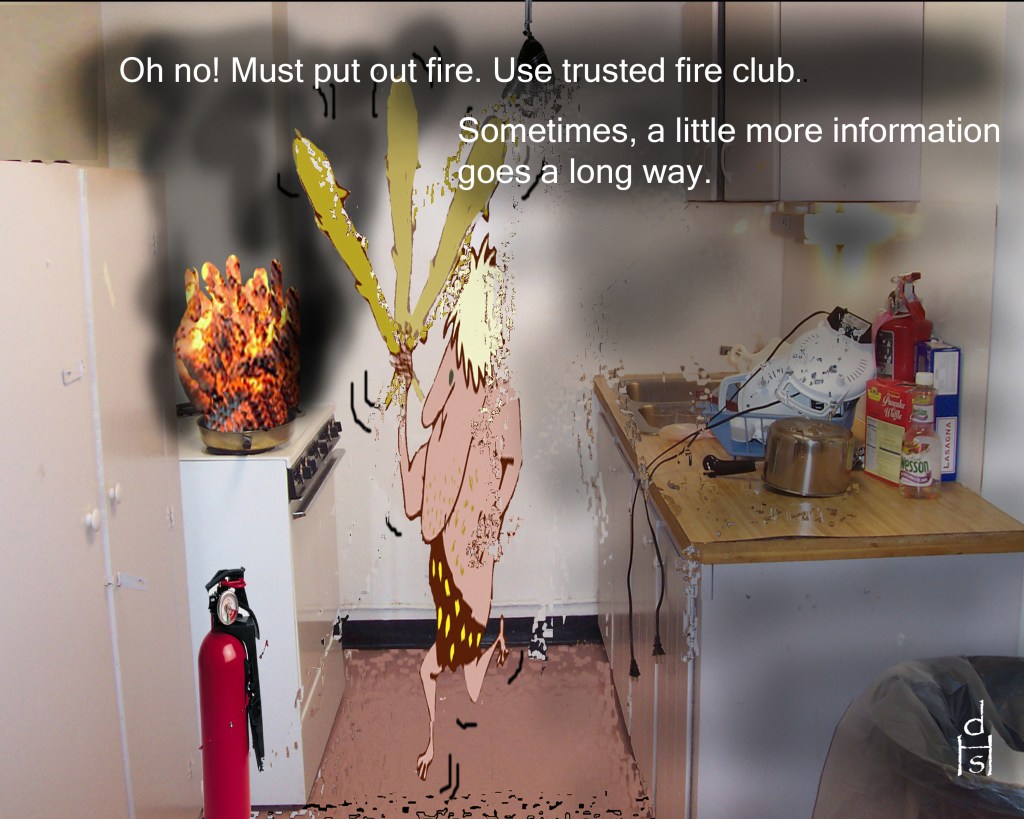
    Having said that, there are times, sometimes humorously, when our reactions are way off the mark. Like the picture above where the caveman is using a club to put out a fire. The fire extinguisher is right beside him. This is where feelings step in. Fear, panic and anxiety all play a role in how effective we will behave in an emergency.

    Stress produces the same type of reaction. The brain thinks there is a problem. It is either a possible emergency or real emergency and tells us to react. As a result our reactions maybe over the top for the situation. Think about the person who gets road rage because he/she is running late and the person in front is going the speed limit.

    Next time you know you are feeling stressed and you find yourself over-reacting (flee, fight, freeze or flop), try to pull yourself together and regroup before reacting. Good questions would be, why am I reacting this way? Is the danger real? How realistic is my thinking? The one I like the best comes from my husband. He says to me, “I think you are reacting to things not in evidence.” Meaning, I’ve either got the cart before the horse or I believe I know what is going to happen without having a crystal ball.

    None of us have true knowledge of the future but some of us think we do and base much of our choices and behaviors on this illusion. It can’t be done.

    Here’s hoping you have a reaction appropriate day.