Tag: mindfulness

  • My Stress has Stress! Send Help!

    A stress is something in your environment that convinces your body to react as though it’s in danger.  It can be simple things such as new responsibilities at work, changes in your schedule, or ever stimulation such as overcrowding, too much light, too much noise.

    Stress can be Positive, Negative or Neutral. 

    Negative: It can quickly cause headaches, muscle tension, irritability, anxiety, and anger. Examples: Losing a job, health scares, being burgled, too many deadlines.

    Neutral stress typically has the slowest reactions, unless multiple stresses combine.  Examples: Finishing a project, moving to a new city, or a change in family dynamics.

    Relationships are like trees. When the storm of stress hits, it will either bend or snap. All relationships experience stress. You can’t avoid it.

    If you start out with the great relationship, increased stress will still put a strain on that relationship.  If you have a mediocre or poor relationship increased stress will make the road much rockier and possibly snap the relationship.

    The severity of the stress, the couple’s support system and how well they communicate will help determine how strong and healthy their relationship will be after the storm. Therefore, I always tell people they should have stress inoculation.

    Each person handles threats in a different way.  You may remember being taught that people either flee, fight, freeze or flop. Stress is experienced in the brain as a threat.

    Two people in the same situation can react completely differently from each other.

    Fleeing: One person in the relationship may need to take more walks alone or go out with friends more often.  This person is fleeing.  They need to escape the situation, even if only temporarily.  They feel if they don’t flee they will be unable to tolerate the situation.

    Fighting: Another person may start arguments, have tantrums, or start physical fights when they are stressed.  They may tell you they feel they’re up against the wall and need to react this way to protect themselves.  There really is no physical danger or need for protection, but their biology and past learning convinces them otherwise. These people are the fighters.

    Freeze: Another person will do nothing. These people become quiet, withdrawn and can’t handle having confrontations.  The more upsetting the stress around them the more they shut down.  These people are the freezers.

    Flop: Another person will flop.  Flopping means the person falls down or faints.  This usually occurs during times of extreme, sudden stress.

    Adrenaline fatigue is an example of flopping (burnout) can happen when a person experiences a long-term stressful environment. It manifests as extreme fatigue sometimes debilitating, and the person can’t function.   In time the body wears down and the person gets sick more often and in severe cases can cause or speed the rate of heart disease and death.

    So how can a person stress inoculate?

    Step one: remember stress happens it’s only a matter of when and what kind.

    Step two: know how you react to stress.  Are you a flopper, the fleer, a fighter, or someone who freezes?

    Step three: if you’re in a relationship, which of these reactions does your significant other use?

    Step four: acknowledge and accept that the way your significant other reacts does not have to be the way you react.

    Step five: develop good communication before stress hits.  If you’re already in the stress boat, take a timeout away from home in neutral territory where you can discuss the stress and how it affects each of you.

    Step six: do not bring other parties into your conflict.  This is not about he said, she said, he’s bad, she’s bad, I’m right, they’re wrong.  It’s about coping when you’re not your best or when loved ones are not at their best

    Step seven: do not make any life changing decisions while under extreme stress unless absolutely necessary.  You’re not in your normal thinking mind.  You’re in survival mode and the part of your brain that deals with rational thinking has taken a side seat to your primitive survival brain.

    Step eight: focus your thinking on elements in your life that currently give you joy.  There is no such thing as not having joy.  Joy is a way of looking at elements in your life that bring peace, appreciation, good healthy feelings if viewed in a positive light.  Find it and make it significant.

    Step nine: this too shall pass.  The outcome of a stressful event may not be positive but the events unfolding are moving in time as you are.  You’ll either make decisions for change to get in a better place or the events will change and there will be release.

    Step 10: after riding that storm of stress, sit down and evaluate how you reacted and how you both reacted as a team.  What worked, what needs tweaked and what needs changed to prepare for the next round.

    In the end I’d like to think that most people want their relationships to be healthy, happy and supportive.  Remember you are team. Even if you didn’t say the words, for better or worse, as part of a marriage ceremony or you have a committed relationship of any kind, the intent is implied.  If your relationship starts looking rocky, do a stress evaluation for both of you.  Do it together.  Remember, this too shall pass.

  • Why We Do What We Do (Even When It Doesn’t Make Sense)

    ©AI Generated

    Let’s continue the conversation about how to build healthier relationships—with others and with yourself.

    Here’s a powerful truth to sit with:

    Everything we think, feel, or do is based on what we believe is in our best interest at the time.
    Even when it looks like the exact opposite.

    That’s a hard concept to swallow—especially when we think about someone staying in an abusive relationship, joining a gang, getting hooked on drugs, or constantly procrastinating. Even in these situations, the person believes—on some level—that their actions are helping them survive, cope, or meet a deep emotional need.

    We all do things that aren’t in our best interest sometimes. That’s human. (And if you think you never do, you may want to call a mental health provider. Just saying.)

    So why do we act against our own well-being?

    It comes down to how our brains are “programmed.”

    Think of your brain like a computer. It only works based on the data it’s been fed. You were born with some basic instincts—crying when hungry, searching for comfort—but most of your programming came from your parents, your environment, school, relationships, and everything you’ve experienced since birth.

    And the earlier that programming is installed, the deeper it runs.

    Let’s say Joe is a warm, affectionate guy who grew up in a cold, distant home. His inner radar is now tuned to search for love and connection—sometimes in all the wrong places. If his need is strong enough, he might even engage in risky or self-destructive behaviors just to feel loved or valued.

    Our brains are always scanning for ways to meet our needs, just like we search for a deal on ground beef or the right words to win an argument. Every choice we make—whether we eat a salad or grab a Big Mac—is based on our filters and beliefs about what will help us feel better, safer, happier, or more in control.

    So here’s your challenge:
    Pause today and ask yourself why you’re doing (or not doing) something.

    • Why did you hold the door for someone?
    • Why did you snap at your spouse?
    • Why are you running late again?
    • Why are you reading this blog?

    Every action has a deeper motivation, even if it’s buried.

    Let me give you an example:
    You’re late for work, exhausted, and have to give a big presentation. You know espresso makes you jittery, but you drink one anyway—and sure enough, you flub the presentation.

    Why did you drink it? Not just because you were tired.

    Dig deeper. Maybe you were desperate to impress, hoping for a promotion. Why? Because you want to be seen as a good provider. Why? Because you want your family to love and respect you. Boom. That’s the real reason.

    But here’s the twist: What if chasing that promotion makes you less available to your family? What if it leaves you feeling even less loved?

    It’s time to ask the bigger question: What does love really look like to me?
    And are my current actions bringing me closer to it—or pushing it away?

    You don’t have to have all the answers. But if you can recognize your deeper needs, question your beliefs, and stay open to new perspectives—you can begin to make healthier, more intentional choices.

    And always remember:
    Sometimes, the choice that seems irrational to others is the best a person can do in that moment—especially when survival is on the line.

  • Eliminate the Worrywart: Understanding and Managing Everyday Anxiety

    @ Deborah Hill

    Eliminate the Worrywart: Understanding and Managing Everyday Anxiety
    By Deborah Hill, LCSW (Ret.)

    “I had a big presentation today and was up all night worrying.”
    “I’m running late again—I’m afraid I’ll lose my job.”
    “I’m so worried about Jim’s health, I can’t eat.”

    Sound familiar? We all worry. But chronic worry is more than emotional discomfort—it’s a contributor to high blood pressure, digestive issues, insomnia, and even long-term health breakdowns. Some people literally worry themselves sick.

    Worry Is an Illusion of Control

    Worrying often feels like doing something—but it’s really just a poor attempt at control. When we worry, we unconsciously think:

    • “If I think hard enough, I can stop something bad from happening.”
    • “If I don’t worry, I’ll be unprepared or uncaring.”
    • “If I mentally run every possible outcome, I can force the right one.”

    None of that is true. A woman worrying in the waiting room during her husband’s surgery isn’t helping him heal—she’s draining her own energy. If she took a walk, grabbed coffee, or talked with a friend, the outcome wouldn’t change—but her resilience to face it would improve.

    Worry = Self-Induced Stress

    Unlike external stress (deadlines, illness, difficult people), worry is internal and voluntary. It places your body on red alert:

    • Muscles tense
    • Digestion slows
    • Heart rate and blood pressure rise
    • Adrenaline spikes
    • You lose sleep, focus, and peace

    Your body thinks it’s in battle mode. But there’s no enemy. Chronic worriers stay on this battlefield for years—until their body breaks down.

    Why We Worry

    Worry can stem from love, fear, or habit. People say, “If you love someone, you worry about them.” But love doesn’t require mental telepathy. It asks for care and presence—not obsessing over things you can’t control.

    The term “worrywart” makes sense. Left unchecked, worry grows and consumes. Like a wart on the body, it starts small but can overtake everything.

    How to Squash the Worrywart

    1. Recognize What Worry Is

    Worry is a thought loop aimed at controlling the uncontrollable. You’re trying to predict, prevent, or fix something—often using nothing but mental energy.

    2. Acknowledge You’re Not Telepathic

    You cannot control life, death, illness, or other people’s decisions by thinking hard enough. No one can. And that’s okay.

    3. Tune into Your Warning Signs

    Your body gives you early alerts—like a ship moving from green to yellow to red alert. Ask yourself:

    • Are my thoughts racing?
    • Do I feel tense or sick?
    • Am I imagining worst-case scenarios?

    Name it: “I’m worrying.” Awareness breaks the cycle.

    4. Ask: Can I Control This?

    If the answer is no, accept that. Letting go doesn’t mean you don’t care—it means you’re reclaiming energy for what is within your power.

    5. Turn Worry into Work

    Prayer or Reflection

    Prayer isn’t worry—it’s surrender. It can offer peace and perspective. If prayer’s not your thing, mindful reflection or meditation works too.

    Redirect Your Thoughts

    Change your environment: get up, move around, talk to someone, take a walk, or do something tactile. Worry often fades when we shift context.

    Focus Your Mental Beam

    Engage in hobbies or tasks that require concentration—baking, puzzles, gardening, music. Focus crowds out worry.

    Move Your Body

    Physical activity releases stress. You don’t need a gym membership. Dance in your kitchen, walk the dog, clean the garage. Use that fight-or-flight energy productively.

    Get Involved

    Channel worry into action:

    • Concerned about health? Research and prepare.
    • Afraid of crime? Join a community initiative.
    • Overwhelmed by a deadline? Learn time management or ask for help.

    The Energy Shift

    “I wish I had her energy—I feel so drained.”
    She may not have more energy, just fewer leaks. Chronic worry is an energy drain. When you stop trying to control what you can’t, that energy returns. You feel lighter. Healthier. Calmer.

    Bottom Line?

    Worry is optional. Learned behavior can be unlearned. Stop rehearsing disaster. Step away from the red alert. Reclaim your body, mind, and peace. It’s never too late to squash the worry wart.

  • Finding Happiness in an Uncertain World

    Deborah Hill LCSW (Ret.)

    Estimated reading time: 3–4 minutes

    The world right now feels unpredictable. We’re flooded daily with news—some real, some not—that stirs up anger, helplessness, depression, and anxiety. At the same time, life marches on. We celebrate birthdays, plan weddings, cherish family moments, and get promotions—while wars rage, politics divide, and personal struggles like job loss or divorce quietly unfold behind the scenes.

    It may seem counterintuitive, but finding happiness amid turmoil isn’t denial—it’s survival. It’s not forgetting what’s happening or pretending to be unaffected. It’s more like holding an umbrella in a storm or finding the strength to lift your hand above rising waters.

    Happiness, in times like these, becomes a quiet act of resistance. Here are 15 ways to cultivate it—even when the world feels heavy:

    1. Smile more. Find joy in simple moments and the people around you.
    2. Take breaks from the news and social media. Constant exposure fuels stress and fear.
    3. Stay connected. Nurture relationships and activities that uplift you.
    4. Give generously. Compliments, kindness, and small gestures go a long way.
    5. Acknowledge your feelings. Journal, move your body, or channel your emotions into purpose.
    6. Challenge negative self-talk. When your inner critic speaks up, reframe the message.
    7. Let go of hate. Hatred solves nothing—it only poisons the vessel that carries it.
    8. Stop living in the past. Release the “should haves” and “what ifs.”
    9. Immerse yourself in music. Let it lift, heal, or energize you.
    10. Nourish your spirit. Whatever your beliefs, cultivate a deep spiritual life.
    11. Don’t assume or judge. You can’t read minds, and you never know someone else’s story.
    12. Prioritize self-care. You can’t pour from an empty cup.
    13. Declutter your space. A clear environment helps create a clearer mind.
    14. Get good sleep. Rest isn’t a luxury—it’s a necessity.
    15. Step into nature. Even a brief walk can reset your soul.

    Life is complicated, but within the chaos, we can choose moments of peace, joy, and connection. The goal isn’t to ignore what’s hard—it’s to find the light that helps us move through it.

  • A Day in the Life: Finding Stillness in a World on Hyper-Speed

    A Day in the Life: Finding Stillness in a World on Hyper-Speed
    Estimated Reading Time: 5–6 minutes

    By: Deborah Hill LCSW (Ret.)

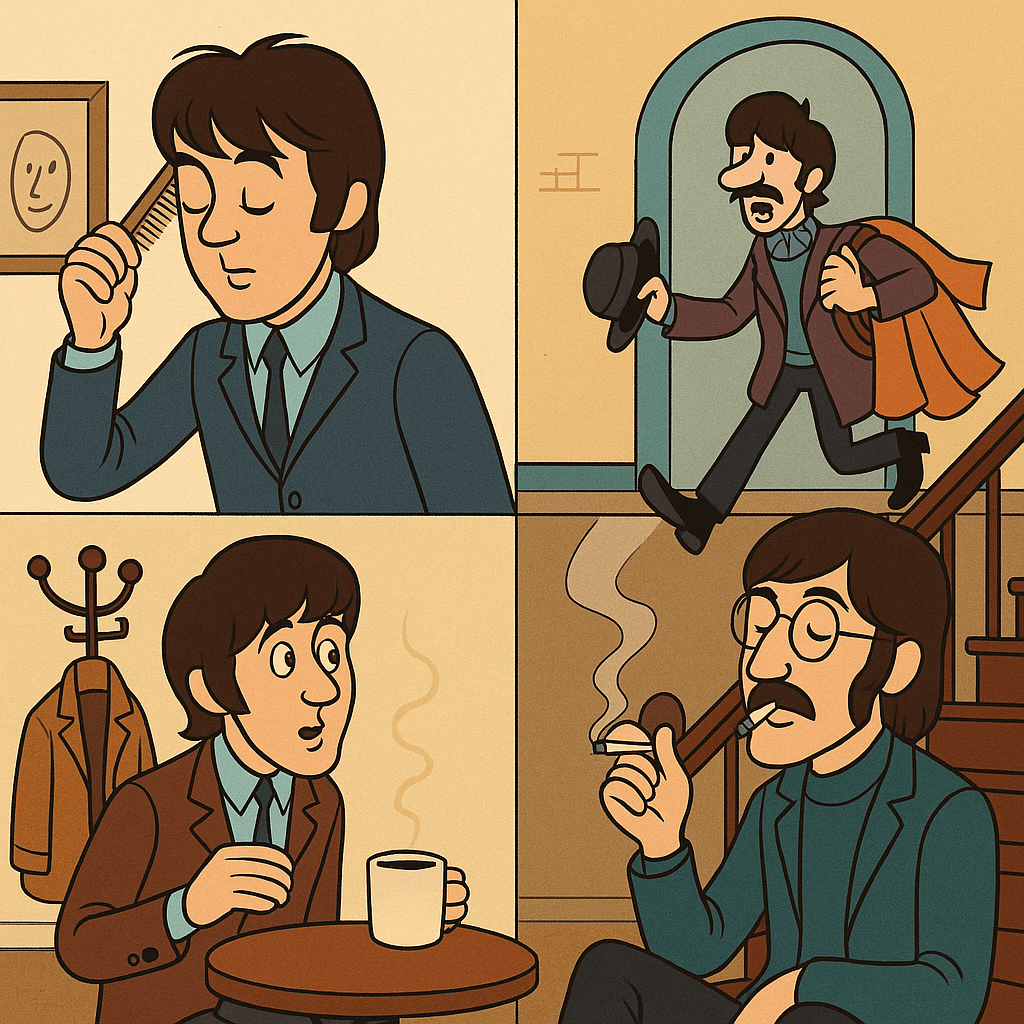
    Found my coat and grabbed my hat, Made the bus in seconds flat.
    The Beatles, “A Day in the Life”

    Even in 1967, Lennon and McCartney captured the frantic pulse of modern life. If that was fast forward, today we live in hyper-speed.

    People are burning out. Relationships are strained. Families falter. And for some, their most consistent companion is a phone, tablet, or video game.

    As a therapist, I’m often asked how to navigate this constant rush—too many responsibilities, too many places to be, and never enough time. Any crisis or transition throws the entire system into chaos. The answer I offer, tailored slightly per person, always returns to the same foundation. It’s simple to say—but practicing it is where the shift begins.

    Pay Attention. Be Aware. Have Acceptance, Be Mindful.

    Pay attention—to you. What are you doing and why? What drives your schedule, your responsibilities, your pace? Are you someone who can’t say no? Are you trying to impress someone—a parent, a boss, a partner? Are you afraid of what will happen if you slow down? Are you overcompensating for something, giving your kids everything you didn’t have, believing more is better?

    What drives you? What behaviors are rooted in that drive? Are they healthy—or are they draining the life out of you?

    Be aware. Notice the patterns that keep failing you. Staying up too late and feeling terrible in the morning? Grabbing a double espresso and then snapping at your coworkers? Signing your kids up for everything and ending up exhausted in a carpool circuit? Maybe you’re a creative soul forcing yourself into a rigid, linear mold without the tools to cope.

    We all have mindless behaviors—habits that keep us spinning. Take a few quiet moments each day. You don’t need an hour. Just enough to notice what you do on autopilot. Ask yourself: Is there a better way?

    And then, own your thoughts, your choices, your life. Blaming someone else for your reactions only prolongs the cycle. Your inner world belongs to you.

    Have acceptance. This is your life, as it is today. Maybe it’s messy. Maybe it’s far from what you planned. But it’s yours.

    Even if tragedy or trauma shaped it, what you do with that shape is up to you. Accept the parts you cannot change. Let go of gossip, comparison, chronic complaining—none of these lighten the load. They only muddy the mind.

    Drop the self-judgment. Words like should, must, bad, stupid, failure—they weigh more than you think. They don’t motivate, they demoralize. When something isn’t working, accept it. Then do what you can with what you have, right now. This moment is all you’re guaranteed.

    Angry at the driver going slow in front of you? That’s your problem, not theirs. Maybe your own rush caused the tight squeeze in the first place. Breathe. Let it go.

    Be mindful, not mindless. Find meaning in small things. Even in hardship, there’s often one thing worth noticing—worth being present for.

    Take five minutes today. Sit somewhere quiet—preferably in nature. Listen. Smell. Feel. See. Let stillness enter the storm. Know that peace is available, but it begins within.

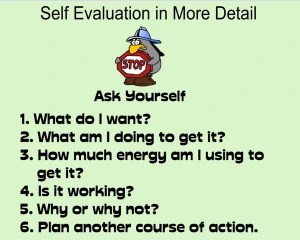
    Ask yourself: What do I truly want? Is there a gap between that and what I’m doing? Then, gently begin to close the gap.

    This is your life. No one else can live it. Own it. Shape it. Live it.

    (If you are having life concerns and need help, I suggest you find a therapist in your area to help)

  • Who Are You? Quiz Time!

    Everyone of us is need based:

    I’ve said before that ALL BEHAVIOR (Everything you think, feel, and do) is based on your experiences, perceptions, and your deepest needs.

    We all have the same needs, but in different degrees. Someone may have strong love and belonging needs while another has strong survivalist needs.

    To understand your behaviors, figure out which universal need is your strongest. In doing so, you can get an ah-ha about your thoughts, feelings, and actions. In doing this, you can open yourself up to new experiences and understanding to hopefully make healthy choices in your life to get your need(s) met. You can have more than one strong need.

    EVERYONE HAS THE SAME NEEDS IN DIFFERENT DEGREES

     Love and belonging

    Power

    Freedom

    Fun

    Survival

    Purpose in life (spiritual)

     Below are examples of behaviors you might see in someone with a high degree of need in a specific area.  See if you can find yourself. Beside each behavior, place a number based on whether it fits you. At the end of each section, count up the points and see in what order your universal needs stack up.  (These are ONLY SOME examples of typical behaviors)

      Scoring:

    1 = Not me at all

    2 = Maybe relates to me but very rarely

    3 = Relates to me but only under certain circumstances

    4 = I do this more often than not

    5 = This is me, no question

    LOVE AND BELONGING 
    Enjoys social activities 
    Cooperative with others 
    Likes to belong to clubs, groups, community events 
    Seeks out friendships 
    Family is very important 
    Craves intimacy 
    Self esteem derived from what others think of them 
    Feel lonely and/or depressed if not involved in a greater cause or group 
    Strives to please others 
    Puts others needs before their own 
    Has many friends 
    Teacher’s/boss’s pet 
    Tends to be affectionate 
    More likely to be a follower then leader 
    Strives to find others needs and to fill them 
    High need to be liked by others 
    Hard time saying NO 
    Purpose in life is in ability to help others 
    POWER 
    High achiever 
    Competitive 
    Desires recognition for achievements/ skills 
    Strong will for self-worth 
    Needs to win at games 
    Needs to feel correct 
    Pride in completing challenging goals 
    Enjoys being highly skilled 
    Need to dominate situations/and or people 
    Over achiever 
    Involvement in political/social activist activities 
    Aggression 
    Involvement in behaviors that make the person feel stronger/invincible (excessive drinking, fighting, risk taking behaviors)   
    Wants to be influential 
    Need to be affiliated with other people at the top of their game 
    Desires to gain higher education to feel better about self 
    Sexually aggressive 
    Gives up family/friends to climb their career ladder 
    Has a hard time being told they are wrong 
    Prefers independent sports as opposed to team sports 
    FREEDOM 
    Desire to make their own choices 
    Does not want responsibilities  to tie them down 
    Does not like to listen to people in authority 
    Strives to be their true selves regardless of consequence 
    Does not want to make commitments 
    Does not give in to peer pressure 
    Independent 
    Likes to choose their own path 
    Likes to be seen as outside the box 
    Likes to keep their opinions open and not make decisions 
    Craves spontaneity 
    Enjoy independent thinking and creativity 
    Not satisfied with other’s answers, needs to find things out on their own 
    Restrictions make them restless 
    Likes to be self-sufficient 
    Bores easy with daily routines 
    Relates to other’s needs for freedom 
    Creative expressionism 
    Does not do well maintaining or seeing need for planning 
         
     FUN 
    Likes to throw parties 
    Craves the energy of new/adventurous things 
    Likes to be around other people with common interests 
    Can be indiscriminate  
    Pleasure centered 
    Easily bored with daily routines 
    Does not take self/life too seriously 
    Enjoys playing but does not need to be competitive 
    Humorous 
    Willing to break tradition for fun, excitement, joy  
    Searches for humorous things/people/events 
    Can bore easily in long term relationships 
    Likes to travel to learn and experience new things 
    Creative for pleasure and not for completion of a project 
    Craves originality 
    Does not like confrontation 
    Enjoys learning in nontraditional ways 
    Can be seen as always on the go 
    Enjoyment of life is seen as most important 
    SURVIVAL 
    Fears for the future 
    Stores or hordes food/water/survival tools 
    Low trust of others/government 
    Fears losing their freedoms 
    Needs to feel prepared for anything 
    Typically very tense 
    Fears the unknown 
    Very observant 
    Instinctive 
    Self efficient 
    Can become impulsive, aggressive is threat of survival is challenged 
    Can be considered primitive in thinking/living (so busy concern about surviving all else is put to the side) 
    Strong ego, pits self against others 
    Can be seen as greedy 
    Needs things to be predictable to feel safe 
    Sees threats where others do not 
    Often intolerant of differences in other people or ways of living 
    Can have conspiracy based thinking 
    Feels insecure/anxious inside 
    PURPOSE DRIVEN (SPIRITUALITY) 
    Desires to be closer in relationship with higher being/power/element 
    Explores self/meaning of life 
    Needs purpose in life to feel whole 
    Can become judgmental and self-righteous 
    Can be religious/external doctrine focused 
    Can fears doing the wrong thing or for the wrong reason 
    Can  be existential and altruistic 
    May break from tradition to explore other cultural spiritual practices 
    Maybe willing to give up much to gain spiritual wisdom 
    May have complex rituals of behavior to feel closer to a higher power or their true being 
     May seek out paranormal experiences or classify experiences as miracles, demonic or other worldly 
    May refuse to conform to society norm of religious or doctrine related thoughts, dictates 
    Can be more tolerant of differences in people and cultures then average person 
    May have experienced one or more profound mystical, paranormal or other worldly event 
    May seek out others who share similar experiences or views of life and/or  a higher power 
    May seek and find spiritual values/meaning in life based on nature/science 
    May engage in experimental/chemical/risk taking behaviors to find a feelings of nirvana or out of body experience   
    Attempts to fill voids in life/past through higher thoughts/learning/spiritual education/practice 
    May extend need for meaning of  one’s life to reason and causation for universe and life in general 

     Total scores:

     Love and Belonging: _________

     Power: _________

     Freedom: __________

     Fun: ___________

     Survival: ____________

     Purpose of Life (Spirituality): __________

    Ask someone close to you to take the same quiz and compare the results. It may help explain why you gravitated toward them or why there are conflicts between the two of you.

    Let’s say you have a strong love and belonging and someone else has a strong freedom need. Can you see how these two people might have misunderstandings and conflicts? Once you know the needs, why the person chooses the behaviors they do, it gives an opportunity to communicate to find a common ground that meets both needs.

     ** Information based on the work of Dr. William Glasser

  • The Healthy Relationship Part 4: What do I Really Want and How do I Get it?

    I’ve been breaking down basic rules for healthy relationships. In Part 3 we looked at identifying our NEEDS. Now we need to explore our WANTS.

     Ask someone what they want and often they can give you a very quick definitive answer.  But is that answer REALLY what they want?

    I can say, “I want chocolate chip cookies.”  This sounds simple enough; however, it really isn’t. In this particular case, I’m watching television and I’m anxious about a meeting I’m having in the morning. I’m not hungry or deprived of sweets but chocolate chip cookies are what hits me that I want.

    Knowing what I know about myself and human behavior, I know chocolate chip cookies are not really what I want. I don’t want the calories or the mess of making them. I’m not hungry. So, I start to dissect this WANT. Broken down, it looked like this:

    • I want chocolate chip cookies, more specifically
    • I want chocolate, more specifically
    • I want to stop feeling anxious, more specifically
    • I want to not go to this meeting tomorrow, more specifically
    • I want to feel I have more control over the outcome of tomorrow’s meeting, more specifically
    • I want to feel more confident in my ability to handle the unknown of tomorrow’s meeting

     Why is this important to me? Because I see myself as self-reliant, intelligent and due to my past, I have a strong need to feel in control.  When I get into situations where I can’t be or do these, I get anxious and feel out of balance. I need to do something to feel back into balance.

    As I’m watching TV, my brain jumps to the old stand-by, carbohydrates! They are the building blocks of changing the body chemistry for a short period of time. Will chocolate chip cookies help me feel self-reliant, intelligent and in control? NO! They will only make me feel fatter and give me more dishes to clean.  Making and eating chocolate chip cookies is a horrible plan to get my needs and wants met. It’s time to plan another strategy. Instead of cooking and eating chocolate chip cookies, I can take that energy and plan a healthier way to prepare for this meeting.

     When you know your real wants, you can better evaluate what behaviors you are choosing to accomplish your want.  So, step one is to EXPLORE what your REAL WANT is. Step two is to EVALUATE if the behaviors you are choosing will get you closer to that goal. Step three, if the answer to step two is no, INVESTIGATE other options. Get more information. Think about in the past, what you might have done that did work in a similar situation. Step four, make a PLAN and follow through.

    In my case, I had to address the demons in my thinking. I had to explore the negative images and thoughts I was allowing to run amok in my brain. My poor body was only reacting to my thoughts. The result was anxiety and the desire to feel better through food.  I also had to relax, journal and start saying a positive mantra.

    Patterns of behavior do not change overnight, but you have to start somewhere. I was still anxious, but much more in control of me, feeling more self-reliant because I took the steps and therefore feeling more intelligent and back in balance.

    If your behavior (thinking, feeling or acting) does not get a need met or a want achieved, a re-evaluation is in order. More than likely, what you think you want is only the surface-want or you are using the wrong behaviors to get you there.  Dig a little deeper and do the steps.

  • Sorry, the Life you Wanted is Currently Out of Stock

    Have you ever wondered if people in developing countries spend time dreaming about “something better”? Or is this constant questioning—this hunger for more—a distinctly Western habit, born of comfort, choice, and relentless comparison?

    I first learned to long for something more when I saw Cinderella as a child. The girl in rags, waiting to be rescued from misery, dreaming of a love that would change everything. Or Casper—the lonely ghost who just wanted to be accepted and loved. If I really thought about it, I could name a hundred stories with the same core message: there must be something better out there.

    But how do we decide when “what we have” isn’t enough? In my work as a therapist, I’ve seen people thrive in hardship and suffer in abundance. It seems happiness isn’t about circumstances—it’s about mindset.

    We hear sayings like, “When life gives you lemons, make lemonade.” But what if you don’t want lemonade? What if you want mangoes or chocolate cake or something no one ever offered you? Is the quest for more a refusal to settle—or an inability to accept?

    Maybe it’s not about choosing between reaching for more and embracing what is. Maybe the real trick is balancing both.

    I’ve met people living with far fewer material resources—like in North Africa or Haiti—who radiate joy. Is that joy selective, performative, or real? Maybe they’ve learned to be content while still holding hope. Maybe they’ve mastered the paradox that trips so many of us up.

    Because the truth is, some people will always chase “what’s next,” and others will find deep satisfaction in the present. The happiest lives may not be the ones that had the most—but the ones that struck a balance between striving and surrender.

    So if you’ve ever been told, Sorry, the life you wanted is out of stock, you still have choices. You can keep hoping, keep growing. You can pour your dreams into the life you already have. Maybe that’s not settling. Maybe that’s the truest form of freedom.

  • Houston, We Have A Problem

    The oh sh-t moment when life goes from wonderful to dread and we have to act fast. We all have them. Sometimes we handle the situation well and other times, well, we ponder for decades what we could have done differently. Can a person truly be prepared for those problematic moments?

    We are all basically hard wired the same way. Note the word basically. It is rare in life when things are one-hundred percent. There are four things we are programmed to do in emergencies. They are flee, fight, freeze or flop. Pretty easy to understand. To flee is to run away from the situation. To fight is to attack the situation head-on. To freeze is to become paralyzed and not able to do much of anything. To flop is to faint.

    Which of these tactics a person picks may be the same in all emergencies or can change depending on the circumstances. A woman who suddenly has the strength to lift a car off her child (to fight), might not attack an intruder inside her home. Can we know in advance which behavior we will chose?

    Hard to say. The military trains our troops by using repetition. Instilling into them, this is what you do in the following situation. The lives of these people depend upon it. Firefighters, police officers and all other careers where lives are at stake do the same thing. But even then not everyone is able to follow that programming when needed. Why not?

    It comes back to all our past experiences. Those experiences become chemical memories in our brains. When a situation occurs similar to a past situation, the brain compares it and acts based on what worked before. No matter how much training a person has, there are times the old experiences will over-ride the current situation. Why? Because, training that your life is in danger is very different from it truly being in danger.

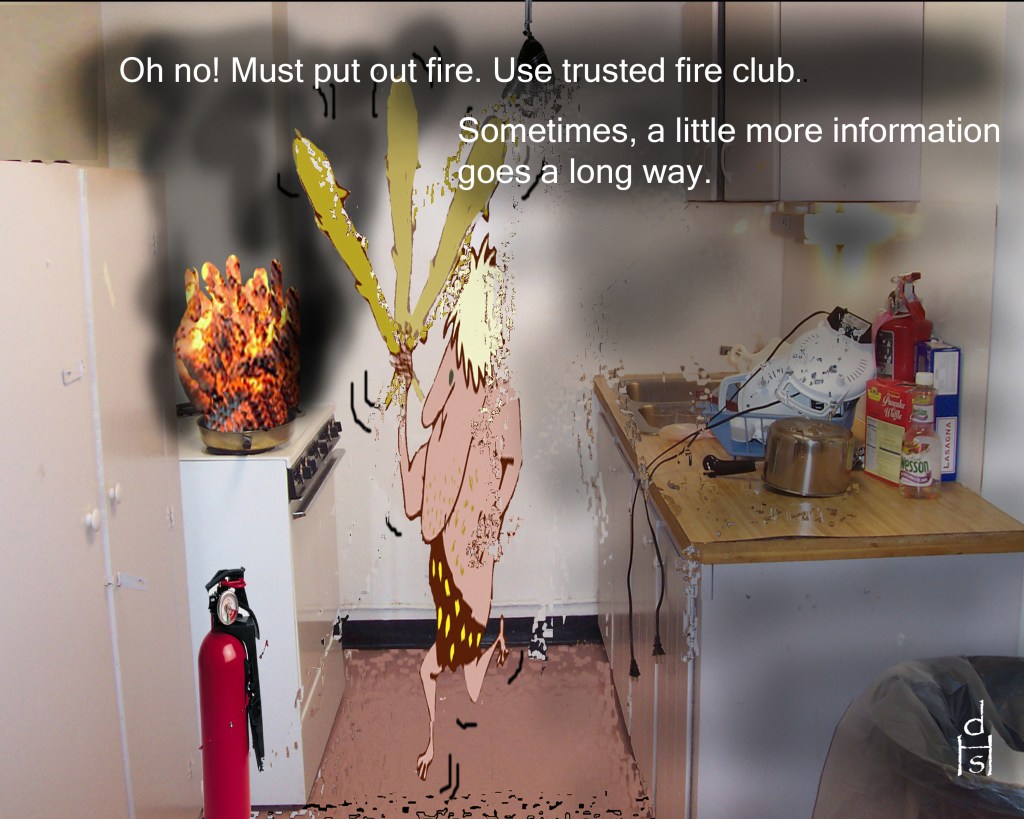
    Having said that, there are times, sometimes humorously, when our reactions are way off the mark. Like the picture above where the caveman is using a club to put out a fire. The fire extinguisher is right beside him. This is where feelings step in. Fear, panic and anxiety all play a role in how effective we will behave in an emergency.

    Stress produces the same type of reaction. The brain thinks there is a problem. It is either a possible emergency or real emergency and tells us to react. As a result our reactions maybe over the top for the situation. Think about the person who gets road rage because he/she is running late and the person in front is going the speed limit.

    Next time you know you are feeling stressed and you find yourself over-reacting (flee, fight, freeze or flop), try to pull yourself together and regroup before reacting. Good questions would be, why am I reacting this way? Is the danger real? How realistic is my thinking? The one I like the best comes from my husband. He says to me, “I think you are reacting to things not in evidence.” Meaning, I’ve either got the cart before the horse or I believe I know what is going to happen without having a crystal ball.

    None of us have true knowledge of the future but some of us think we do and base much of our choices and behaviors on this illusion. It can’t be done.

    Here’s hoping you have a reaction appropriate day.