Tag: mental-health

  • Who Are You? Quiz Time!

    Everyone of us is need based:

    I’ve said before that ALL BEHAVIOR (Everything you think, feel, and do) is based on your experiences, perceptions, and your deepest needs.

    We all have the same needs, but in different degrees. Someone may have strong love and belonging needs while another has strong survivalist needs.

    To understand your behaviors, figure out which universal need is your strongest. In doing so, you can get an ah-ha about your thoughts, feelings, and actions. In doing this, you can open yourself up to new experiences and understanding to hopefully make healthy choices in your life to get your need(s) met. You can have more than one strong need.

    EVERYONE HAS THE SAME NEEDS IN DIFFERENT DEGREES

     Love and belonging

    Power

    Freedom

    Fun

    Survival

    Purpose in life (spiritual)

     Below are examples of behaviors you might see in someone with a high degree of need in a specific area.  See if you can find yourself. Beside each behavior, place a number based on whether it fits you. At the end of each section, count up the points and see in what order your universal needs stack up.  (These are ONLY SOME examples of typical behaviors)

      Scoring:

    1 = Not me at all

    2 = Maybe relates to me but very rarely

    3 = Relates to me but only under certain circumstances

    4 = I do this more often than not

    5 = This is me, no question

    LOVE AND BELONGING 
    Enjoys social activities 
    Cooperative with others 
    Likes to belong to clubs, groups, community events 
    Seeks out friendships 
    Family is very important 
    Craves intimacy 
    Self esteem derived from what others think of them 
    Feel lonely and/or depressed if not involved in a greater cause or group 
    Strives to please others 
    Puts others needs before their own 
    Has many friends 
    Teacher’s/boss’s pet 
    Tends to be affectionate 
    More likely to be a follower then leader 
    Strives to find others needs and to fill them 
    High need to be liked by others 
    Hard time saying NO 
    Purpose in life is in ability to help others 
    POWER 
    High achiever 
    Competitive 
    Desires recognition for achievements/ skills 
    Strong will for self-worth 
    Needs to win at games 
    Needs to feel correct 
    Pride in completing challenging goals 
    Enjoys being highly skilled 
    Need to dominate situations/and or people 
    Over achiever 
    Involvement in political/social activist activities 
    Aggression 
    Involvement in behaviors that make the person feel stronger/invincible (excessive drinking, fighting, risk taking behaviors)   
    Wants to be influential 
    Need to be affiliated with other people at the top of their game 
    Desires to gain higher education to feel better about self 
    Sexually aggressive 
    Gives up family/friends to climb their career ladder 
    Has a hard time being told they are wrong 
    Prefers independent sports as opposed to team sports 
    FREEDOM 
    Desire to make their own choices 
    Does not want responsibilities  to tie them down 
    Does not like to listen to people in authority 
    Strives to be their true selves regardless of consequence 
    Does not want to make commitments 
    Does not give in to peer pressure 
    Independent 
    Likes to choose their own path 
    Likes to be seen as outside the box 
    Likes to keep their opinions open and not make decisions 
    Craves spontaneity 
    Enjoy independent thinking and creativity 
    Not satisfied with other’s answers, needs to find things out on their own 
    Restrictions make them restless 
    Likes to be self-sufficient 
    Bores easy with daily routines 
    Relates to other’s needs for freedom 
    Creative expressionism 
    Does not do well maintaining or seeing need for planning 
         
     FUN 
    Likes to throw parties 
    Craves the energy of new/adventurous things 
    Likes to be around other people with common interests 
    Can be indiscriminate  
    Pleasure centered 
    Easily bored with daily routines 
    Does not take self/life too seriously 
    Enjoys playing but does not need to be competitive 
    Humorous 
    Willing to break tradition for fun, excitement, joy  
    Searches for humorous things/people/events 
    Can bore easily in long term relationships 
    Likes to travel to learn and experience new things 
    Creative for pleasure and not for completion of a project 
    Craves originality 
    Does not like confrontation 
    Enjoys learning in nontraditional ways 
    Can be seen as always on the go 
    Enjoyment of life is seen as most important 
    SURVIVAL 
    Fears for the future 
    Stores or hordes food/water/survival tools 
    Low trust of others/government 
    Fears losing their freedoms 
    Needs to feel prepared for anything 
    Typically very tense 
    Fears the unknown 
    Very observant 
    Instinctive 
    Self efficient 
    Can become impulsive, aggressive is threat of survival is challenged 
    Can be considered primitive in thinking/living (so busy concern about surviving all else is put to the side) 
    Strong ego, pits self against others 
    Can be seen as greedy 
    Needs things to be predictable to feel safe 
    Sees threats where others do not 
    Often intolerant of differences in other people or ways of living 
    Can have conspiracy based thinking 
    Feels insecure/anxious inside 
    PURPOSE DRIVEN (SPIRITUALITY) 
    Desires to be closer in relationship with higher being/power/element 
    Explores self/meaning of life 
    Needs purpose in life to feel whole 
    Can become judgmental and self-righteous 
    Can be religious/external doctrine focused 
    Can fears doing the wrong thing or for the wrong reason 
    Can  be existential and altruistic 
    May break from tradition to explore other cultural spiritual practices 
    Maybe willing to give up much to gain spiritual wisdom 
    May have complex rituals of behavior to feel closer to a higher power or their true being 
     May seek out paranormal experiences or classify experiences as miracles, demonic or other worldly 
    May refuse to conform to society norm of religious or doctrine related thoughts, dictates 
    Can be more tolerant of differences in people and cultures then average person 
    May have experienced one or more profound mystical, paranormal or other worldly event 
    May seek out others who share similar experiences or views of life and/or  a higher power 
    May seek and find spiritual values/meaning in life based on nature/science 
    May engage in experimental/chemical/risk taking behaviors to find a feelings of nirvana or out of body experience   
    Attempts to fill voids in life/past through higher thoughts/learning/spiritual education/practice 
    May extend need for meaning of  one’s life to reason and causation for universe and life in general 

     Total scores:

     Love and Belonging: _________

     Power: _________

     Freedom: __________

     Fun: ___________

     Survival: ____________

     Purpose of Life (Spirituality): __________

    Ask someone close to you to take the same quiz and compare the results. It may help explain why you gravitated toward them or why there are conflicts between the two of you.

    Let’s say you have a strong love and belonging and someone else has a strong freedom need. Can you see how these two people might have misunderstandings and conflicts? Once you know the needs, why the person chooses the behaviors they do, it gives an opportunity to communicate to find a common ground that meets both needs.

     ** Information based on the work of Dr. William Glasser
  • The Healthy Relationship Part 4: What do I Really Want and How do I Get it?

    I’ve been breaking down basic rules for healthy relationships. In Part 3 we looked at identifying our NEEDS. Now we need to explore our WANTS.

     Ask someone what they want and often they can give you a very quick definitive answer.  But is that answer REALLY what they want?

    I can say, “I want chocolate chip cookies.”  This sounds simple enough; however, it really isn’t. In this particular case, I’m watching television and I’m anxious about a meeting I’m having in the morning. I’m not hungry or deprived of sweets but chocolate chip cookies are what hits me that I want.

    Knowing what I know about myself and human behavior, I know chocolate chip cookies are not really what I want. I don’t want the calories or the mess of making them. I’m not hungry. So, I start to dissect this WANT. Broken down, it looked like this:

    • I want chocolate chip cookies, more specifically
    • I want chocolate, more specifically
    • I want to stop feeling anxious, more specifically
    • I want to not go to this meeting tomorrow, more specifically
    • I want to feel I have more control over the outcome of tomorrow’s meeting, more specifically
    • I want to feel more confident in my ability to handle the unknown of tomorrow’s meeting

     Why is this important to me? Because I see myself as self-reliant, intelligent and due to my past, I have a strong need to feel in control.  When I get into situations where I can’t be or do these, I get anxious and feel out of balance. I need to do something to feel back into balance.

    As I’m watching TV, my brain jumps to the old stand-by, carbohydrates! They are the building blocks of changing the body chemistry for a short period of time. Will chocolate chip cookies help me feel self-reliant, intelligent and in control? NO! They will only make me feel fatter and give me more dishes to clean.  Making and eating chocolate chip cookies is a horrible plan to get my needs and wants met. It’s time to plan another strategy. Instead of cooking and eating chocolate chip cookies, I can take that energy and plan a healthier way to prepare for this meeting.

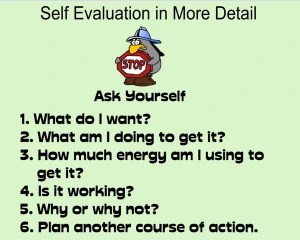
     When you know your real wants, you can better evaluate what behaviors you are choosing to accomplish your want.  So, step one is to EXPLORE what your REAL WANT is. Step two is to EVALUATE if the behaviors you are choosing will get you closer to that goal. Step three, if the answer to step two is no, INVESTIGATE other options. Get more information. Think about in the past, what you might have done that did work in a similar situation. Step four, make a PLAN and follow through.

    In my case, I had to address the demons in my thinking. I had to explore the negative images and thoughts I was allowing to run amok in my brain. My poor body was only reacting to my thoughts. The result was anxiety and the desire to feel better through food.  I also had to relax, journal and start saying a positive mantra.

    Patterns of behavior do not change overnight, but you have to start somewhere. I was still anxious, but much more in control of me, feeling more self-reliant because I took the steps and therefore feeling more intelligent and back in balance.

    If your behavior (thinking, feeling or acting) does not get a need met or a want achieved, a re-evaluation is in order. More than likely, what you think you want is only the surface-want or you are using the wrong behaviors to get you there.  Dig a little deeper and do the steps.

  • Toddlers Found Amid Bloodbath – When Children Experience Trauma

    The headline read: Toddlers found Amid Bloodbath. Four-year-old Amy and two-year-old Abbey (not their real names), had witnessed the murder/suicide of their parents.  The girls were rescued a day later playing around their dead parents. The police were able to place the children with extended family thought they could cope. They were wrong.

    Amy, once toilet-trained, started soiled her pants on a regular basis. Abbey started sucking her thumb and refused to leave her sister’s side. For reasons no one could understand, the two would suddenly become enraged and on one occasion Amy lunged at her uncle (the current guardian) with a kitchen knife lacerating his leg. Both girls asked frequently, when their parents were coming back. Amy on occasion, would become nauseated and vomit when she would walk in and see her aunt preparing raw meat for dinner.  Neither girl slept well and night terrors accompanied with screams that woke the entire house occurred weekly. When they played, the themes were often violent with toys being destroyed and their behaviors escalating into physical fights between them. Abbey refused to be held, would cry a lot and bite herself.  Amy refused to play with other children and her daycare provider said she sometimes resembled a trapped animal that lashed out when you tried to come near her.  

    Their home placement quickly became jeopardized as the already distraught family was not prepared for, nor did they understand, what was occurring. The result, the children ended up in foster care, with a family that had wonderful intentions but was not properly trained on what to expect from traumatized children, how to help them and how to cope.

    From the family’s perspective the children should have been relieved and happy to be in a loving, caring environment. They became very confused and angered with the girl’s behavior did not match what they expected. They returned the children to the county for another placement. This happened several times before the girls ended up with a specialized foster care family who already had four special needs children.

    The girls were seen by multiple counselors/therapists and doctors. Many of which did not have specialized training in helping children who have been traumatized.  By the time the girls were ready to go to middle school, they were separated, living in different homes (the fifth for Amy and the eighth for Abbey), were promiscuous, hard to handle, occasionally heavily drugged by well-meaning doctors and their school performance was very poor with frequent suspensions. 

    This is a horrendous story. It is horrendous because the children experienced such a horror. Worse because no one knew information to help understand the natural reactions the children were having as a result of the events they experienced.  By the time I got the case, years of compounded stress and trauma had to be unraveled.

    There is an old myth that children are very resilient that they bounce back from adversity better than adults. Notice I said myth. Children are just as traumatized and reactive as adults to traumatic events. Children, however, often present different then their adult counterparts.

    To the unaware adult, the child is acting out, being obstinate, not reacting to the events. The child typically is not able to sit down and tell you or debrief the events the way an adult can.  Depending on their age, children are not able to verbally process the events and their meaning due to limited cognitive development. For example, children do not have a concrete understanding of death as being final until around age ten.

    The case with Amy and Abbey is extreme; however, traumas do occur frequently to children. Divorce, child and domestic abuse, school bullying, parents who are involved in severe drug and alcohol abuse, deaths or serious illness in the family, loss of income of a parent, moving to a new school and home. All these and many more are examples of events that are very stressful and at times traumatic enough to cause severe reactions in a child.

    It is important to anyone with a child who has or is currently stressful and/or traumatic or who work with children to understand the nature of trauma on a child to learn ways children express and process these events.

    The brain acts like a movie camera during a traumatic event. It will record the images, sounds, smells and touch feelings associated with it. This occurs so the brain can figure out how to react for protection. Integrate this into the person to make sense of the event.  How to self protect if it happens again or try to prevent it from happening again.  The behaviors you see in a child are the outward manifestations of these attempts.

    Here are some of the behaviors you may find in children coping with extreme stress and or trauma in their life.

    1. Children will typically digress in their developmental levels (forget learned behaviors like toilet training, talk babyish, need stuffed animals to sleep, night lights, want more cuddle time, forget how to do skills learned in school)
    2. Nightmares, night terrors, sleep walking, sleep talking, refusing to go to bed or sleep.
    3. Refusing to eat, over eating, nauseated at certain foods, craving certain foods such as feel good foods, wanting a pacifier or bottle fed.
    4. Refusing to go to the bathroom, soiling their clothing, smearing feces, obsessive masturbating.
    5. Aggressive or violent behaviors, crying spells and tantrums.
    6. A drop in school performance, decrease in grades, acting out in school, not wanting to go to school.
    7. Moodiness, bursts of anger, crying spells, moppyness, laughing inappropriately, pulling out hair, twirling hair, pulling out eye lashes or eye brows, hurting themselves on purpose, clumsiness or accident prone.
    8. Flashbacks (experiencing the trauma event as if it is currently happening), responding to things that remind them of events (the blood of raw meat for someone who witnessed a bloody event).
    9. Promiscuousness, early involvement with smoking, drugs and alcohol, deviant behaviors, abuse of others, abuse of self, disrespect for adults or specific adults.

    If extreme stresses or a traumatic event happens to your family, your child or a child in your care, note these reactions. Do not assume the child will manage without help. It is better to act as if need is eminent then to ignore the potential as behaviors of a child’s distress may not show up right away. It may take days or weeks to show. There are times where the child appears to do well and after they reach a more developed cognitive ability (the older they get) their mind will once again address what they experience and this is when you may see behaviors develop. The sooner the child is able to get help, the better things will be for them.

    Use the services of school counselors, professional counselors/therapists (make sure they are trained in childhood trauma if trauma is the issue), a doctor’s care maybe necessary as well. Learn all you can about how severe stress and trauma affects children and incorporate this for the children in your care.  If you are also a part of the extreme stress or trauma, remember that you are also struggling on various levels. Take care of yourself.

    Extreme stress and trauma can occur in anyone’s life. Be prepared if you have or work with children. Know the signs and how to get help. The emotional health and well being of a child may depend on it. 

  • Sorry, the Life you Wanted is Currently Out of Stock

    Have you ever wondered if people in developing countries spend time dreaming about “something better”? Or is this constant questioning—this hunger for more—a distinctly Western habit, born of comfort, choice, and relentless comparison?

    I first learned to long for something more when I saw Cinderella as a child. The girl in rags, waiting to be rescued from misery, dreaming of a love that would change everything. Or Casper—the lonely ghost who just wanted to be accepted and loved. If I really thought about it, I could name a hundred stories with the same core message: there must be something better out there.

    But how do we decide when “what we have” isn’t enough? In my work as a therapist, I’ve seen people thrive in hardship and suffer in abundance. It seems happiness isn’t about circumstances—it’s about mindset.

    We hear sayings like, “When life gives you lemons, make lemonade.” But what if you don’t want lemonade? What if you want mangoes or chocolate cake or something no one ever offered you? Is the quest for more a refusal to settle—or an inability to accept?

    Maybe it’s not about choosing between reaching for more and embracing what is. Maybe the real trick is balancing both.

    I’ve met people living with far fewer material resources—like in North Africa or Haiti—who radiate joy. Is that joy selective, performative, or real? Maybe they’ve learned to be content while still holding hope. Maybe they’ve mastered the paradox that trips so many of us up.

    Because the truth is, some people will always chase “what’s next,” and others will find deep satisfaction in the present. The happiest lives may not be the ones that had the most—but the ones that struck a balance between striving and surrender.

    So if you’ve ever been told, Sorry, the life you wanted is out of stock, you still have choices. You can keep hoping, keep growing. You can pour your dreams into the life you already have. Maybe that’s not settling. Maybe that’s the truest form of freedom.

  • Anyone See Where I Left My Scalpel? Now That’s A Brush With Reality!

    Its 11:11, an hour and ten minutes into my daughter’s five hour spine surgery. I’m sitting with her fiancé, a menagerie of electronic devices to keep me entertained and a fully charged cell phone.

     I’m on level 33 in the game Candy Crush and fiancé is on level 65, not that it’s a competition. Steve Harvey is on the television chattering away about Jack Russell Terriers. I have one of those.  Chicken-dog we call him due to his un-bounding ability to find the most minuscule piece of chicken bone from the trash. No one in the room seems to notice the television exists. No one cares that I have a chicken-dog at home or why I’m sitting in this artificial environment called a waiting room.  I however, cannot say the same about my feelings toward the other people in the room.

    I hear snippets of conversations, small windows into the lives of others, small dramas in adult human packages.  She did well, you can go back; He had problems and will be in recovery another hour; I’ve been here all night and I got a parking ticket; I’m sorry, we need to talk to you in private. Things didn’t go as expected.  This is what I am currently calling my reality.

    I’ve heard that word in different contexts lately making me wonder, what is reality?

    Outside the hospital walls, people continue to rush around grabbing coffee, the latest news, the morning dead-lock on I-83, pushing their kids onto school buses. In here I sit and wonder why it’s taking me so many attempts to get past level 33 in Candy Crush and what fiancé knows that I don’t.  Its easier then thinking that the woman I once spent forty-two hours giving birth to is lying on a table being flayed by a man I’ve met only once.

    Okay, maybe flayed is not the most accurate word. No correct that, this is what I feel, so it is the exact word for my current reality. What is reality? How can my reality consist of one way of life and the next day be completely alien from the day before? Are they the same? Is my reality the same as someone in a country where there is no electricity and my daily existence is spent finding food and fresh water?

    My first inclination is to say, no, they are not the same reality. How can they be? When I think about the veterans returning home after active duty, I think the same thing. How do they wrap their heads around the life they lived overseas in war zones too returning home to, hey, the neighbor cut the hedge too short?  Do something about that.

    My second inclination is to say; yes it is the same reality, only different facets. As quantum physics contemplates the ramifications of string theory, (alternate dimensions in time and space) I think I’ll view reality as a large, loosely woven textile. Twisted, strands of cotton into yarn blended together and the fibers criss-crossing, under and over each other. You pull one string and the whole thing wobbles or comes undone.

    There is a large family in the hallway outside the trauma intensive care ward. From their faces I can tell they are sitting on the edge of threads coming undone if not completely ripped. I make eye contact with their pleading, empty eyes. I can almost hear the word, why, from their minds. Why did this thread have to snag or be cut? I don’t have an answer.

    It’s surreal to see. Daughter’s fiancé and I are walking down the hallway toward the hospital cafeteria. He’s talking about a stock car race and the amount of hours they give him at work. I am flashing back to when I was in the trauma intensive care ward down at Shock Trauma in Baltimore. I can smell the alcohol and hear the doctors and nurses talking as they filleted me open to save my life. I never lost consciousness till the end.

    Daughter’s fiancé does not know my reality just sharply changed course on that textile of life. Nor do I think he caught how close we both just walked around another reality sharply snagged and unraveling as we passed that family in the hallway. A chill goes down my own spine. My spine, intact, closed within the confines of my muscles and skin. I flash to my daughter lying there in surgery.

    Do you think a doctor ever left a tool or cotton wad in someone, I hear someone say while in the cafeteria line. I’m trying to decide on a nice, healthy fish or a piece of cake. I pick up the cake and another cup of really bad coffee. I know medical issues like these happen more times than we might want to think about. After all, we are only human. All on that same piece of fabric that twists and turns under our feet.

    If a surgeon is having a fight with his spouse or had a minor accident on the way to work, do they take that energy into the operating room? Do they get as scatter-brained as I do when things knock me off my routine? If I were surgeon, on days like that, I’d lose my scalpel in someone for sure.

    I can’t handle thoughts like that right now. I grab a second piece of cake in case the first piece is not enough comfort food. I notice fiancé has grabbed three times his normal amount of food for lunch. Nerves, I tell myself. Maybe, he is closer to the unraveled part of the textile then I think.

    Do any of us really know where in reality we are? I don’t have any answers to this either. This cake is really moist; I wonder if they bake it here?

    The nurse tells us my daughter came through surgery well. I sigh in relief. My section of the textile is still raveled and I’m pretty sure the surgeon still has his scalpel. Not a bad day overall.

  • Finding the Land of Oz When Life Blows You Asunder

    I’ve been asked if there are any axioms I use to ground me when life tries to blow me away.  Yes, there are. I use the below axioms all the time when life is sunny. When life gets blustery, I sometimes have to remind myself that they exist.  If I remember and fall back on these axioms, things always turn out for the best.  It might not be the best I would have wanted, but I find myself relatively unscathed or able to bounce back quickly.  Kind of like the wizard in the Oz, The Great and Powerful or another well known film, The Wizard of Oz.

    Restlesswanderer61’s axioms for surviving and thriving:

     1.     The only person I can change is me.

    2.     No matter what life hands me, ultimately I choose how it effects me long term.

    3.     Everyone has the same basic needs, only in different degrees. Love people including myself, even the ones hardest to love.

    4.     Everyone’s behavior is purposeful.  They are the best choices I use or have used (whether healthy or regrettable, knowingly or subconsciously) to find balance. Don’t judge others or myself.

    5.     I am energy at my deepest level and a spiritual being that can connect with anyone and is only limited to the constraints I place around me.  Even if I doubt or don’t believe, I can’t be disconnected from the creator or all of creation. It is no more possible then living without taking in oxygen.

    6.     My brain is a creative and amazing devise. I will strive to develop what is not and prevent my thoughts from running amok.

    7.     People have the most amazing resilience and overcome the incredible horrors. So do I.

    8.     I am not perfect and never will be. There is no such thing as perfect.

    9.     The answers to my problems will ultimately come from me even if I can’t see them currently.

    10.   I have an amazing talent and gift, even when I don’t think so. Everyone has a talent or gift to be tapped to fulfill themselves and the world around them.  Let others shine, take the back seat and clap thunderously at other’s accomplishments no matter how big or small whether I know them or not.

    11.   Never lose my childlike wonder, imagination and desire for play.

    12.   Resistance to issues is futile. Deal with it, don’t repress or pretend it does not exist.

    13.   It’s okay to reach beyond my comfort zone. In fact, I will grow from doing so.

    14.   Strike a balance between being self-absorbed and other-focused.

    15.   There is usually no such thing as the no win scenario. It’s only how to win and what “to win” really means.

    16.   I don’t have to be correct all the time.  Pick my disagreements for when it really matters and let the rest go.

    17.   Everyone has baggage and crap. Mine is no better or worse than someone else’s, only different. Accept it.

    18.   Treat others the way I want them to treat me, even if they don’t.

    19.   Unless I have no food, shelter or loved ones, I have nothing to seriously complain about. My life is fine, no matter what is happening. Be grateful for every person, everything I have and everything that happens to me.

    20.   Be amazed by little things, joyful, laugh often and hard.

    21.   I can make a difference in everyone’s life I meet. Even if it is a small one.

    22.   Have patience. There is a reason things or people are as they are. Watch it unfold and learn.

    23.   Dream big, make goals, explore, learn and strive to make those dreams a reality.

    24.   Be proactive not reactive. This is my life, the only one I have, don’t get to the end and have regrets.  Make each moment count.

    Do you have a list of axioms you follow? If you don’t or are not sure, it might be something to think about. If you have a code you follow that is true, there is no telling the wonderful places it will take you. You are your best and worst enemy. Find balance and find peace not only in times of sun but when the tornado’s in life blows your balloon off course.

  • Repurposing Your Life: Becoming An Improved You!

    I went to the Goodwill store looking for a lamp to re-purpose.  I really enjoy combing through flea-markets and second-hand shops to find elements of objects discarded to make something new. Something I create to be meaningful or purposeful to me.

    I found a lamp, bought it. That afternoon I water colored the shade in hues of green. I realized, this object transformation was symbolic of my life and what I help others do – Re-purpose their lives. Life will always give reasons to step back and ask questions like: What the hell just happened? Why did this happen to me? What am I going to do now? Who am I as a result of this? Re-purposing helps bring answers to those questions.

    My journey with Post Traumatic Stress (PTSD) catapulted me into demanding answers to those questions. I didn’t think I could function without them. Luckily, a person does not have to endure severe traumas demanding immediate attention. Anyone can have a desire, a spark to find their authentic self and live a fuller, happier, more balanced life.

    People change slowly over time being enhanced or torn down by life’s challenges. Most appear to view this change as outside themselves. They don’t care or they fear looking inward and asking the hard questions. Finding the answers and stepping out into the great unknown. They accept life as it is. The result is often bitterness, anger and depression. This does not have to be. Life happens, yes, but what you do with it makes all the difference in the world – your world.

    Re-purposing takes time and usually happens in stages. As a person learns more about them self and the universe around them, there is an aha moment. My experience is that this is followed by a stewing process. The mind soaks in the information and applies it to everything it knows. The person acts on their new awareness and then it hits.

    New questions arise! Well, if that’s true, then what about this situation? Why did I act that way when I could have done this?  What else have I believed about life that suddenly is not true? What is truth?  The questions become less about the person and more about the world, the universe and the spiritual.

    It might be helpful to look at the journey in terms of cooking or food. At first, it probably seems similar to peeling off layers of an onion. I picked onion because pealing an onion can bring tears and at times not very pleasant. Thoughts and memories, who we have become over time has built around our core like the layers surrounding the core of the onion.  The larger the onion, the more changes, adaptations or layers a person has developed.

    There should come a time when a person can see beyond the onion metaphor and see layers as welcome opportunities for re-purposing, bringing enrichment to their lives.  Life’s journey now becomes more like layers of string cheese, baklava, lasagna, or some other pleasant concoction you can think of. Not as threatening or uncomfortable if done in moderation. It is good to note, that even with pleasant or desired elements of change, too much too soon can cause distress. I really would not recommend sitting down and eating en entire family size lasagna! All things should be done in moderation, which includes re-purposing.

    After a while, the person may no longer find total enrichment and the questions asked of the self changes again. Using the cooking metaphor, questions might revolve around the concern, how can I improve on this recipe? The types of questions are as vast as the grains of rice in a box of Minute Rice.

    Re-purposing time varies from person to person. Some only strive for feeling slightly better, like putting on a band-aid and waiting. Others, like me, spend a lifetime joyfully exploring, learning and becoming. At this point in my journey, the questions are no longer the ones stated above. Some of my current questions are: Where do I go from here? What does this say about me? How can I turn this into something good for myself and others?

    My lamp is now painted, trimmed and assembled. Another human-made element re-purposed for a new beginning, a new life. Aren’t all our experiences in some way, human-made? It’s up to us to do the re-purposing to make our lives the best they can be.

    I offer a challenge to you. Start re-purposing your life. The results are worth the journey. Below I offer some first steps to get you started. If you would like some help, you can check out my e-mail counseling/coaching services. If you are in the area, make an appointment or attend a class. Have a great journey!

    First Steps to Start Re-purposing Your Life:

    1. Get a notebook or journal.

    2. List as many qualities about yourself as you can think of. Ask others for their impute. What do you think/feel about your list?

    3. List things, people or events where you feel/felt: 1) happy: 2) accomplished: 3) loved: 4) experienced freedom: 5) had fun.  Are there any areas where you had a hard time listing things? Some needs that you are falling short in having fulfilled?

    4. What movies, characters, TV shows, music, artists, books do you relate to? Why?

    5. Make a timeline of your life – the goods, bads, neutrals, accomplishments, regrets. Why did you label these in the categories you placed them? Example: Why is difficulty in 3rd grade math a good thing?

    6. Answer the statement: If I had a magic wand, my life would look like… (be specific). Why would you want the elements you picked?

    7. List and evaluate areas of your life where you feel out of balance or unhappy. Why do feel this way about this area? (Try to be inward focused and not “because he made me…”)

    8. Ask yourself, what role do you play in number 7? We always play a role, even if it is not doing anything.

    9. Continue to ask yourself, what do I really want? (see my blog, Life’s Little Instruction Manual, Healthy Relationships Part 4)

    10. Review everything you have written. See if you are starting to understand who you really are, how you got here, the role you play, and where your life is unbalanced. You can’t formulate any goals on making improvements without this base-level structure.

    Congratulations on taking the first steps in re-purposing your life. Job well done! Drop me a comment and let me know how it’s going!

  • Step Away from the Cinnabon and No one Gets Hurt!

    This morning I discovered a wonderful and deadly secret, Burger King now carries Cinnabons.  I love Cinnabons! Until this morning, I could only get them at the airport. Usually, I could resist them, too worried about making my flight or having oozing cinnamon sauce dripping down my chin and shirt.

    Now, I can go less then a mile from my home, sit in my car and indulge in cinnamon-sugar ecstasy.  Burger King has Cinnabons!

    Like a cocaine addict, there I sat. Could have ordered the bacon, egg sandwich or better still, the oatmeal with fruit. No, I ordered Cinnabons, two of them. I deserved them, I told myself. Reasons why, I have no clue.

    I ordered, paid and planned to sit in the parking lot eating them. My napkins in hand for the dribble mess that only a Cinnabon can produce.  I opened the box. Two scrumptious, twisted, doughy circles dripping in brown cinnamon syrup and decadent white icing stared at me. Oh my! 

    My cell phone clock buzzed. I looked at the dash clock. It’s later then I thought. if I sat in the parking lot, I’d be late for my class on spiritual discipline. You know, learn not to over indulge. Keep an even-keel, that sort of thing. So, I have to eat the Cinnabons on the go. What could go wrong?

    I turn out of the Burger King parking lot and the first gob of icing hits my jeans. It’ll wait. I can’t turn, hold a Cinnabon and grab a napkin at the same time. I’m not that coordinated. Not a problem. For the three miles it takes me to get to my class on discipline, I gorge myself on these overly-large, incredibly addictive, way-more-than-I-can-eat rolls. Pleased, that I only have that one glob of icing on my jeans to contend with.

    At my destination, I pulled into the parking lot and found a spot. The rolls are eaten.  Not something to be proud of, but next time, I’ll order the oatmeal. No one has to know I slipped up and once again found myself in a sugary stupor. I’d gotten away with it! Ha, ha, indulge today, disciple tomorrow!

    I garb a napkin to remove the incriminating evidence from my jeans only to find… it is joined by five other considerable larger globs all down my shirt and jeans. Crap! Good thing they gave me many napkins. 

    Did you know napkins adhere to Cinnabon icing globs like flies on flypaper? Napkins ripped, shredding all over my shirt and jeans. I look like a kid just learning how to shave, ending up with toilet paper wads all over their face! 

    I should be in class several minutes ago! How in the hell am I going to clean this up and look dignified? No one is supposed to know I fell off the band-wagon! I wonder if I can lick some of it off. I don’t have any water and drowning myself in caramel-mocha coffee doesn’t seem like the answer!

    There is a knock on my car passenger window. It’s a friend of mine also going to this class. Her gleeful expression quickly turns to confusion. I’d be confused too if I wandered up to her car only to find her sitting there with napkin shreds hanging off globs of icing all over her shirt, hands and pants.

    There is really nothing to say here except, “Burger King now has CInnabons.”  She still looks confused. 

    “I’m not really sure how to help you with this one,” she says. Her head cocks sideways the way my dog does when I’m trying to explain the concepts of karma to him. 

    “That’s okay, I don’t’ know either.”  I wonder if I can claim this as  a new grunge/bohemian look.

    So, I’m going to class wearing shredded napkins and not-strategically placed globs of syrup and icing. A smile on my face. I’m taking responsibility for my actions. I’ll take the consequences, the tisk-tisks, the smirks, and the malaise when this sugar rush crashes. 

    I get out of the car and straighten out my newly decorated shirt and strategically hug my friend who says,  “Wow, you smell like a bakery, like Christmas cookies! That’s not too bad. It could be much worse.”

    And this is why I have her as my friend. Everyone should have friends like this.

    Hello, my name is Deborah Sickle Hill, Burger King has Cinnabons, and I have a problem. Damn good thing I’m taking a class on spiritual discipline.   I think I have a stomachache.

  • Man-Eating Chicken: The Healthy Relationship Vol 5

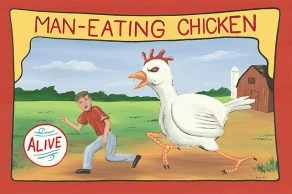
    A sign in an amusement park says; look in peep hole to see a man eating chicken. Now, if you saw that sign what image do you think you’d see through the hole? Is it a man munching out on a piece of chicken? Or is it a large chicken eating a man?

    What about these sentences? The man saw the boy with the binoculars.  Did the man have the binoculars or the boy? Or, how about, hole found in changing room wall; police are looking into it. Are they investigating the incident or looking in the hole?  

    These are called syntactic ambiguities. Why am I telling you all this? Because it is a good demonstration of how our brains perceive the world around us. For every person who sees a man eating a piece of chicken there are probably equal number who see a large chicken eating a man.

    If we want to understand and navigate our behaviors we have to grasp the way our brains see our world.

    Image

    All around us is the Real World. This is everything that exists; no matter if we realize it or not. The real world contains trillions of pieces of information bombarding us constantly. Our brains are not equipped to handle all this so it selects what is most important and screens out the rest. 

    It is generally accepted that there are three filters used to screen select Real World information for our use.  They are called: Knowledge, Values, and Perceptions.

    Whatever information remaining after screening is now evaluated and a decision is made. Either, this information is in-line with our wants and needs and we feel good. This information is neutral and does not matter to us. Or this information is not in-line and may threaten our wants and needs and we feel bad.

    If we decide that the information is in-line and we feel good, we keep our filters screening the same way, and continue to behave based on this information. The system is working well.  However, if the opposite is true, we feel out of balance and our system goes into red-alert. Depending on how far off balance we feel determines how much drastic action we take.  

    For example, let’s say you are watching your child on the swing-set at a local playground.  The weather is good, the park is not crowded, and your child is having fun. You feel good.  All of the sudden, the swing chain brakes and endangers your child. Chances are at this point in time, your brain could care less what the weather is like or how crowded the park is. Instead information such as speed and what angle to leap in order to catch the falling child would be more practical.

    Problems pop-up when we feel bad or out-of-balance and the adjustments we make are not the best.  Our actions could make things worse. They could fix things in the short-run but not long term. Or the adjustments solve what we think is the real issue making us feel out-of -balance when it is another issue deeper down we have not addressed.

    When we feel out-of –balance, we think, feel or do something different to feel better. The next step is, did it work? If not or it did not work the way we hoped, then a change in the information screened through the filters or an adjustment to the filters might be in order.

    The filtering system is one of the easiest ways to get from out-of- balance to in-balance.

    Knowledge Filter: This is a filter that contains pieces of information we already learned. I don’t think all information learned is actually in this filter. I think we have the ability to alter this. For example, I learned my ABCs in pre-school. This is always in my filter because I read and write daily.  I learned to fish when I was four-years-old but never fish. I really don’t think this is in my knowledge filter. But if I pushed myself, I could remember some memory of fishing and probably some terms from hearing others talk of fishing.   

    If the information we are using to filter Real World information prevents us from acting in a way to feel good, get our needs met and be in-balance, we need to search for new knowledge. We can also reassess knowledge we already have and decide what needs to be added or subtracted. 

    This is as easy as someone saying, “Hey, remember back when and you had this happen. You did such-and-such and it worked out. Maybe you should try that now.”

    Your reply, “Oh, I’d forgotten that. I’ll have to re-pull that knowledge and see how it changes my options.” Now you have added old information to your active knowledge filter.

    Values Filter:  This is the, how important is this information to me, filter.  When information enters this filter a value is placed on it. Is it positive information? Information that helps us become balanced, meets our needs? Or is it negative, something that has the potential to prevent or hinder getting our needs met? Some information is neither and we don’t give it a value.  

    Perception Filter: This filter is the very selective, how we see the world based on everything that is us. This includes our gender, culture, experience, sexual orientation, parents, age, race, etc. The amount of inclusions in here can be astronomical.  Because no one is the same as anyone else, each person’s Perception is different. Like the other filters, it can change.  Perspective might be another good word for this area. To change our perspective is to change our perception filter.

    All of the above is then evaluated against what Dr. William Glassier called the Quality World. The QW is sort of like the answer to the magic wand question many therapists ask. If you had a magic wand, what would life be like? In the Quality World we have pictures of how we think we can get our needs met in the most satisfying way. All our filters are balanced to provide the Real World information the system needs to best get to our Quality World picture.

    For example: If I have a high need for love and a low need for power (see prior posting for more details), my Quality World might have a picture of me being adored by family and friends. There is never conflict. I do volunteer work and always put others ahead of my needs. 

    It is probably more specific than this. Maybe, I’m a stay-at-home mother with three adorable, cherub-like kids and a dog named Elmo. My husband, who looks like George Clooney, works as a Podiatrist and I go to the Sisters of Perpetual Mercy Church three times a week.  I make an amazing meat-loaf. It’s to die for.

    That picture is what my brain will use to set my filters and gather information from the Real World. It is through that information, evaluated against my Quality World picture that I will use to behave. I will use it to think, feel and act a certain way. My way, may not be your way.

    Image

    That is why some of us see a man eating a chicken while others see a chicken eating a man!

  • Why I Still Haven’t Painted That Wall

    The universe keeps telling me to slow down—loudly and often. Apparently, I have short-term memory loss.

    This morning started with a doable to-do list. That lasted about 30 seconds. I noticed a water stain on the wall, which reminded me the upstairs needs painting. Since I’m turning that space into an office, it suddenly felt urgent. And that’s when it all unraveled.

    7:30 a.m.
    “Okay, that wall… and that one… and wow, the ceiling? What mood am I going for? Time for a paint color deep-dive!”

    9:00 a.m.
    Two hours later, I’ve selected nothing but somehow watched a YouTube video on belly fat and found myself planning a trip to Lowe’s.

    10:30 a.m.
    In Lowe’s, I get overwhelmed by paint options. Do I want satin or semi-gloss? Quart or gallon? Also, how did I end up in the garden section eyeing Lily of the Valley bulbs?

    11:30 a.m.
    Back home with paint and leftover pizza in the microwave, I head out to the garage to get the roller. Instead, I spot the half-dug hole for a future fish pond and—naturally—start rototilling.

    11:45 a.m.
    I hit a rock, grab a trowel, and find myself digging with archaeological precision (old habits die hard). I find a marble. Then six more.

    Clearly, someone lost their marbles, and I wonder if it’s me.

    12:15 p.m.
    The rototiller hits steel wire and wraps around the axle. I flip the machine over and head to the basement for WD-40, dragging dirt through the kitchen.

    There, I realize I forgot to switch the laundry.

    12:25 p.m.
    Back outside, staring at the broken machine, I finally get it: This is one of those “slow your roll” moments from the universe. So naturally, I decide to blog about it.

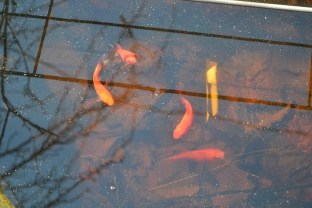
    I grab my camera to document the chaos and end up taking pictures of the fish instead. They’re the real reason I came outside, after all. They survived the winter in an above-ground pond—the least I can do is give them a moment on the internet.

    Sure, getting only three hours of sleep probably didn’t help this morning’s misadventure. But if I’m honest, I’ve done this well-rested too.

    So now I’m making coffee. I’ll take it slow. I still have the afternoon to get something done.

    Maybe I’ll paint.
    Or maybe I’ll finally eat that pizza still waiting in the microwave.