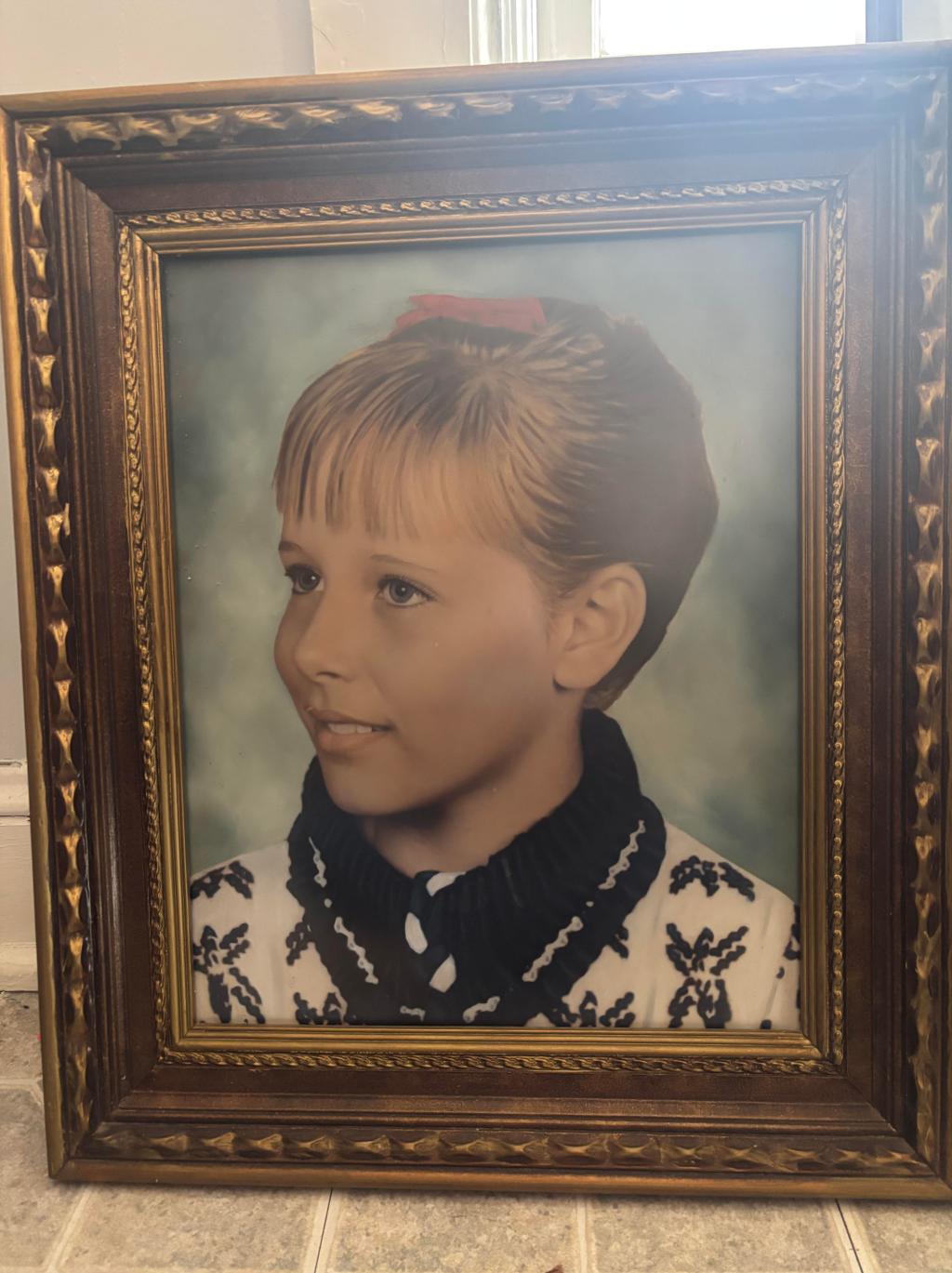
It’s been fifty-seven years since she passed. I keep mementos around my office and bedroom, so she’s never far from my thoughts. About fifteen years ago, I realized I could talk about her and see pictures of her without losing my mind. Our long book of grief was finally closed and set on the shelf. Then I was given the portrait.
A huge school picture, the kind meant for hanging over a fireplace. I’d stared at this picture and longed for it most of my life. Now it sits in my office, still without a place on the wall. Part of me wants to hang it prominently in the living room—but she means nothing to my family. My office? Would that be hiding her away—or finally putting her where she belongs?
Last night, she sat in my living room while we watched TV. I think I spent as much time watching her as I did the screen. Remembering words I never got to say. I was probably much too young to speak them then. Not that I haven’t talked with her over the years—countless hours lying by her grave, telling her about my day, playing our music, and getting lost in our past. My portrait. Her face.
I always thought I should have been the one to pass on, me being the sickly one. Irrational, but a part of me still carries that guilt. Growing up, I wanted to be perfect so I’d get to heaven and see her again. I wanted to be the best to fill the hole her absence left. I was just a kid—I’ve had plenty of therapy since then.
So why am I sitting here now, lightly sobbing? It’s only a portrait that needs a home. But I wonder if I ever told her I loved her—not after the fact, but in the moment, when she could answer back.
It’s been fifty-seven years since she passed, fifteen since I stopped punishing myself. And now this portrait sits here, reminding me that maybe grief isn’t a closed book after all—it’s a story that keeps finding its way back into my hands.
My uncle was dying in a Florida hospital, a thousand miles away. The call came early: Expect the inevitable. Keep your phone close.
He wasn’t just an uncle—he was a second father. But I was home with my daughter, helping her recover from major spine surgery. She needed me. I couldn’t leave.
All day, I juggled logistics, wondering if I could fly down. My mother said, “Let us visit the hospital, then we’ll talk tonight.” But the call never came.
By midnight, my imagination took over. Maybe he’d already passed. Maybe they were too distraught to tell me—like when my sister died when I was seven and I couldn’t say goodbye.
At 12:30 a.m., I half-joked to my daughter, “Maybe he’ll come say goodbye.” I thought of my grandmother’s rocker that moved by itself after she died. Surely my uncle could find a way.
Unable to sleep, I crept downstairs for Lucky Charms, passing my late sister’s Chatty Cathy doll. I pulled out my uncle’s old camera, set it on the table, and cried until empty. Then—a shadow at my feet. I screamed. The milk went flying.
“Meow.” Just the cat.
The phone rang—he was still alive. Instead of relief, I felt emptiness. The next night, the real call came: my uncle was gone. I went numb, then collapsed into wailing.
I’ve seen a lot of grief in my practice, and I know: do whatever healthy thing you need to survive. I let my thoughts spiral. I isolated. Days later, I picked up his camera and started shooting stills while playing childhood music.
My office door swung open. A warm, healing feeling washed over me—comforting, not frightening. I like to think my uncle came to give me a hug. It was what I needed to begin the long, twisting road of healing. Who are you to tell me it was anything different?
IF YOU ARE GRIEVING, KNOW THESE THINGS:
No one grieves the same.
Don’t let anyone tell you you’re taking too long.
Use your support system.
Keep a treasured object.
Write letters to your loved one.
Join a support group when ready.
Seek counseling if you’re struggling—or simply to talk.
Pray, meditate, or find your own way to connect.
If you’re grieving, my condolences. I hope my experience helps you on your journey. —Debbie
Have you ever heard the saying, “Don’t throw out the baby with the bathwater”?
A friend and I have both survived near-death experiences—events that altered us permanently. On long drives, we often dive deep into conversations about spirit, soul, God, and nature. We’ve walked away from rigid dogmas—those rules imposed by religion that demand your belief to belong—and instead, we’ve chased after truth. Real truth. The kind you feel in your bones.
Hence, throwing out the bathwater and keeping the baby.
That mindset often leads us to places charged with meaning. On this particular day, we felt called to Gettysburg National Battlefield.
We took the Taneytown exit just before sunset. As we approached the old Cyclorama, my friend said quietly,
“I feel something pulling me here. Something important.”
“Tell me when to stop,” I said.
“Stop.”
We parked beside an older man and his massive Irish Wolfhound, Tanner. He greeted us kindly and shared that he was a local who came to the battlefield seeking meaningful encounters. Usually, he sat at Little Round Top. But tonight, he’d felt drawn here instead.
He’d had a near-death experience—just like us.
For over an hour, the three of us stood and talked. About life. About death. About energy, God, and the battlefield itself. “This place is alive with spirit,” he said. “Something here vibrates because of the hell that happened.”
And I understood exactly what he meant.
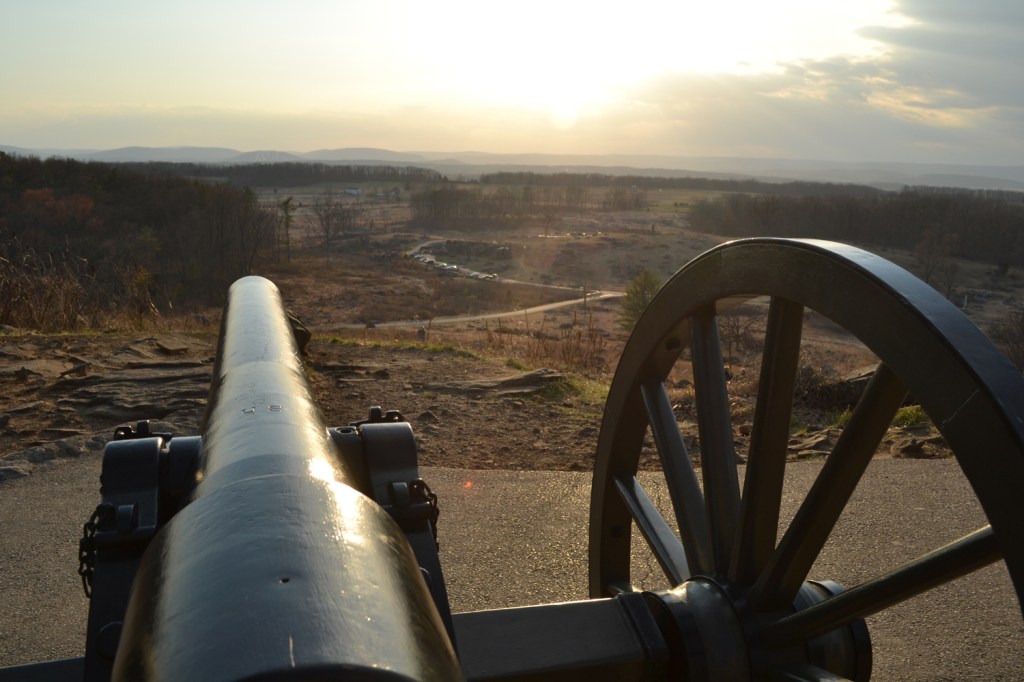
We looked around at the silent cannons—posed and waiting, like sentinels. Witnesses to the deadliest battle of the Civil War. I shivered.
We are sensitives—whether born or trauma-made. Drawn like moths to flame. To trauma. To death. To sacred, ruptured ground.
“It’s the energy,” my friend said. “Spiritual energy.”
I couldn’t disagree. What is spirit, if not supernatural energy? The Shekinah. The Holy Spirit. Energy.
She seeks to understand it. Me? I feel it. Especially trauma. It lights something up in me.
You don’t need a wild imagination to be humbled by Gettysburg. The place speaks for itself.
As the sun set (the park remains open until 10:00), we parted ways with the man—three strangers connected through invisible threads. Before he left, he said, “Be careful.”
We drove slowly through the darkening park and passed the Wheatfield. Suddenly, we both felt it—tingling skin, tight throats, nausea. The air felt electric, charged with something unseen. Then, as soon as we passed the bend, it disappeared.
“You felt that?” she asked.
We described it the same way. Yes, I had.
At Devil’s Den, we got out and wandered behind the granite boulders. A low rumble echoed nearby—maybe thunder, maybe phantom cannon fire. That’s not unheard of here.
My friend led me to a tall tree and stood still.
“There’s peace here,” she said.
But I felt dizzy. Nauseous. Unbalanced. “Stand next to me,” I told her. She did—and immediately felt the same. The air smelled metallic.
Blood, I thought, but didn’t say. I know that smell.
Maybe it was the dark. The uneven ground. But we didn’t feel normal again until we walked away.
Later, as we drove past Little Round Top, I was hit by sudden chest pain, nausea, and a sharp pain behind my eye.
For a split second, I thought I’d been shot.
I swerved and pulled over. The sensation vanished.
“Do you still feel peace?” I asked. “No,” she said. “It feels horrible now. So much death. I’m ready to leave.”
As we exited the park, we passed the same cannons we’d seen earlier—but I saw them differently this time. They were more than relics. They were keepers—of sorrow, of pain, of history we can’t possibly comprehend.
They reminded me of my own inner wounds. Silent. Unnoticed by most. But always there.
Not everything in life can be explained. But we’re not alone.
There are hundreds of thousands of us—like Tanner’s owner, like me and my friend—living on the fringe between the seen and unseen. We’ve experienced too much. We’ve been changed. And we’ve been given a gift: vision born from trauma.
A gift that lets us throw out the bathwater—and still keep the baby.
Maybe that’s why we keep returning to places like Gettysburg. Not just to understand the past.
It’s Friday morning, exactly one week from my uncle’s funeral. Family is headed back to Florida and for the first time since the death, the house is quiet and the stillness overpowering.
It’s a surreal morning. I had set the alarm on my cell phone for a seven o’clock wake up but forgot to turn up the volume. I hear pounding on the door and shoot out of bed confused.
“We need to leave in ten minutes!” My daughter yells through the door. This morning is the first in a series of physical therapy appointments she has, post-back surgery. “We can stop at Dunkin’ Donuts on the way. They have great breakfasts and awesome coffee.” This is a dig against her brother, my son who lives and breathes Starbucks.
I brush my teeth; throw on some clothes and stumble, still half-asleep into the hallway. She is standing by the front door with my purse in one hand and my keys in the other. I find my shoes and struggle to get them on my feet. She ushers me out the door.
We get into my mini-van and I’m seated in the driver’s seat. A revelation hits me, I’m awake and going somewhere. I slap my face a time of two and turn up the radio. Something has to wake me up. I’m driving for goodness sake!
“Dunkin’ Donuts is right around the corner. You can get a large coffee,” daughter tells me.
Before her surgery, my daughter was a three times a week Dunkin’ Donuts regular. We enter the coffee shop. She waves at the staff and rattles off what she calls her regular order. The counter person puts this into the register and looks at me.
I don’t have a clue what I want. Daughter and counter person spit out several adjectives describing food and beverage choices; eggs with bacon and toast, no toast, no egg, cheese, no cheese, bagels, coffee, iced, hot, latte, espresso, creamer, no creamer, mocha, mint, raspberry.
“Well?” Daughter asks.
I think I heard one of them say coffee, hot. I remember, the other day after daughter’s post neurology appointment we stopped at Sheetz, a regional gas, restaurant, and convenience store for coffee. That coffee, ordered for me by daughter, I really liked. “What was that?” I ask her.
“Iced, white-chocolate, raspberry with soy creamer,” daughter replies but for some reason I can’t wrap my head around all the words.
“Raspberry, chocolate,” I say. Miraculously, a breakfast and hot drink are handed to me and we head back to the car. I drop daughter at physical therapy and head back home.
Walking in the front door, I smell something dead and rotting. I check for the dog and cat. They are both accounted for and alive. Down on my hands and knees, I sniff the carpet, the couches and the afghans. Everything smells like it is supposed to. I’m stumped and tell myself I’ll deal with it later.
It’s been two weeks since I opened my mail or answered my business phone. Life literally has been at a stand-still. I leave the smell of the living room and head upstairs to my office. It’s a business disaster. Piles of paper and files have shifted around so many times in making room for extra, visiting family that I no longer know where anything is located.
I fire up the computer and find over three-hundred e-mails needing my attention. My office phone is blinking, ten missed messages. I’m so overwhelmed and exhausted I don’t know where to start or how to prioritize. This is grief and stress, I tell myself.
I sit in my office chair, close my eyes and do some deep breathing. I tell myself an altered mantra I learned at an acupressure seminar months ago. I have all the energy I need. My body is taking in the energy around me, re-filling where I am depleted. I refuse to let things or people take away my power or energy.
I open my eyes and see five minutes have gone by. That’s okay; I feel refreshed and know what direction to take with the clutter. The dog and cat get into a spit and I need to intervene. I can feel my energy draining and have to fall onto my office couch before I collapse. So much for the mantra working, I tell myself and cry.
Cried out, I lay there watching spider-webbing cracks in the ceiling paint. The house is so quiet. I didn’t realize how much the family being all-together helped keep each of us afloat through the past two weeks. I push myself to go back downstairs; I’ll deal with the office chaos later. I quickly move past the smell of death in the living room and back to the bedroom.
There are several beds we’d assembled for extended family. I decide there’s no time like the present to strip the sheets and start reversing the process I started two weeks ago. The beds come apart fairly easily and I’ve stowed them, for now, in the dining room next to the left-over paper plates, cups, napkins and plastic ware from the post-funeral get-together. I can’t deal with the things in this room right now. I’ll get to it later.
I have enough time to shower before returning to pick up my daughter. I grab some clothes from the laundry basket in the living room still waiting to be put away. What the hell is causing that smell?
I shower, pick up my daughter and head home. “There’s a smell,” I tell her. “When I open the front door, find it.”
We open the door and the smell is obnoxious. Again, I get on my hands and knees and feel more like a police dog looking for illegal contraband.
“This would be a good time for a picture,” daughter says. “Did you smell the fireplace? The other day we heard birds in there.”
Birds: Our chimney does not have an enclosed top. Every year starlings nest on top of our flue. When the eggs hatch, we have our own bird sanctuary. We can hear the parents fluttering up and down the chimney, baby birds chirping, singing and screeching. We can tell when a parent bird is bringing food back to the nest by the excitement coming from the behind the bricks. Eventually, the babies learn to fly and everything goes quiet until next spring. I don’t know why there would be a dead bird in our chimney in July.
I lean in the direction of the fireplace and don’t have to go any further. Sh-t, it is a dead bird in the fireplace above the flue. I open and close the flue several times hoping the bird body will fall and I can dispose it. Nothing happens.
A crazy thought, maybe I can smoke or incinerate the body with a fire. Okay, I know its July, but it is cool enough outside that I can turn off the air conditioner. I open the flue, turn off the air and toss a Duraflame log in the fireplace and set it ablaze.
My daughter and I sit on couches watching the dancing flames and my son comes in to join us.
“Reminds me of camping,” he says.
“Reminds me of my step-mom raising and killing her own chickens for food,” daughter replies.
“They’re making a new product called Soylent,” my son says. “It has all the nutrition anyone needs. Soon we won’t have to worry about food.”
Conversation lulls with the flames and both kids leave the room to live their lives. I’m alone with the cat nestled up beside me. The Duraflame log is half its original size but continues to deliver a calliope of blue, green, yellow and orange flames. The house is so quiet.
I realize what I’m really doing is cremating the bird and flash back two weeks ago. Corner’s reports, probable causes of death, cremation and internment paperwork, planning a get-together for everyone post funeral, setting up beds, buying and making food for everyone, military send-off with Taps and a tri-folded flag while we stare at Uncle’s portrait and the urn containing his ashes. It was almost one-hundred degrees that day and with high humidity. Everyone was drenched in a mixture of sweat and tears.
The fire is nearly out now. I don’t smell death anymore but it’s all around me. Every room in my house has at least a small remnant of the past two weeks. I can walk here or there and hear snippets of conversations between family members. I can smell the scent of various shampoos and soaps everyone used. My brother left some cigarette butts behind on the front porch. My mom left her ice pack in the freezer. Aunt Mary left her socks and my dad forgot his belated father’s day card. My uncle’s picture is on the mantel of my fireplace. He is smiling.
Maybe, death is not all around me but snippets of life. Sure, my alarm didn’t wake me up but I got up. I got to see my daughter blossom, knowing she is finally getting well enough to join society. Her car which has been dead since surgery, is going to be fixed free of charge. The smell in the chimney is gone and the method I used got two of my kids together for a nice conversation. I have remnants of the past two weeks all over my house but I got two weeks with people I love more than anything. We had a death to attend to, but in his passing, I reconnected with very close cousins I lost touch with over the years. We laughed, smiled, sang, told jokes and reminisced about my uncle and our entire family. I had expected people to stay maybe two hours at the get-together. Most stayed at least five.
My house is very quiet and I’m crying. But I realize, this is not the ending. This is just the beginning of a new chapter for all of us. I should- will embrace finding the how and where we go from here.
 Deborah Sickle Hill