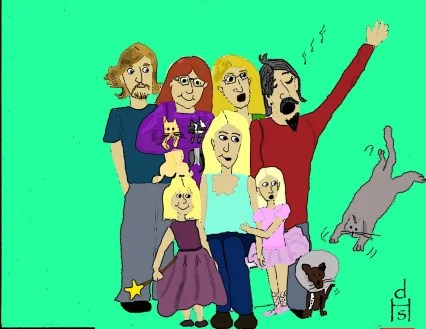
Tag: children

  • Disney World vs South of the Border

      We decided to take the family on a trip to Disney World. It was the first time for our five- and seven-year-old granddaughters. The drive? About 18 hours. We pulled out of the driveway at 5:30 a.m. No problems.

    The seven-year-old had been learning about states in school, so as we crossed each state line, we’d shout its name and everyone would cheer. One state down—so many more to go.

    Somewhere in our third state, the five-year-old sighed and said, “I’m tired of all these little states. Just tell me when we get to the state of Japan.”
    No problem.

    The day rolled on smoothly. The kids napped between viewings of Cinderella for the thousandth time. Before we knew it, the giant, gaudy South of the Border sign appeared on the horizon. If you’ve never seen it, it’s a long-standing tourist trap-slash-rest stop sitting right on the North/South Carolina border. Bright lights, oversized cement animals, buildings painted in every color of the rainbow. It’s been around since the 1950s, and for us, it’s almost a mandatory stop on the way to Florida.

    We pulled into the lot.
    “Everybody up!” I called. “Time to stretch!”

    The five-year-old popped up, looked out the van window, and gasped.
    “We made it! Oh my gosh, we’re really at Disney World! I can’t believe it!”

    Without missing a beat, my husband said, “Yep! We made it to Disney World! I think I just saw a princess go around the corner!”
    I gave him a look.
    He leaned in and whispered, “Just think of all the time and money we’d save if they really believe this is Disney.”
    He’s smiling. I’m not.

    Meanwhile, the seven-year-old had leapt from the van and planted herself in front of her twirling little sister.

    “This is NOT DISNEY!” she shouted, her voice rising with each sentence.
    “Do you see any CASTLES?
    Do you see any PRINCESSES?
    Do you see MICKEY MOUSE!?”

    The five-year-old stopped twirling and looked crushed.
    “Rats. I thought this was Disney.”
    She crossed her arms and added, “Well… at least tell me we’re as far as Japan.”

    My husband and I just stared at each other.
    I said, “Well, I suppose we could take her to Epcot. They do have a Japan.”

    He shook his head.
    “No, no. All we have to do is tell her the Georgia Welcome Center is the entrance to Japan. She’ll never know the difference.”

    It’s going to be a long trip.

  • Toddlers Found Amid Bloodbath – When Children Experience Trauma

    The headline read: Toddlers found Amid Bloodbath. Four-year-old Amy and two-year-old Abbey (not their real names), had witnessed the murder/suicide of their parents.  The girls were rescued a day later playing around their dead parents. The police were able to place the children with extended family thought they could cope. They were wrong.

    Amy, once toilet-trained, started soiled her pants on a regular basis. Abbey started sucking her thumb and refused to leave her sister’s side. For reasons no one could understand, the two would suddenly become enraged and on one occasion Amy lunged at her uncle (the current guardian) with a kitchen knife lacerating his leg. Both girls asked frequently, when their parents were coming back. Amy on occasion, would become nauseated and vomit when she would walk in and see her aunt preparing raw meat for dinner.  Neither girl slept well and night terrors accompanied with screams that woke the entire house occurred weekly. When they played, the themes were often violent with toys being destroyed and their behaviors escalating into physical fights between them. Abbey refused to be held, would cry a lot and bite herself.  Amy refused to play with other children and her daycare provider said she sometimes resembled a trapped animal that lashed out when you tried to come near her.  

    Their home placement quickly became jeopardized as the already distraught family was not prepared for, nor did they understand, what was occurring. The result, the children ended up in foster care, with a family that had wonderful intentions but was not properly trained on what to expect from traumatized children, how to help them and how to cope.

    From the family’s perspective the children should have been relieved and happy to be in a loving, caring environment. They became very confused and angered with the girl’s behavior did not match what they expected. They returned the children to the county for another placement. This happened several times before the girls ended up with a specialized foster care family who already had four special needs children.

    The girls were seen by multiple counselors/therapists and doctors. Many of which did not have specialized training in helping children who have been traumatized.  By the time the girls were ready to go to middle school, they were separated, living in different homes (the fifth for Amy and the eighth for Abbey), were promiscuous, hard to handle, occasionally heavily drugged by well-meaning doctors and their school performance was very poor with frequent suspensions. 

    This is a horrendous story. It is horrendous because the children experienced such a horror. Worse because no one knew information to help understand the natural reactions the children were having as a result of the events they experienced.  By the time I got the case, years of compounded stress and trauma had to be unraveled.

    There is an old myth that children are very resilient that they bounce back from adversity better than adults. Notice I said myth. Children are just as traumatized and reactive as adults to traumatic events. Children, however, often present different then their adult counterparts.

    To the unaware adult, the child is acting out, being obstinate, not reacting to the events. The child typically is not able to sit down and tell you or debrief the events the way an adult can.  Depending on their age, children are not able to verbally process the events and their meaning due to limited cognitive development. For example, children do not have a concrete understanding of death as being final until around age ten.

    The case with Amy and Abbey is extreme; however, traumas do occur frequently to children. Divorce, child and domestic abuse, school bullying, parents who are involved in severe drug and alcohol abuse, deaths or serious illness in the family, loss of income of a parent, moving to a new school and home. All these and many more are examples of events that are very stressful and at times traumatic enough to cause severe reactions in a child.

    It is important to anyone with a child who has or is currently stressful and/or traumatic or who work with children to understand the nature of trauma on a child to learn ways children express and process these events.

    The brain acts like a movie camera during a traumatic event. It will record the images, sounds, smells and touch feelings associated with it. This occurs so the brain can figure out how to react for protection. Integrate this into the person to make sense of the event.  How to self protect if it happens again or try to prevent it from happening again.  The behaviors you see in a child are the outward manifestations of these attempts.

    Here are some of the behaviors you may find in children coping with extreme stress and or trauma in their life.

    1. Children will typically digress in their developmental levels (forget learned behaviors like toilet training, talk babyish, need stuffed animals to sleep, night lights, want more cuddle time, forget how to do skills learned in school)
    2. Nightmares, night terrors, sleep walking, sleep talking, refusing to go to bed or sleep.
    3. Refusing to eat, over eating, nauseated at certain foods, craving certain foods such as feel good foods, wanting a pacifier or bottle fed.
    4. Refusing to go to the bathroom, soiling their clothing, smearing feces, obsessive masturbating.
    5. Aggressive or violent behaviors, crying spells and tantrums.
    6. A drop in school performance, decrease in grades, acting out in school, not wanting to go to school.
    7. Moodiness, bursts of anger, crying spells, moppyness, laughing inappropriately, pulling out hair, twirling hair, pulling out eye lashes or eye brows, hurting themselves on purpose, clumsiness or accident prone.
    8. Flashbacks (experiencing the trauma event as if it is currently happening), responding to things that remind them of events (the blood of raw meat for someone who witnessed a bloody event).
    9. Promiscuousness, early involvement with smoking, drugs and alcohol, deviant behaviors, abuse of others, abuse of self, disrespect for adults or specific adults.

    If extreme stresses or a traumatic event happens to your family, your child or a child in your care, note these reactions. Do not assume the child will manage without help. It is better to act as if need is eminent then to ignore the potential as behaviors of a child’s distress may not show up right away. It may take days or weeks to show. There are times where the child appears to do well and after they reach a more developed cognitive ability (the older they get) their mind will once again address what they experience and this is when you may see behaviors develop. The sooner the child is able to get help, the better things will be for them.

    Use the services of school counselors, professional counselors/therapists (make sure they are trained in childhood trauma if trauma is the issue), a doctor’s care maybe necessary as well. Learn all you can about how severe stress and trauma affects children and incorporate this for the children in your care.  If you are also a part of the extreme stress or trauma, remember that you are also struggling on various levels. Take care of yourself.

    Extreme stress and trauma can occur in anyone’s life. Be prepared if you have or work with children. Know the signs and how to get help. The emotional health and well being of a child may depend on it. 

  • The Age of the Boomerang Family. When Adult Children Come Home.

     When Grown Kids Come Home Again
    Estimated reading time: 6–7 minutes

    What happens when your empty nest suddenly fills back up—with adult children, grandchildren, pets, and all the baggage (literal and emotional) they bring? This humorous and heartfelt post shares our family’s journey from semi-retirement dreams to boomerang reality, complete with ghosts, minivans, and lessons learned the hard way. If you’re navigating the new norm of multigenerational living, these 10 tips just might save your sanity.

    Had I known ten years ago what I know now, I could have saved the cost of seven boxes of tissues and taken a trip around the world instead. It never occurred to me that my three wonderful kids would graduate high school, launch into the world, and then circle back to the parental nest.

    I watched each child proudly—and a little sadly—march down the graduation aisle to “Pomp and Circumstance.” College, marriage, big dreams—duly blessed and applauded. I called it semi-retirement. It didn’t last.

    Daughter #1 came home first, with two toddlers, a dog, and half of the marital assets after her husband went fishing in different waters. Our small house quickly overflowed with boxes, furniture, and baby gear.

    “We have to move,” I told my husband.

    “We raised three kids here. It’s just the two grandkids and Daughter #1. We’ll be fine,” he insisted. Apparently, the hallway squeeze and the blocked dining table didn’t register.

    Two weeks later, the house was for sale. When the Realtor asked what we were looking for, the responses were—predictably—very different.

    Me: Five bedrooms, two bathrooms, big kitchen, fenced yard, family room, porch, maybe a koi pond. Hubby: Three bedrooms, one bathroom is fine, small yard, no need for fancy extras.

    The Realtor smiled. “I think I have just the place.”

    “What are you thinking?” my husband hissed. “We’re not made of money.”

    “I have a feeling the other two are coming back, too,” I replied.

    He looked unconvinced. “No babies. No puppies. No more.”

    Fast forward: We moved into a 110-year-old house with five bedrooms, three bathrooms, a first-floor master suite, a screened-in porch, a fish pond, a fireplace, and a ghost (who eventually left due to overcrowding).

    We also upgraded to a minivan. Hubby protested: “This is my red Corvette era!”

    “It’s a mutant Jeep,” I replied, taking the little red car to work.

    Soon after, Daughter #2 moved back with two cats. Another broken marriage. She had no winter coat, no job, and no medical insurance. Daughter #1 decided to go to college, which we agreed was a good long-term move.

    Then our son returned from Boston. His funding fell through and he had to leave Berklee. He came back with a drum set, guitars, keyboards, amps, furniture, and dreams deferred.

    Seven people, three cats, two dogs, and a cast of extras: friends, dates, stray pets, and visiting students. It was beautiful chaos.

    Along the way, we discovered some survival tips. Here are:

    10 Tidbits to Curb the Insanity of Boomerang Families:

    1. Update Your Relationship Status: They are adults now. That dynamic shift requires mutual respect and negotiation.
    2. Rules: It’s still your house. Adjust outdated rules, but set clear expectations.
    3. Logical Consequences: Make consequences fair, logical, and agreed upon. Contracts help.
    4. Future Goals: Ensure they have direction—school, work, or saving for independence.
    5. Money and Responsibility: Tailor rent based on income. Consider savings plans. Decide what’s an emergency. Use contracts for loans.
    6. Boundaries: From food to bathroom schedules, set and communicate clear boundaries. Label food!
    7. Grandkids & Pets: Clarify roles. Don’t parent the grandkids unless explicitly agreed upon. Support without overstepping.
    8. Communicate, Don’t Argue: Choose dialogue over drama. Use central messaging. Humor helps.
    9. Avoid Their Drama: Offer wisdom when asked, but resist solving their problems.
    10. Take Care of You: Eat well, sleep, enjoy a life outside the home. Reconnect with your partner or a trusted friend.

    Boomeranging is stressful but rewarding. You may rediscover deeper relationships and shared joy. And when it’s time, you can shout upstairs, “Hey adult-child, Ghost Hunters is on—I’m off duty!”

    Enjoy the chaos. And be happy.