Call me morbidly curious, gothic—not goth, macabre, perhaps even a dark coper. They all mean about the same thing. Paraphrased from the dictionary, someone having a fascination for dark and unpleasant subjects, the supernatural, death, and melancholy. A dark coper, a person who uses scary media to process fear to gain a sense of preparedness for real-world dangers.
You would never know this looking at me. I don’t advertise. This leads me to a quandary: trying to explain my writing to people who view dark fiction (horror) as slasher movies and grotesque. Yes, there is a market for this type of film. It’s not my market, and it is definitely only a sub-genre of a vast cornucopia of artistic endeavors.
To me, a good dark fiction novel contains deep, well-rounded characters with strong arcs and meaningful relationships. They encounter, because of their own actions or the actions of someone or something else, a situation(s) leading them to a life and death situation. Physically or psychologically. A cause to reevaluate everything they thought they knew about life. A chance to make a difference. An opportunity to do the greater good—even if the result is self-sacrifice.
Yes, there are works of fiction where the antagonist is the main character. The twists and turns of a mind deliberately cause the protagonist to struggle. Even then, both the antagonist and the protagonist need to be well-rounded characters—why else would you root for success? Though in some situations, the result is disquieting as the antagonist wins, leaving the reader with their own sense of dread or self-evaluation. The Invasion of the Body Snatchers is a good example of this. Spoiler: the aliens win.
Someone asked me, “Why do you write horror? Why not write romance or dramas?”
All my novels contain historical drama and romance. However, my answer is simple. It’s a great way to have a safe place to explore fears and past traumas. It’s cathartic, entertaining. I like it when a character beats the odds and comes out whole. And of course, it harks back to Memento Mori. I’m drawn to it like a moth to a flame, unable to resist its calling. (Not today—at least I hope not!)
To date, I’ve written and self-published two fiction books. Death in Disguise is a dark murder mystery taking place in the 1950s in a small fictional town. The Revelation is a dark, supernatural tale set on an archaeological site in the 1980s. My latest finishedwork, currently vying for an agent, is called Dark Consequences, about an Irish famine victim, forced to come to America, where he makes a fateful decision bringing death to the small quarry community where he settles. It’s book one of a four-part series.
If you’re interested in well-developed characters living somewhere in history, a solid cast of characters and plots where the consequences of decisions are life-changing, exploring the world of the supernatural, give me a try. I’m really not that scary.
Have you ever heard the saying, “Don’t throw out the baby with the bathwater”?
A friend and I have both survived near-death experiences—events that altered us permanently. On long drives, we often dive deep into conversations about spirit, soul, God, and nature. We’ve walked away from rigid dogmas—those rules imposed by religion that demand your belief to belong—and instead, we’ve chased after truth. Real truth. The kind you feel in your bones.
Hence, throwing out the bathwater and keeping the baby.
That mindset often leads us to places charged with meaning. On this particular day, we felt called to Gettysburg National Battlefield.
We took the Taneytown exit just before sunset. As we approached the old Cyclorama, my friend said quietly,
“I feel something pulling me here. Something important.”
“Tell me when to stop,” I said.
“Stop.”
We parked beside an older man and his massive Irish Wolfhound, Tanner. He greeted us kindly and shared that he was a local who came to the battlefield seeking meaningful encounters. Usually, he sat at Little Round Top. But tonight, he’d felt drawn here instead.
He’d had a near-death experience—just like us.
For over an hour, the three of us stood and talked. About life. About death. About energy, God, and the battlefield itself. “This place is alive with spirit,” he said. “Something here vibrates because of the hell that happened.”
And I understood exactly what he meant.
We looked around at the silent cannons—posed and waiting, like sentinels. Witnesses to the deadliest battle of the Civil War. I shivered.
We are sensitives—whether born or trauma-made. Drawn like moths to flame. To trauma. To death. To sacred, ruptured ground.
“It’s the energy,” my friend said. “Spiritual energy.”
I couldn’t disagree. What is spirit, if not supernatural energy? The Shekinah. The Holy Spirit. Energy.
She seeks to understand it. Me? I feel it. Especially trauma. It lights something up in me.
You don’t need a wild imagination to be humbled by Gettysburg. The place speaks for itself.
As the sun set (the park remains open until 10:00), we parted ways with the man—three strangers connected through invisible threads. Before he left, he said, “Be careful.”
We drove slowly through the darkening park and passed the Wheatfield. Suddenly, we both felt it—tingling skin, tight throats, nausea. The air felt electric, charged with something unseen. Then, as soon as we passed the bend, it disappeared.
“You felt that?” she asked.
We described it the same way. Yes, I had.
At Devil’s Den, we got out and wandered behind the granite boulders. A low rumble echoed nearby—maybe thunder, maybe phantom cannon fire. That’s not unheard of here.
My friend led me to a tall tree and stood still.
“There’s peace here,” she said.
But I felt dizzy. Nauseous. Unbalanced. “Stand next to me,” I told her. She did—and immediately felt the same. The air smelled metallic.
Blood, I thought, but didn’t say. I know that smell.
Maybe it was the dark. The uneven ground. But we didn’t feel normal again until we walked away.
Later, as we drove past Little Round Top, I was hit by sudden chest pain, nausea, and a sharp pain behind my eye.
For a split second, I thought I’d been shot.
I swerved and pulled over. The sensation vanished.
“Do you still feel peace?” I asked. “No,” she said. “It feels horrible now. So much death. I’m ready to leave.”
As we exited the park, we passed the same cannons we’d seen earlier—but I saw them differently this time. They were more than relics. They were keepers—of sorrow, of pain, of history we can’t possibly comprehend.
They reminded me of my own inner wounds. Silent. Unnoticed by most. But always there.
Not everything in life can be explained. But we’re not alone.
There are hundreds of thousands of us—like Tanner’s owner, like me and my friend—living on the fringe between the seen and unseen. We’ve experienced too much. We’ve been changed. And we’ve been given a gift: vision born from trauma.
A gift that lets us throw out the bathwater—and still keep the baby.
Maybe that’s why we keep returning to places like Gettysburg. Not just to understand the past.
Wouldn’t it be nice if people came with instruction manuals? Better yet—what if we came with our own?
Imagine how much easier relationships would be—both with ourselves and with others—if we had a clear set of directions to follow. You might be surprised to learn: you don’t need a 200-page manual. A couple of index cards would do.
That’s because the basics are simple. Unfortunately, most people never get taught them. So we end up walking through life with blinders on, trying one approach after another, hoping something sticks.
Take this example: Someone gets angry and gives the silent treatment. Why? Because they believe the other person should know what they did wrong. The problem is—it solves nothing, gains nothing, and slowly chips away at the relationship. The more chips, the more dysfunction. Yet the behavior continues, often with confusion and surprise when the relationship sours.
Why do we do this? Because no one gave us the index cards.
Here’s the first card:
1. People can only act and react (thinking, feeling, doing) based on what they know.
Sounds obvious, right? But if it were, we’d all be a lot gentler with each other. Instead, we regularly expect others to respond the way we would, based on our experiences, our knowledge, and our perceptions (meanings).
Let’s look at a few examples:
Expectation: “If you loved me, you’d bring me chocolate donuts with sprinkles.” Reaction: “I brought you flowers. I thought that meant I loved you. How was I supposed to know donuts meant love?”
Expectation: “You should know better than to leave the oven in clean mode when leaving the house! Everyone knows that’s a fire risk!” Reaction: “I didn’t know that. I’ve never cleaned an oven before. How would I know it could catch fire?”
Expectation: “Can’t you do anything right? You can’t even load the dishwasher correctly!” Reaction: “Is there a right way? I was just trying to help. You know what—next time, you do it.”
Want to be shocked? Try this:
Spend one full day paying attention to how often you expect someone to act or respond based on your knowledge. Count how many times you assume someone “should just know.”
Then, spend another day observing how you feel when others make the same assumption about you—expecting you to read their minds, meet their needs, or act in a way that makes sense only in their world.
You’ll start to see just how much of our conflict stems from this silent mismatch of expectations.
And one last thought: Even if you’ve known someone your whole life, don’t assume they know what you know—or that they’ll process things the same way. We’re all working without manuals.
What is it about bacon that holds such power? T-bone steaks, chocolate cake, homemade ice cream—delicious, sure. But none of them have the mysterious, magnetic pull of bacon.
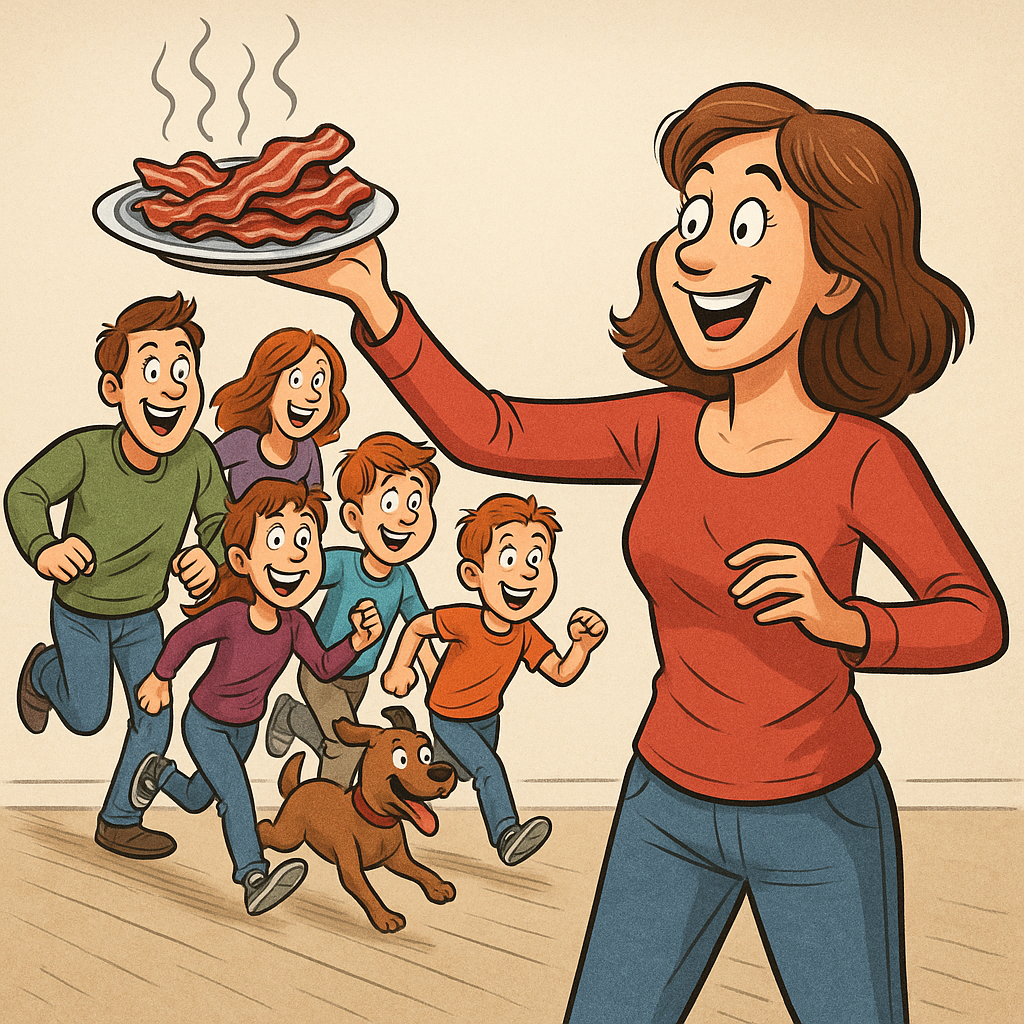
In my house, we’re a full crew—seven people and one dog. I can yell “Dinner’s ready!” or even “Breakfast is on!” and maybe, eventually, people will wander in.
Unless there’s bacon.
The moment I lay that first strip on the griddle, something primal awakens. The entire family—dog included—suddenly appears. No yelling. No group text. Just the unmistakable scent of sizzling bacon, working its magic.
Because of this, I’ve decided to stash an emergency pack of bacon in the freezer. Not for breakfast. Not for BLTs. For actual emergencies.
If the day ever comes when I need everyone’s immediate attention—when yelling “We’re all going to die unless you run like hell!” won’t cut it—I’ll skip the home alarm system and toss that sacred bacon on the stove. It’s the one sound and smell that guarantees a response.
Bacon: It’s not just for breakfast. It’s a homing device.
Many people live with chronic mental health conditions—depression, anxiety, ADHD, PTSD, and more. These are real, brain-changing diagnoses that often require medication and therapy just to maintain a sense of “normal.” For some, the illness is severe enough that the old normal no longer applies. They’re left to build a new one from scratch.
The same is true for those facing chronic or life-altering physical illness. They too must learn how to cope, adapt, and find a new way forward.
I live with CPTSD, depression, and anxiety. Over the years—both personally and professionally—I’ve seen a pattern: we often see ourselves as broken pieces of china, trying desperately to glue the fragments back together. But at the same time, we treat ourselves like disposable red Solo cups—crushed under the weight of perceived failure, the loss of a “normal” life, self-blame, and anger toward ourselves, others, the universe, even God.
It doesn’t have to be this way.
We deserve better from ourselves. Healing is hard enough. Beating yourself up will only make it harder.
If life has chipped or cracked your fine china, you have every right to grieve. You have every right to mend. But stop letting yourself—or others—treat you like a crushed plastic cup.
Here are some ways to start reclaiming your worth:
Know your limitations—and respect them. Boundaries aren’t weakness; they’re wisdom.
Create a safe space. Whether physical or emotional, make a place where you’re untouchable.
Practice stress reduction. Listen to music. Meditate. Read. Walk in nature. Do what calms your nervous system.
Pay attention to your self-talk. Are you your own worst enemy? Are you constantly angry, hopeless, or stuck in shame?
Spend time with supportive people. Seek out those who lift you up, not tear you down.
Explore a spiritual practice. Remind yourself that you are more than this moment, this diagnosis, or this body. There is a bigger picture—and you are a meaningful part of it, even if you don’t fully see it yet.
You are not broken. You are fine china—fragile, perhaps, but still beautiful. Still valuable. Still worth protecting.
I went to the Goodwill store looking for a lamp to re-purpose. I really enjoy combing through flea-markets and second-hand shops to find elements of objects discarded to make something new. Something I create to be meaningful or purposeful to me.
I found a lamp, bought it. That afternoon I water colored the shade in hues of green. I realized, this object transformation was symbolic of my life and what I help others do – Re-purpose their lives. Life will always give reasons to step back and ask questions like: What the hell just happened? Why did this happen to me? What am I going to do now? Who am I as a result of this? Re-purposing helps bring answers to those questions.
My journey with Post Traumatic Stress (PTSD) catapulted me into demanding answers to those questions. I didn’t think I could function without them. Luckily, a person does not have to endure severe traumas demanding immediate attention. Anyone can have a desire, a spark to find their authentic self and live a fuller, happier, more balanced life.
People change slowly over time being enhanced or torn down by life’s challenges. Most appear to view this change as outside themselves. They don’t care or they fear looking inward and asking the hard questions. Finding the answers and stepping out into the great unknown. They accept life as it is. The result is often bitterness, anger and depression. This does not have to be. Life happens, yes, but what you do with it makes all the difference in the world – your world.
Re-purposing takes time and usually happens in stages. As a person learns more about them self and the universe around them, there is an aha moment. My experience is that this is followed by a stewing process. The mind soaks in the information and applies it to everything it knows. The person acts on their new awareness and then it hits.
New questions arise! Well, if that’s true, then what about this situation? Why did I act that way when I could have done this? What else have I believed about life that suddenly is not true? What is truth? The questions become less about the person and more about the world, the universe and the spiritual.
It might be helpful to look at the journey in terms of cooking or food. At first, it probably seems similar to peeling off layers of an onion. I picked onion because pealing an onion can bring tears and at times not very pleasant. Thoughts and memories, who we have become over time has built around our core like the layers surrounding the core of the onion. The larger the onion, the more changes, adaptations or layers a person has developed.
There should come a time when a person can see beyond the onion metaphor and see layers as welcome opportunities for re-purposing, bringing enrichment to their lives. Life’s journey now becomes more like layers of string cheese, baklava, lasagna, or some other pleasant concoction you can think of. Not as threatening or uncomfortable if done in moderation. It is good to note, that even with pleasant or desired elements of change, too much too soon can cause distress. I really would not recommend sitting down and eating en entire family size lasagna! All things should be done in moderation, which includes re-purposing.
After a while, the person may no longer find total enrichment and the questions asked of the self changes again. Using the cooking metaphor, questions might revolve around the concern, how can I improve on this recipe? The types of questions are as vast as the grains of rice in a box of Minute Rice.
Re-purposing time varies from person to person. Some only strive for feeling slightly better, like putting on a band-aid and waiting. Others, like me, spend a lifetime joyfully exploring, learning and becoming. At this point in my journey, the questions are no longer the ones stated above. Some of my current questions are: Where do I go from here? What does this say about me? How can I turn this into something good for myself and others?
My lamp is now painted, trimmed and assembled. Another human-made element re-purposed for a new beginning, a new life. Aren’t all our experiences in some way, human-made? It’s up to us to do the re-purposing to make our lives the best they can be.
I offer a challenge to you. Start re-purposing your life. The results are worth the journey. Below I offer some first steps to get you started. If you would like some help, you can check out my e-mail counseling/coaching services. If you are in the area, make an appointment or attend a class. Have a great journey!
First Steps to Start Re-purposing Your Life:
1. Get a notebook or journal.
2. List as many qualities about yourself as you can think of. Ask others for their impute. What do you think/feel about your list?
3. List things, people or events where you feel/felt: 1) happy: 2) accomplished: 3) loved: 4) experienced freedom: 5) had fun. Are there any areas where you had a hard time listing things? Some needs that you are falling short in having fulfilled?
4. What movies, characters, TV shows, music, artists, books do you relate to? Why?
5. Make a timeline of your life – the goods, bads, neutrals, accomplishments, regrets. Why did you label these in the categories you placed them? Example: Why is difficulty in 3rd grade math a good thing?
6. Answer the statement: If I had a magic wand, my life would look like… (be specific). Why would you want the elements you picked?
7. List and evaluate areas of your life where you feel out of balance or unhappy. Why do feel this way about this area? (Try to be inward focused and not “because he made me…”)
8. Ask yourself, what role do you play in number 7? We always play a role, even if it is not doing anything.
9. Continue to ask yourself, what do I really want? (see my blog, Life’s Little Instruction Manual, Healthy Relationships Part 4)
10. Review everything you have written. See if you are starting to understand who you really are, how you got here, the role you play, and where your life is unbalanced. You can’t formulate any goals on making improvements without this base-level structure.
Congratulations on taking the first steps in re-purposing your life. Job well done! Drop me a comment and let me know how it’s going!
This morning I discovered a wonderful and deadly secret, Burger King now carries Cinnabons. I love Cinnabons! Until this morning, I could only get them at the airport. Usually, I could resist them, too worried about making my flight or having oozing cinnamon sauce dripping down my chin and shirt.
Now, I can go less then a mile from my home, sit in my car and indulge in cinnamon-sugar ecstasy. Burger King has Cinnabons!
Like a cocaine addict, there I sat. Could have ordered the bacon, egg sandwich or better still, the oatmeal with fruit. No, I ordered Cinnabons, two of them. I deserved them, I told myself. Reasons why, I have no clue.
I ordered, paid and planned to sit in the parking lot eating them. My napkins in hand for the dribble mess that only a Cinnabon can produce. I opened the box. Two scrumptious, twisted, doughy circles dripping in brown cinnamon syrup and decadent white icing stared at me. Oh my!
My cell phone clock buzzed. I looked at the dash clock. It’s later then I thought. if I sat in the parking lot, I’d be late for my class on spiritual discipline. You know, learn not to over indulge. Keep an even-keel, that sort of thing. So, I have to eat the Cinnabons on the go. What could go wrong?
I turn out of the Burger King parking lot and the first gob of icing hits my jeans. It’ll wait. I can’t turn, hold a Cinnabon and grab a napkin at the same time. I’m not that coordinated. Not a problem. For the three miles it takes me to get to my class on discipline, I gorge myself on these overly-large, incredibly addictive, way-more-than-I-can-eat rolls. Pleased, that I only have that one glob of icing on my jeans to contend with.
At my destination, I pulled into the parking lot and found a spot. The rolls are eaten. Not something to be proud of, but next time, I’ll order the oatmeal. No one has to know I slipped up and once again found myself in a sugary stupor. I’d gotten away with it! Ha, ha, indulge today, disciple tomorrow!
I garb a napkin to remove the incriminating evidence from my jeans only to find… it is joined by five other considerable larger globs all down my shirt and jeans. Crap! Good thing they gave me many napkins.
Did you know napkins adhere to Cinnabon icing globs like flies on flypaper? Napkins ripped, shredding all over my shirt and jeans. I look like a kid just learning how to shave, ending up with toilet paper wads all over their face!
I should be in class several minutes ago! How in the hell am I going to clean this up and look dignified? No one is supposed to know I fell off the band-wagon! I wonder if I can lick some of it off. I don’t have any water and drowning myself in caramel-mocha coffee doesn’t seem like the answer!
There is a knock on my car passenger window. It’s a friend of mine also going to this class. Her gleeful expression quickly turns to confusion. I’d be confused too if I wandered up to her car only to find her sitting there with napkin shreds hanging off globs of icing all over her shirt, hands and pants.
There is really nothing to say here except, “Burger King now has CInnabons.” She still looks confused.
“I’m not really sure how to help you with this one,” she says. Her head cocks sideways the way my dog does when I’m trying to explain the concepts of karma to him.
“That’s okay, I don’t’ know either.” I wonder if I can claim this as a new grunge/bohemian look.
So, I’m going to class wearing shredded napkins and not-strategically placed globs of syrup and icing. A smile on my face. I’m taking responsibility for my actions. I’ll take the consequences, the tisk-tisks, the smirks, and the malaise when this sugar rush crashes.
I get out of the car and straighten out my newly decorated shirt and strategically hug my friend who says, “Wow, you smell like a bakery, like Christmas cookies! That’s not too bad. It could be much worse.”
And this is why I have her as my friend. Everyone should have friends like this.
Hello, my name is Deborah Sickle Hill, Burger King has Cinnabons, and I have a problem. Damn good thing I’m taking a class on spiritual discipline. I think I have a stomachache.
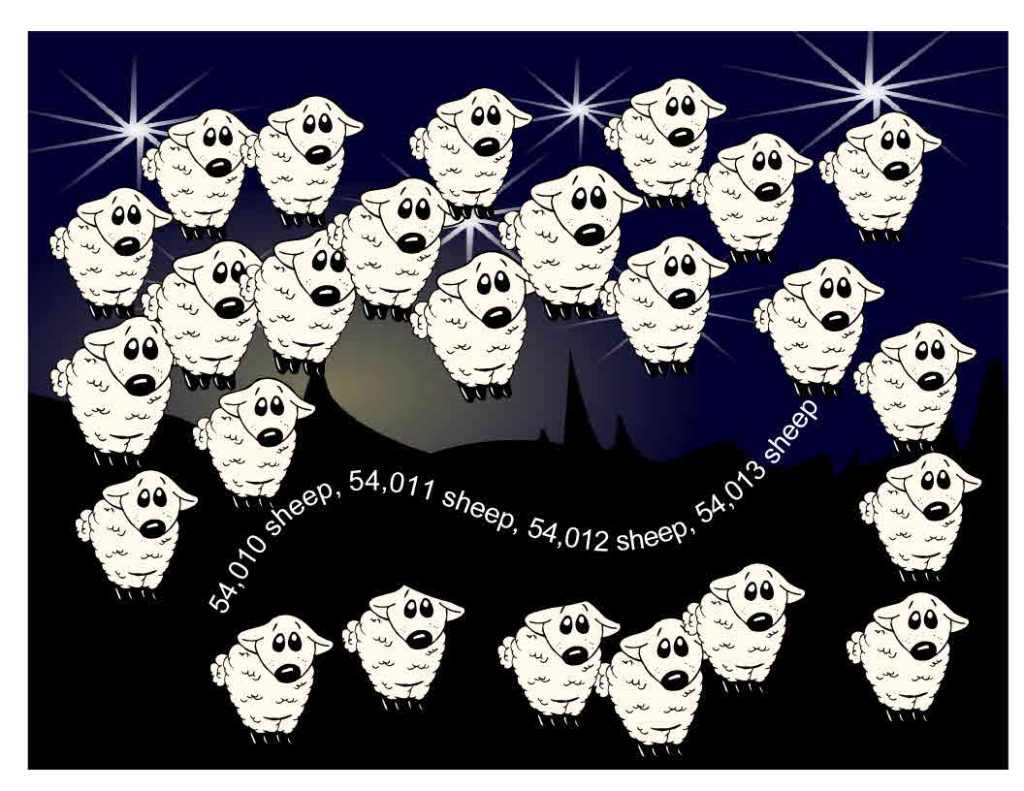
I’d love to sleep the hours I believe most Americans sleep. To be part of the: to bed at eleven, seven to eight hour sleep period and wake refreshed at six or seven a.m. people.
I’d love to sleep like this, but I can’t. Doctors have tried numerous over-the-counter and prescription aids. I’ve read multiple books on healthy sleep habits. I’ve used a sound machine, played a video of the ocean, ear phones and meditation music, hugged a stuffed animal. My diet was changed. I stopped drinking caffeine and alternated the temperature of my bedroom. Exercise, yep, I’m doing it. Meditation is great but not for my insomnia. I’m not sitting awake worrying. My life is going well. Nothing works. AHHHHH!
I was diagnosed with Post Traumatic Stress Disorder (PTSD) in 1981. Truth be known, I actually have Complex PTSD although at the time they didn’t have that diagnosis. The hows and whys of this are not important for this writing. I’m telling you this because it and some wacky thinking on my part are the reasons for my insomnia.
I am so hyper-vigilant (on edge waiting for something inevitably horrible to happen) that any noise or movement jolts me awake with a startle. Then I’m up for several hours until I can no longer keep my eyes open. With any luck, I will return to some kind of sleep. Some nights this cycle takes an hour or two, other nights I’m up all night.
The less sleep I get the more my thinking becomes derailed. Things that normally would not bother me become monumental. I start taking things more personally and become defensive. Skills and determination take a sharp decline and old thoughts of self-doubt and self-scrutiny flourish and will spiral out of control if I don’t intervene.
I’ve tried many techniques and mild to wacky interventions to help me or force me to sleep. Occasionally, I think I’ve hit the right combination of circumstance, rituals and mind-set only to find it was all a fluke. I can blame my mattress, my hubby, the cat, the noise level in the room, hormones or any number of elements. While some of this is probably a contributing factor the end result is me and a need to find a way within myself to work with who I am now in a non-judgmental way.
Sleep eludes me. So I try to spin it positive. The house is quiet, I can write. There is time to process my day and goals for the future. There is quality time with my cat. All nice things but sleep would be greatly appreciated.
So, I am curious both as an insomniac and a therapist, what have you tried when facing insomnia? Did it work?
Maybe there are some techniques or home reminds I’m not familiar with. If you have any I’d love to compile them for anyone who needs aid. Myself included. Sweet dreams!
When Grown Kids Come Home Again Estimated reading time: 6–7 minutes
What happens when your empty nest suddenly fills back up—with adult children, grandchildren, pets, and all the baggage (literal and emotional) they bring? This humorous and heartfelt post shares our family’s journey from semi-retirement dreams to boomerang reality, complete with ghosts, minivans, and lessons learned the hard way. If you’re navigating the new norm of multigenerational living, these 10 tips just might save your sanity.
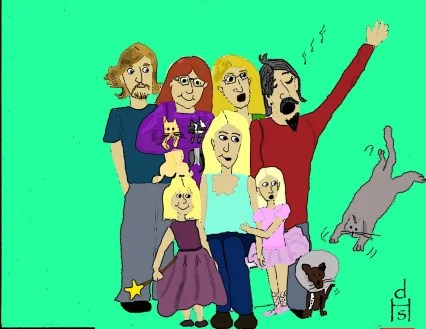
Had I known ten years ago what I know now, I could have saved the cost of seven boxes of tissues and taken a trip around the world instead. It never occurred to me that my three wonderful kids would graduate high school, launch into the world, and then circle back to the parental nest.
I watched each child proudly—and a little sadly—march down the graduation aisle to “Pomp and Circumstance.” College, marriage, big dreams—duly blessed and applauded. I called it semi-retirement. It didn’t last.
Daughter #1 came home first, with two toddlers, a dog, and half of the marital assets after her husband went fishing in different waters. Our small house quickly overflowed with boxes, furniture, and baby gear.
“We have to move,” I told my husband.
“We raised three kids here. It’s just the two grandkids and Daughter #1. We’ll be fine,” he insisted. Apparently, the hallway squeeze and the blocked dining table didn’t register.
Two weeks later, the house was for sale. When the Realtor asked what we were looking for, the responses were—predictably—very different.
Me: Five bedrooms, two bathrooms, big kitchen, fenced yard, family room, porch, maybe a koi pond. Hubby: Three bedrooms, one bathroom is fine, small yard, no need for fancy extras.
The Realtor smiled. “I think I have just the place.”
“What are you thinking?” my husband hissed. “We’re not made of money.”
“I have a feeling the other two are coming back, too,” I replied.
He looked unconvinced. “No babies. No puppies. No more.”
Fast forward: We moved into a 110-year-old house with five bedrooms, three bathrooms, a first-floor master suite, a screened-in porch, a fish pond, a fireplace, and a ghost (who eventually left due to overcrowding).
We also upgraded to a minivan. Hubby protested: “This is my red Corvette era!”
“It’s a mutant Jeep,” I replied, taking the little red car to work.
Soon after, Daughter #2 moved back with two cats. Another broken marriage. She had no winter coat, no job, and no medical insurance. Daughter #1 decided to go to college, which we agreed was a good long-term move.
Then our son returned from Boston. His funding fell through and he had to leave Berklee. He came back with a drum set, guitars, keyboards, amps, furniture, and dreams deferred.
Seven people, three cats, two dogs, and a cast of extras: friends, dates, stray pets, and visiting students. It was beautiful chaos.
Along the way, we discovered some survival tips. Here are:
10 Tidbits to Curb the Insanity of Boomerang Families:
Update Your Relationship Status: They are adults now. That dynamic shift requires mutual respect and negotiation.
Rules: It’s still your house. Adjust outdated rules, but set clear expectations.
Logical Consequences: Make consequences fair, logical, and agreed upon. Contracts help.
Future Goals: Ensure they have direction—school, work, or saving for independence.
Money and Responsibility: Tailor rent based on income. Consider savings plans. Decide what’s an emergency. Use contracts for loans.
Boundaries: From food to bathroom schedules, set and communicate clear boundaries. Label food!
Grandkids & Pets: Clarify roles. Don’t parent the grandkids unless explicitly agreed upon. Support without overstepping.
Communicate, Don’t Argue: Choose dialogue over drama. Use central messaging. Humor helps.
Avoid Their Drama: Offer wisdom when asked, but resist solving their problems.
Take Care of You: Eat well, sleep, enjoy a life outside the home. Reconnect with your partner or a trusted friend.
Boomeranging is stressful but rewarding. You may rediscover deeper relationships and shared joy. And when it’s time, you can shout upstairs, “Hey adult-child, Ghost Hunters is on—I’m off duty!”




 Deborah Sickle Hill