I’ve never chased a giant before. The reason is simple. Except for several black bears in the Great Smoky Mountains. Buffaloes and other residents of Yellowstone National Park—wildlife avoid me.
It’s a running joke between my husband and me. Still, traveling across the U.S.A., my camera or cell phone is always at the ready. One day, I know, the ultimate image of my Leviathan will come—even if I don’t know what that looks like. But I’ll know it when I see it!
The search reminds me of Herman Melville’s quest to find Moby Dick—wait! That’s it! Whales!
The advertisement stated, ‘Guaranteed to see whales and dolphins!’Location: Gloucester, Massachusetts. Hmm, whales and dolphins, guaranteed. How could I lose?
We’ll be in New England this fall—think brisk air, fiery foliage. I booked the tour, purchased waterproof pouches for our phones, and researched what we would need for the four-hour tour—namely, heavy coats (waterproof), hats, and gloves. Apparently, it’s twenty degrees colder out at sea in Massachusetts than on land. Um, spending four hours in thirty-something to forty degrees temperature with a wind chill. I was not prepared for that. Bring sea-sickness pills. I didn’t think that through. I get very sick on amusement rides and cruises. Thank goodness for Bonnine!
Hesitation fills my brain and dreams. We miss the boat. I vomit the entire trip. I drop my phone in the ocean. There are no whales. I see whales—but I’m not fast enough to take pictures. What the hell? This was supposed to be a great adventure! Now, wait a minute. Mind-shift.
It’s going to be a great adventure! A lot of fun! It will be like Mr. Scott says to Captain Kirk in Star Trek IV, “Captain, there be whales here!” Like Herman Melville, I’m going to get my whale! I’ll have a picture worthy of National Geographic! One can dream. Wish me luck.
Hubby and I walk into a car rental place and pick out a Chevy Cruze the agency insists is “RED.” I call it terracotta. Chevy’s website calls it Autumn Metallic. Either way, it’s not red.
Why does this matter? Imagine trying to find your rental in a strange lot and saying, “It’s red.” Would you look for that car? Exactly.
The Cruze also has a dashboard computer that does everything but bake bread—without instructions. Too tired to figure it out, we grab gas and snacks at a Kangaroo mini-mart.
While Hubby’s inside, I plug in my phone. He returns and says, “Find something on the radio. Looks like it’s got satellite.” I try, but the screen keeps asking me permission for things I don’t understand. I hit yes. Nothing happens.
Then suddenly—music. “Yo, ho, yo, ho, a pirate’s life for me,” in a voice suspiciously like Johnny Depp. Next up: This Is Halloween from The Nightmare Before Christmas. Perfect, since we’re headed to Disney World.
“It’s like they know we’re coming,” Hubby says. “Disney must have its own station.”
I’m convinced. We sing along—until the songs end abruptly. Then comes a rumba ditty we hate, followed by beeps, whirls, and finally… a telephone ring.
Hubby stares at me. “Those are your ringtones! The car is playing your ringtones. What did you plug into?”
And just like that, the Disney magic vanishes. Johnny Depp wasn’t crooning to me after all; it was an old 99-cent ringtone download. This Is Halloween? Same story.
So no, I don’t know how to work the car’s computer. But I do know one thing: I’m not sitting in a RED car.
Has your car ever synced itself to your ringtones?
There are reasons and times when it is necessary to buy or rent a scooter to get around. This decision does not come easily, and the public, in many cases, is not sympathetic. In fact, they are prejudice, misunderstanding, and outright cruel.
We don’t get out much, but when we do, my husband needs to use a scooter. What we’ve encountered in people is hurtful and frustrating.
They accuse him of faking his disability.
Call him lazy.
Accuse him of milking a system to get privileges or perks.
My husband, to offset some of these things, wears his Navy hat. If people see the hat, they leave him alone. Assuming, I guess, that he was injured during his fourteen years of service. And that makes it okay to use a mobility scooter.
Yes, there are reasons people act like jerks to the disabled.
They do not understand hidden disabilities.
They see scooters as being in the way.
Some people just need to mock or discredit people with disabilities.
Some people use cruelty to not have to look at their own vulnerabilities.
They feel the person is being lazy and want to teach them a lesson.
We especially have this problem in locations where multiple people are using a mobility scooter. You can hear the sighs, the jeers, the personal attacks. People going out of their way to make the person in the scooter feel small.
It’s tough to use a mobility scooter.
You have to face your own issues with loosing mobility.
You are, in a way, putting a bullseye on by using the scooter.
The limited ability to go to all places and terrains, and weather.
I’m sure there are many more reasons it is tough to use the scooter.
So, next time you see someone or a group of people in a mobility scooter, remember they would much rather have your mobility than sit in that chair. For the love of God, stop being so cruel!
Have you ever heard the saying, “Don’t throw out the baby with the bathwater”?
A friend and I have both survived near-death experiences—events that altered us permanently. On long drives, we often dive deep into conversations about spirit, soul, God, and nature. We’ve walked away from rigid dogmas—those rules imposed by religion that demand your belief to belong—and instead, we’ve chased after truth. Real truth. The kind you feel in your bones.
Hence, throwing out the bathwater and keeping the baby.
That mindset often leads us to places charged with meaning. On this particular day, we felt called to Gettysburg National Battlefield.
We took the Taneytown exit just before sunset. As we approached the old Cyclorama, my friend said quietly,
“I feel something pulling me here. Something important.”
“Tell me when to stop,” I said.
“Stop.”
We parked beside an older man and his massive Irish Wolfhound, Tanner. He greeted us kindly and shared that he was a local who came to the battlefield seeking meaningful encounters. Usually, he sat at Little Round Top. But tonight, he’d felt drawn here instead.
He’d had a near-death experience—just like us.
For over an hour, the three of us stood and talked. About life. About death. About energy, God, and the battlefield itself. “This place is alive with spirit,” he said. “Something here vibrates because of the hell that happened.”
And I understood exactly what he meant.
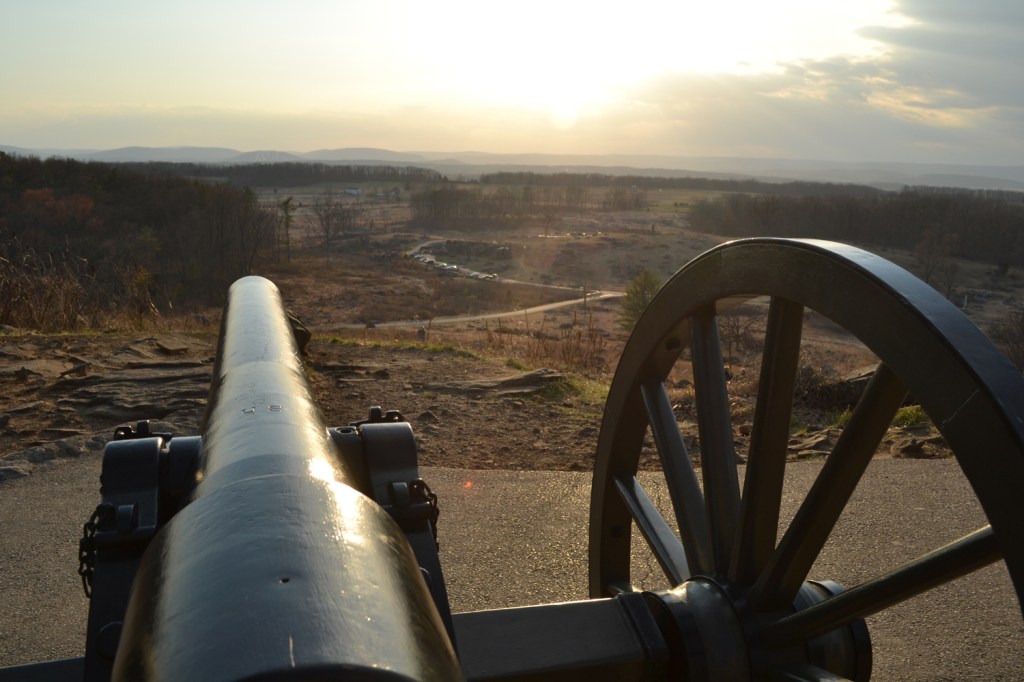
We looked around at the silent cannons—posed and waiting, like sentinels. Witnesses to the deadliest battle of the Civil War. I shivered.
We are sensitives—whether born or trauma-made. Drawn like moths to flame. To trauma. To death. To sacred, ruptured ground.
“It’s the energy,” my friend said. “Spiritual energy.”
I couldn’t disagree. What is spirit, if not supernatural energy? The Shekinah. The Holy Spirit. Energy.
She seeks to understand it. Me? I feel it. Especially trauma. It lights something up in me.
You don’t need a wild imagination to be humbled by Gettysburg. The place speaks for itself.
As the sun set (the park remains open until 10:00), we parted ways with the man—three strangers connected through invisible threads. Before he left, he said, “Be careful.”
We drove slowly through the darkening park and passed the Wheatfield. Suddenly, we both felt it—tingling skin, tight throats, nausea. The air felt electric, charged with something unseen. Then, as soon as we passed the bend, it disappeared.
“You felt that?” she asked.
We described it the same way. Yes, I had.
At Devil’s Den, we got out and wandered behind the granite boulders. A low rumble echoed nearby—maybe thunder, maybe phantom cannon fire. That’s not unheard of here.
My friend led me to a tall tree and stood still.
“There’s peace here,” she said.
But I felt dizzy. Nauseous. Unbalanced. “Stand next to me,” I told her. She did—and immediately felt the same. The air smelled metallic.
Blood, I thought, but didn’t say. I know that smell.
Maybe it was the dark. The uneven ground. But we didn’t feel normal again until we walked away.
Later, as we drove past Little Round Top, I was hit by sudden chest pain, nausea, and a sharp pain behind my eye.
For a split second, I thought I’d been shot.
I swerved and pulled over. The sensation vanished.
“Do you still feel peace?” I asked. “No,” she said. “It feels horrible now. So much death. I’m ready to leave.”
As we exited the park, we passed the same cannons we’d seen earlier—but I saw them differently this time. They were more than relics. They were keepers—of sorrow, of pain, of history we can’t possibly comprehend.
They reminded me of my own inner wounds. Silent. Unnoticed by most. But always there.
Not everything in life can be explained. But we’re not alone.
There are hundreds of thousands of us—like Tanner’s owner, like me and my friend—living on the fringe between the seen and unseen. We’ve experienced too much. We’ve been changed. And we’ve been given a gift: vision born from trauma.
A gift that lets us throw out the bathwater—and still keep the baby.
Maybe that’s why we keep returning to places like Gettysburg. Not just to understand the past.
I am a self proclaimed history buff, paranormal enthusiast with extensive history studying trauma. What would be more natural then for me to gravitate to Gettysburg, especially on such an epic occasion? These days, I am in Gettysburg at least once a month. Usually, you will find me wandering around areas of the battlefield with a camera. I try to capture in photos the moods of July 1863 and now for me as I walk across the once blood soaked fields.
These fields speak; the trees wail with woe, the buildings are still scarred from cannon fire. The battlefield is so vividly re-conditioned to its original state that I can literally walk where great and courageous men made split second decisions that saved many, killed thousands and helped bring a turning point to the Civil War. The history of the town, the people and the soldiers have been so painstakingly researched, preserved and presented for the next generation to remember.
Why do we still harbor strong feelings toward a war that ended over a hundred years ago? Because it is the one time where our own people turned and divided. Brothers fault and killed brothers. Neighbors killed neighbors. I come from Maryland, a state divided in the war. We were neither Yankee nor Confederate and yet we were both. So, there are many stories of families being ripped apart over the issues and ultimately burying their dead.
I used to find it hard to believe that people could turn on each other the way they did before and during the war. That is until recently when I started to hear rhetoric about taking up arms, parts of states wanting to succeed from the country over this issue or that. At times the vocal violence was so lethal, I found it frightening.
I don’t think most people have it within themselves to kill a family member or neighbor over politic differences of opinion. I’d like to think not. I know for sure, most people have never taken another person’s life and have no clue not only if they could, but what that would be like.
I’ve worked with enough veterans and police officers who do know. It’s not pretty. It’s easy to spout at the mouth about wanting internal war. I don’t think people realize if there was an internal war, we, all of us, would be the ones fighting. Not just enlisted people or trained militants. It would be our children, elderly and disabled injured and potentially slaughtered. Our food not able to be harvested from destroyed fields. Food that is harvested, not able to reach its destinations. It is our socio-economic system completely collapsing. There would be no, forgetting we are at war because it does not affect me unless I catch a glimpse on what we currently call the news.
We all need a dose of calming down and a reality check. Gettysburg, while now a thriving tourist destination, being home to one of the most explored, if not the most explored battlefield in the world, is one powerful reality check. For 150 years she’s been screaming at us. Don’t forget!
So, if you come to Gettysburg this year, especially during this celebration of remembrance, don’t’ forget. But at the same time, don’t’ let it swallow you whole. Depending on your own experiences and empathetic abilities, it can do that. Have some fun. There is a lot to take in.
I’ve decided to give you the, if I was a Gettysburg tour guide this is where I would take you, agenda. If your favorite haunt is not listed, well I couldn’t list them all. This is just my list compiled over forty years of visits to town.
Walking Along Cemetery Ridge
Must Haves When Coming to Gettysburg:
Patience! Crowds will be intense this summer and especially during the 150th anniversary. Remember, this is a walking town; pedestrians have the right-a-way. In the traffic circle, the cars inside the circle have the right-a-way. You can only go in one direction. When you get to your street, veer off to the right. Watching for traffic around you.
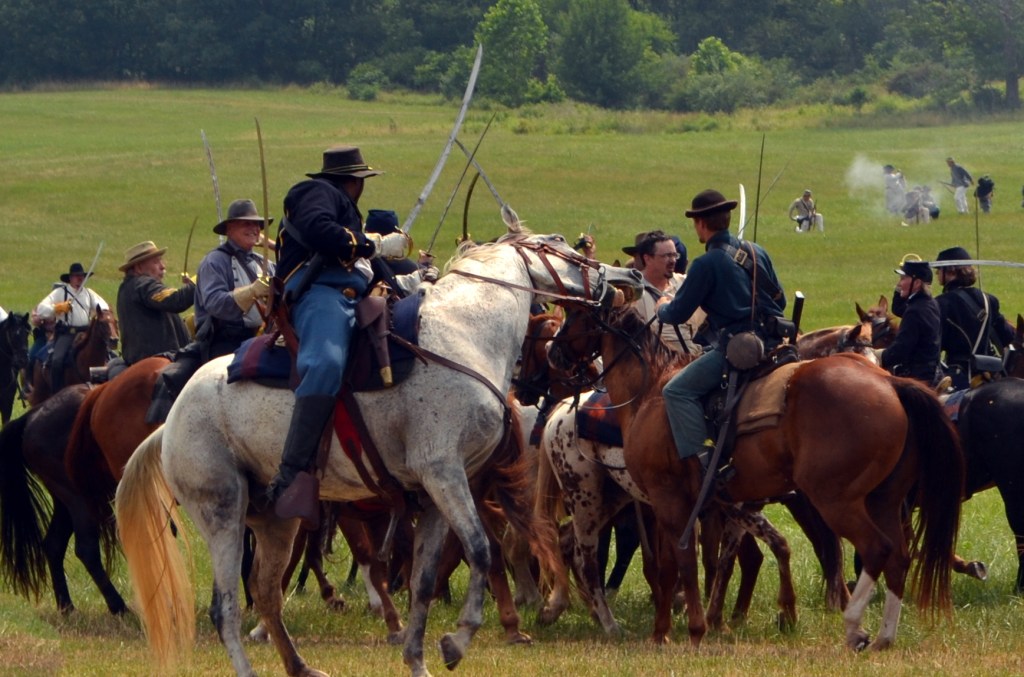
Sunscreen, lots of sunscreen, hats and or parasols. If you are going to the re-enactments, there are few to no trees. The sun gets intense. Remember to shield the kids!
Water! Bright sun and intense July heat equals dehydration. There are venders selling drinks all over town and at the reenactments. Lines can be long and many venders do not sell water. You can’t drink enough water.
Bring cash. Most places accept credit cards, but some venders, again, especially if you are going to a reenactment, may only accept cash.
Time. Give yourself plenty of time to get from point A to point B. Traffic will be difficult. The main historic district of town is located on two cross streets meeting at the traffic circle. Parking is limited.
A map of town and the battlefield. The re-enactments are not on the battlefield. The battlefield is not one large land mass. It surrounds the town and if you are looking for a particular battle location or monument, a map and or GPS is a must.
Sense of humor. Everyone is in town to have a good time, learn new things and experience a piece of history. There will be short tempers, babies crying, people walking into traffic, lines for restaurants and port-a-potties. Accept it and go with the flow. The park service is expecting over 20,000 re-enactors and half a million visitors this summer. Smile!
A place to stay! Don’t come to town expecting to find a place, even if it’s camping. Be smart; get your lodging ahead of time. I’ve heard people are staying in York, Hanover, Chambersburg and Harrisburg for the re-enactment weekends.
Pennsylvania Infantry Memorial
Must Dos (According to me):
Get in town early and have breakfast at one of the many restaurants. I’ve eaten several times at The Avenue Restaurant on Steinwehr Ave. across from O’Rorke’s Irish Eatery and Spirits. The cost is family friendly, food good and lines not too bad. OR
Go to the National Park Service Visitor’s Center and Museum. They have a 19th century eating establishment on site. See the film, cyclorama and the museum. The museum displays give a wonderful, easy to understand presentation of pre, during and post Civil War information and life. Visually stimulating, occasionally interactive displays allow for even the most museum skittish to benefit.
Buy the two hour Battlefield Auto Tour CD from the National Park Service bookstore before touring the battlefield. Stops on the CD correspond to the tour signs on the battlefield. The CD not only gives logistics about sections of the battle but re-enacts stories from the perspective of soldiers, town’s people and generals.
When on the battlefield tour, get out of your car and walk around! Check out the vantage points, variety of monuments and the stories they convey. There is a book you can purchase at the National Park bookstore called, So You Think You Know Gettysburg, by James and Suzanne Gindlesperger. It is an easy to use book giving GPS locations and stories behind some of the parks most memorable statues and monuments.
Rent a horse, Segway or book a bus to tour the battlefield. There are over 6,000 acres of battlefield with out-of-the-way roads and trails.
Have lunch.
Take a walk down Steinwehr Ave. Watch fudge being made in the Chocolate, Fudge and Ice Cream shop on Steinwehr Ave. Dress up in Victorian clothing and have your picture taken. Have a home-made ice cream cone, take in multiple gift shops, art galleries, book shops and souvenir venders.
Veer to the right at the corner of Baltimore Street and Steinwehr Ave. There are several bed and breakfasts, private historic collections and museums with minimal admission fees, candy shops, period clothing shops, restaurants and ghost tours.
Have dinner at either the Farnsworth House or Dobbins House Tavern. There are many great places to eat in town but for me, these historic locations with their ambience, period menus and service can’t be beat. Farnsworth House is located on Baltimore Street. Dobbins Inn is located on Steinwehr Ave.
Take in a ghost tour. Warning, there are several to choose from and one is not the same as another. Some take you directly in front of the building or location where the story takes place. Others only walk you around a circle, stopping here and there to tell a story. Some claim to promise seeing a ghost via orbs on your photos (orbs most likely to be dust, bugs, dew or other weather related element). Some tell stories with minimal to no factual back story. While others give factual, historical information behind the stories and town’s people’s antidotes of unexplained events. You can have a great tour but a minimally effective tour guide and visa-versa. Guides expect a tip after the tour.
My favorite ghost tour is Ghosts of Gettysburg on Baltimore Street. The author, Nesbit wrote the series Ghosts of Gettysburg and runs this operation. Reservations are recommended. I prefer the longer tour as they take you down to the train station and college as well as around town.
End the night head down to the Lincoln Diner at 32 Carlisle Street for a great piece of pie. Located across from the Railroad Station, this college diner is known for its large, scrumptious deserts.
Sach’s Bridge
If you have a second day in town, check out the Jenny Wade house on Baltimore Street. Take a carriage ride. Check out the Lincoln Train Museum on Steinwehr Ave., Soldier’s National Museum on Baltimore Street, and Hall of Presidents also on Baltimore Street. Talk to some re-enactors stationed in encampments about life as a soldier. Pay your respects at the National Cemetery and location of President Lincoln’s famous address.
Little Round looking down on Devil’s Den
At the end of the day, find a large rock on the battlefield at Little Round Top and watch the sunset over Devil’s Den. This location, where thousands lost their lives in the Valley of Death is oddly serene and quiet in the rays of the setting sun. While you are there, don’t’ forget the message these hollowed fields deliver. Find peaceful resolutions. War is not the answer and it’s never what we expect. Once started, it’s hard to turn back.
Kansas is the flattest place I have ever seen. Pancake flat. I-70 is one long stretch of flat, mile after mile of farmland speckled with occasional bouts of religious billboards. If you want to find your fate in the afterlife based on a billboard, I-70 in Kansas is the place to be.
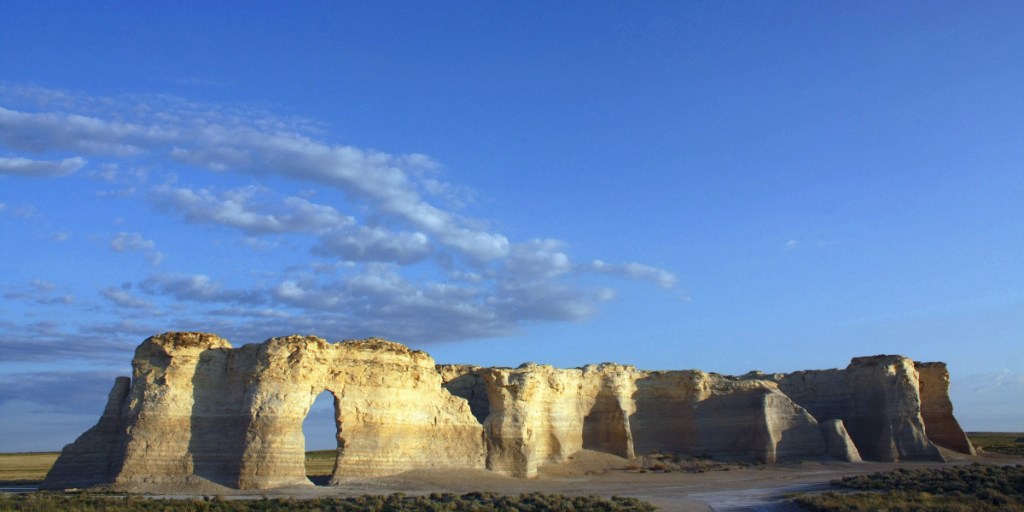
Nestled deep in all this flatitute is a natural site that took my breath away. I called it the Monument Valley of the Mid-west. They call it Monument Rocks and Castle Rocks. We found it only because of a small sign on the side of the road and a reference in the Welcome to Kansas booklet.
It is located down a very long, meandering, dirt road through private ranches. There are no fences and cattle do have the right-of-way. The monoliths are considered a National Monument by the Department of the Interior and one of Kansas’ wonders.
I was positive, despite the sign saying public monument; we were going to get shot for driving across someone’s ranch. There was no hiding. There were no trees or buildings for most of the twenty-some miles of dirt road to the monuments.
They seemed to erupt out of the flatland before our eyes. Buttresses of chilling, lonely, death-white stone at least two stories high. We slowed the van down to a crawl and said nothing. There were no words to describe the awe in this eighty-million-year-old byproduct of the Niobrara Sea that once traversed from the Gulf of Mexico to Canada though this site.
I got out of the van and just stood. The only sound I heard was wind singing around and through the stone arches. The milky buttresses hungrily sucked in the rays of the bright sun leaving nothing behind. They were not quartz as I expected, but made of white chalk with streaks of grey lines.
I walked around the monoliths and arches trying to wrap my brain around my feelings. It was more than mere awe. It was spiritual. I was walking in the footsteps of countless others before me and walking over countless fossils of marine animals long ago extinct. I pulled out my camera, a video recorder and a digital voice recorder. I walked around for about an hour taking over a hundred pictures, a video, and recorded my thoughts and the environment. I left knowing I had not succeeded in capturing the experience. Some places refuse to be captured.
As we pulled away, I felt remorse and watched the site disappear in the dusty trail of our van’s wheels. I often tease that I am a restless wanderer but in this place, I felt grounded. If you get a chance, go see it. I understand the land where it sits was sold late last year but I am under the impression, visitors are still welcomed. ** Beware of rattle snakes! There are no bathroom facilities! *****
Directions: (derived from Kathy Weiser’s site, Legends of America)
Monument Rocks is located about 28 miles southeast of Oakley Kansas. Take U.S. 83 south, then 4 miles east on Jayhawk Road, 3 miles south, and 1 mile east (dry weather road only). From Scott City, travel 18 miles north on U.S. 83, east 2 miles on Dakota Road, 1 mile north, 3½ miles east, and 2½ miles north.
Castle Rock can be reached by taking the Quinter Exit #107 off I-70, traveling 15 miles south on Castle Rock Road to the intersection of GO-80 and GO-K, then 4 miles east to Castle Rock sign, and north across a cattle guard (dry weather road only).
Listening to the Sounds of Nothing ~ Approx. 4–5 min read
Monument Valley
Monument Valley National Park spans the corners of Utah, New Mexico, Arizona, and Colorado, and rests within the Navajo Nation. I’d never been, but something about that red earth called to me. I wasn’t interested in the usual dirt drive tourists take. I needed more. I needed connection.
My husband and I hired a Navajo (Diné) guide and climbed into his jeep. He took us to parts of the valley off the beaten path. About two-thirds through our tour, nearly axle-deep in rich orange sand, he stopped the engine.
“What do you hear?” he asked.
“Nothing,” I said. I had never heard nothing before. My heart beat faster.
“Exactly.”
He grinned, turned the key, and we continued through the quiet, swerving toward a towering sandstone alcove. Once parked, he motioned for us to follow.
Inside the alcove, the temperature dropped twenty degrees. He told us to lean against the stone wall, and we did. The rock was smooth, cool, grounding. I closed my eyes. I didn’t want to leave.
Again, he asked, “What do you hear?”
This time, I heard our breathing echoing in the stillness. Then he began to sing. Words I didn’t understand in a rhythm that seeped deep into my bones. His voice reverberated across the alcove in a way that felt like a secret between the rock and my soul.
He stopped. “Isn’t that something?”
I couldn’t answer. My body felt full and hollow at the same time. He nodded, understanding.
“We have to go back,” he said.
I didn’t want to. This encounter changed me, inspired me, and saddened me as well. What did it mean?
The Gift
Later,we detoured to a cliffside overlook where you can view ancient dwellings carved into the stone. As I walked the path, an elderly Native woman and a teenage girl approached me. The woman held a necklace—glass beads and juniper berries with a wire dreamcatcher pendant.
She said something I didn’t understand. The girl smiled. “It’s a gift,” she said. “From my grandmother.”
I hesitated. Was this a tourist trap? A silent exchange of expectation?
Maybe I looked wary because they grew more insistent. So, I took the necklace and said thank you. They both smiled, then disappeared up the path.
After taking my photos, I returned to find a tin can on a folded blanket with a few bills and coins inside. I dropped in a twenty, unsure if I’d just honored or violated something sacred.
And that’s the word that felt right–sacred. I felt at one with the universe, hearing something most people will never hear—nothing. And it was powerful.
The necklace hangs on my wall, a quiet reminder that in stillness, we touch the sacred.
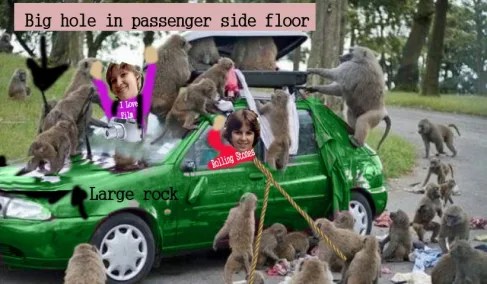
What do you get when you mix a lime green Datsun with floor portholes, a trunk full of Twinkies, and an angry mob of monkeys? A safari detour gone spectacularly wrong—and a car barely held together by granite and hope. Hang on tight for this laugh-out-loud road trip through chaos, feathers, and fur. (Reading time about 8 minutes)
It was a two door, 1971, lime green Datsun B-210 with a black vinyl roof. Custom detailed with dual, on-the-floor, port holes for your road viewing pleasure. An additional emergency pull-rope release added onto the driver-side door for times when it’s not cool to use a handle. And a specially designed hood bent into the majestic shape of a steep mountain. Perfect for quick engine checks and radiator ventilation without having to fool with antiquated, interior, hood releases. The five pound Massachusetts’ granite, air-filter and cover-attachment-system fit perfectly under the shape of the hood.
Roach clips, never used, with hot pink feathers are swinging to the riffs of Keith Richards’ bass guitar and Mick Jagger’s edgy vocals. It’s Sue’s car. To the world, I am a Lennon/McCartney girl. Behind closed doors, I’m a Richards/Jagger mistress. I have a Sweet Pollyanna Purebred reputation to uphold.
We’re in New Jersey on a sweltering hot, July morning after a heavy rain. The smell of evaporating water on asphalt whiffs through my passenger side, floor porthole. I watch the macadam and occasional puddle fly by my feet straddling the hole.
“Let’s go see the monkeys at the drive-thru safari,” I suggest. I’d seen a sign just outside of New York City. “We’re only twenty miles away.”
“Sure, why not.” Sue replies. Sue is a tomboy. Something she readily embraces. This is evidenced by her grungy rock band tee-shirts, faded jeans, cowboy boots, and hat, slightly greasy dirty blonde hair, and automotive grease under her fingernails. She was always tinkering with the car.
I used to be a tomboy but exchanged it for grace, poise and the showmanship my performance persona demanded. I envy Susan’s grunge while I sit here in a crisp white pair of shorts, turquoise and white spaghetti strap tank top, with appropriately and pain staking matched jewelry. My white Jack Purcells are as spotless as my fingernails which have never touched motor oil.
The car wheel hits a puddle, splashing muddy water into my floor porthole. My crisp, clean whiteness is now a muddy, drenched mess. Water is running off the end of my pampered, Maybelline, light beige covered nose. It took me fifteen minutes trying to find my reflection in a campground mirror this morning to get this nose well blended!
Susan looks over at me and asks. “What the hell? How did you get all wet and muddy?”
“Oh I don’t know. Something about a hole in the floor that needs fixed.” At least my Nikon camera and accessories didn’t get wet. I look around for something to use as a towel but only find our mildewed tent, sleeping bags, duffle bags, firewood, a half empty bag of potato chips and an unopened box of Twinkies.
“Serve’s you right for wearing white!” She laughs, pulls the 8 track tape out of the dashboard, shakes it and puts it back in. I have no idea what this ritual does but this will be the sixth time I’ll hear the song, I Can’t Get No Satisfaction, in the past two days.
A kid with pimples greets us at the safari gate. He announces to no one, “Twenty dollars, stay in your car, the windows can be down except in the monkey enclosure, don’t feed the animals, the animals have the right a way, don’t stop in the monkey enclosure, take all the pictures you want, have a nice day.” He takes a breath. We drive on to join a long line of slow moving vehicles.
Our windows are down so I can take pictures without a glare. I tend to see everything through a camera lens. I go almost everywhere with my gear ready for that opportune moment. Several cars ahead, I see two mammoth gray ostriches weaving between them. Occasionally they case a car, seemingly looking for trouble. This could be that moment.
“Hey look.” Susan says as she points to the birds. “They’re getting really close. You might actually get a good picture.”
The birds are now several car lengths away. I look at my camera and realize I don’t need the telephoto lens so I bend down to get the 50 mm.
“Um,” Sue says. Her voice sounds a bit distressed but not enough for me to sit up. “Um, don’t, okay, just don’t get, um, I think we might have a problem.” I cock my head toward her to figure out why she suddenly forgot how to formulate sentences. Her face is oddly drained of color. “Right now,” she continues in a near whisper. “Don’t move, Debbie. We have a serious problem happening.”
I slowly turn my head to face the largest beak I’ve ever seen followed by two, large, black eyes on a face covered by prickly hairs. I definitely remember the animals have the right of way.
The beak, eyes and prickly hairs jolt past me heading for the back seat. It’s followed by an incredibly powerful, prickly haired, neck and a body of varying shades of musky smelling, gray plumage that completely covers my window opening. I’m pretty sure the 50 mm lens is the wrong one. What I really need is an extreme wide angle lens. But that‘s okay because I don’t think the ostrich is in the mood.
The gray plumage and powerful, prickly haired neck whip back out my window with the half-eaten bag of potato chips covering its eyes and beak. It’s really very stunning. The red and white of the family size, chip bag, against the increasingly frantic varying shades of musky smelling, gray plumage now in full regalia is so avant-garde. I can’t decide what strength and angle of flash to use on all this gray plumage with the very overcast, gray sky in the background. This would be a great shot in subtle shades of grays, blacks and white in the style of Ansel Adams.
“Put the window up!” Susan yells. “You’re gonna get in so much trouble for feeding the animals!” I really didn’t need to get into anymore trouble. I nervously try to push strands of my honey blonde hair behind my ear without success. It’s cut too short.
I look over at Sue’s white knuckles wrapped around the steering wheel. Her breathing is labored but is curiously in rhythm with her head shaking left to right and back again. It’s not my fault the damn bird likes chips. Not that it matters. I glance around the back seat for damages. Except for a few remaining terrified chips scattered hither and dither, all seems normal. The chips were destined for consumption anyway. What’s the problem?
“Well,” I tell her, “at least they didn’t get the Twinkies.” I can see from Sue’s expression there are no words to express her feelings on the topic. We start moving forward again.
The monkey enclosure looms ahead with its two-story cement walls topped in high voltage wire. Cars are only allowed through the massive wood and steal double doors at select intervals. Two armed animal control wardens monitor the opening diligently.
“They did say this is a monkey enclosure, right?” I ask. Sue nods yes and pulls the car up to the stop line before the immense, fortified doors. I recheck the settings on my camera.
A warden steps up to Sue’s window and says, “Door’s locked, windows up, don’t stop, no exceptions – got it?”
The massive doors open wide enough to swallow us and no wider. We pull through and they close quickly behind us. I look around expecting to see a cross between Godzilla and King Kong. I see nothing but the road we’re on and a well manicured lawn with lots of low shrubby trees. There is a red car about three hundred feet ahead of us moving slowly..
A large, gray-brown male macaque steps out from behind a tree onto the road ahead of us and sits down. Sue stops the car. His steal, green eyes watch us, the animals in the cage. He’s in no hurry to move. Peripherally, I see movement and turn to my right to see macaque mother’s with their babies.
“Check it out!” I tell Sue. “ Aren’t they cute?” I want to shoot a picture but my window has animal slobber all over the exterior. “What does it look like out your window?” She doesn’t answer and I turn to find out why.
On her side of the car, the one with the convenient, emergency, pull-rope door release, a line of fidgety, gray-brown fury bodies with green eyes watch us.
“This can’t be good,” Sue says. She turns the tape player off and we wait in silence.
The large, gray-brown, male macaque responsible for stopping the car jumps onto our mountain shaped car hood. He yawns, shakes his head and urinates all over the window.
“That’s something you don’t see every day,” I say and take a picture.
“This isn’t gonna to be good. I think we might have a problem,” Sue whispers.
Urine-monkey stands, flaps his arms, and opens his mouth displaying sharp incisors and screeches like a banshee. Suddenly, al I see out any window is a gray-brown, fury, moving carpet. The car shakes and bounces reminding me of an amusement park ride. I struggle to turn and look out the back window and see black ash rain.
“Sue, is that your black vinyl roof?” I ask. Thousands of pieces of black vinyl roof slide down the back window. I brace the camera against the rocking car seat and shoot a couple shots of the storm.
“Oh hell! No!” Sue yells. I spin around, jostled off balance as I go. “ They’ve got the rope!”
I lean over to assess the situation. Five monkeys are in a line pulling on the convenient, emergency, pull-rope release. It’s the exterior part with the knot we untie to release the door. Sue has the other shorter, interior end in hand. It’s obvious they have more leverage then we do. I can’t grab the rope. Sue is in the way. So, I move back to my side of the car. Counter balance, I figure.
My side of the window is now void of fur and I have a clear, abet smudged shot of the baby monkeys with their mothers. What the hell? I shoot a couple shots at different focal lengths and apertures, trying to adjust for the rocking motion of the tug of war occurring on the driver side of the car.
“What the hell are you doing?” Sue yells at me. I spin and look at her.
“I’m taking pictures.” I say and notice her eyes. Their size and her panic enhance their green and brown color making them look wickedly, earthy in this light. I shoot a picture.
“They’re going to kill us, you know.” She struggles to wrap the small section of rope around her arm like she was wrapping a garden hose.
“I suppose this is not a good time to tell you I think disassembling and reassembling the car door last night was a bad idea on your part?”
A blue mini-van filled with kids passes. My window is once again covered in fur but I see camera flashes. I realize the mini-van has a better point-of-view then I do. What good is expensive camera equipment if your point of view is wrong?
I’m distracted by the sensation that my shoe is moving on its own accord. I look down. Little hominid fingers have hold of my muddy, Jack Purcell shoe laces. Crap, I forgot the porthole. I yank my foot up but quickly halt. There is an arm and a shoulder attached to the hand and I’m pulling them inside the porthole. This would make one hell of a short video if I had a camcorder with me.
“Do something!” Susan yells. “Now! Put the damn camera down and kick that beast back to hell! I listen and obey.
The car stops rocking and the windows are fur free. The porthole is empty and the rope release on the door is limp. It’s no longer raining black ash. I take a picture of the empty, now larger porthole between my feet. I look up to see a warden in a bright yellow jeep beside us. He looks perturbed. The monkeys act aloof and I don’t know what I look like, but Susan looks like hell. He motions for us to follow him and we do.
“Go to the clerk,” he says. “She’ll take care of the damages.”
We park the car; examine all the thin, side, metal trim now jutting out at odd angles, the driver’s side door no longer sitting flush with the frame and the hole in the black vinyl roof.
“My poor car,” Susan says.
I look at the misshaped hood, the remains of the rope hanging off the broken door and my muddy Jack Purcells, complimentary of the floor porthole. “Yeah, it’s a shame.”
“There is no way the clerk is going to believe this,” Susan says. “Well, we might as well find out.”
We walk over to an office and I proceed to gingerly, almost embarrassingly explain our situation. I know they are going to look at Sue’s car and think we’re idiots.
“Damn monkeys,” the clerk says. “I bet your car is green. There is something about green cars. Take your car over to the park police. They have to make a report and photograph the evidence.”
We drive the car over to the police station. A pudgy, black officer steps out with an antiquated Polaroid camera in hand. “The monkeys did all this?” He asks while circling the car, stopping to look at the Massachusetts’ granite under the bent hood and the missing car floor from my open window. He looks directly at me.
I’m horrible at lying. Ever since I can remember people have told me, don’t play poker! “No.” I tell him.
“So, what damage did they do?” He’s still looking at me. I shoot a look over at Susan who’s shuffling her feet nervously.
“The roof and the metal, jutting out thingies,” I say.
“Thought so,” he says. He takes a couple Polaroid shots and waits for them to develop. “Are you two far from home?”
“Five hours, maybe,” I reply. Not sure why this is important.
“This car is a death trap. You know that?” He’s still looking at me. It’s not my car. I keep quiet.
He comes over to my side and shows me a very tiny, poorly exposed picture of Sue’s car. “This doesn’t quite do the car justice, does it? I bet if you used your camera, we could really see the damage.” He pauses, looks at me, Sue and then the car. He sighs, pulls out a pocket knife and slashes the monkey made hole in the roof and pulls it back exposing the metal. He snaps another picture and looks at me. “I think this might get the point across.” What am I supposed to say?
He takes Susan into the station to fill out paperwork while I stand guard over the car. I’m not sure how we’re going to get the car home with all that metal hanging off the sides. Sue comes out with a smile on her face. They paid her twice the amount of money she originally paid for the car – six hundred dollars.
“Ready to go home?” She asks.
I look over at the metal protrusions. “What about these?”
“That’s not a problem.” She pulls the metal completely off each side of the car and shoves them in the back seat with the moldy tent and Twinkies.
We drive back to Maryland in silence. I know my pictures will all be blurry and I’m bummed. We pull into the driveway, and as we unload the car, it hits me, and I stop moving.
“What?” Sue asks.
I turn and look at her. “I should have put the camera on automatic instead of manual.” I can see from her expression there are no words to express her feelings on the topic.
“Have you ever watched a turtle?” an Oneida woman asked me from behind the counter at the Shako:wi Cultural Center in Oneida, New York.
“Not really,” I admitted—but told her the subject of turtles kept coming up in my life.
She smiled. “Turtles are slow, steady, and strong.”
As she gave me a tour of the center, I mentioned I was looking for a book about Deganawidah and Hiawatha—figures I admired from Travels in a Stone Canoe. I also picked up one on the Oneida creation story.
“It’s the turtle that grows and becomes the island of North America,” she said.
Months later, I found myself at a Lenape inter-tribal Winter Solstice gathering in Pennsylvania, deep into the night as we sang the Walam Olum, the Lenape creation story. As I read along, the words jumped out: and the turtle became the foundation of the earth.
Turtles again.
Overheated and restless, I stepped outside into the cold. A man wrapped in a wool blanket joined me by the fire. “I’m Walking Bear,” he said. “You looked cold. Drum too loud?”
“I just needed a break,” I told him.
He studied me. “What do you know about turtles?”
“Not a lot,” I replied.
“I saw you inside,” he said. “Sometimes, you reminded me of a turtle. Other times, it looked like you forgot how to be one.”
“Turtles are slow, steady, and strong,” I offered.
He nodded. “Turtles carry the horrors of the world and remain connected to the Creator. You have a turtle shell. I see it.”
Then, pausing, he asked: “You’ve seen the Creator, haven’t you?”
He didn’t know me, didn’t know about my near-death experience, my years of service to others, or the guilt-driven urgency I carried. I said nothing. He was called back inside. I never saw him again.
But I couldn’t stop thinking about turtles.
I researched turtle totems, animal behavior, legends—driving my friends nuts. Everyone told me to slow down. I didn’t listen.
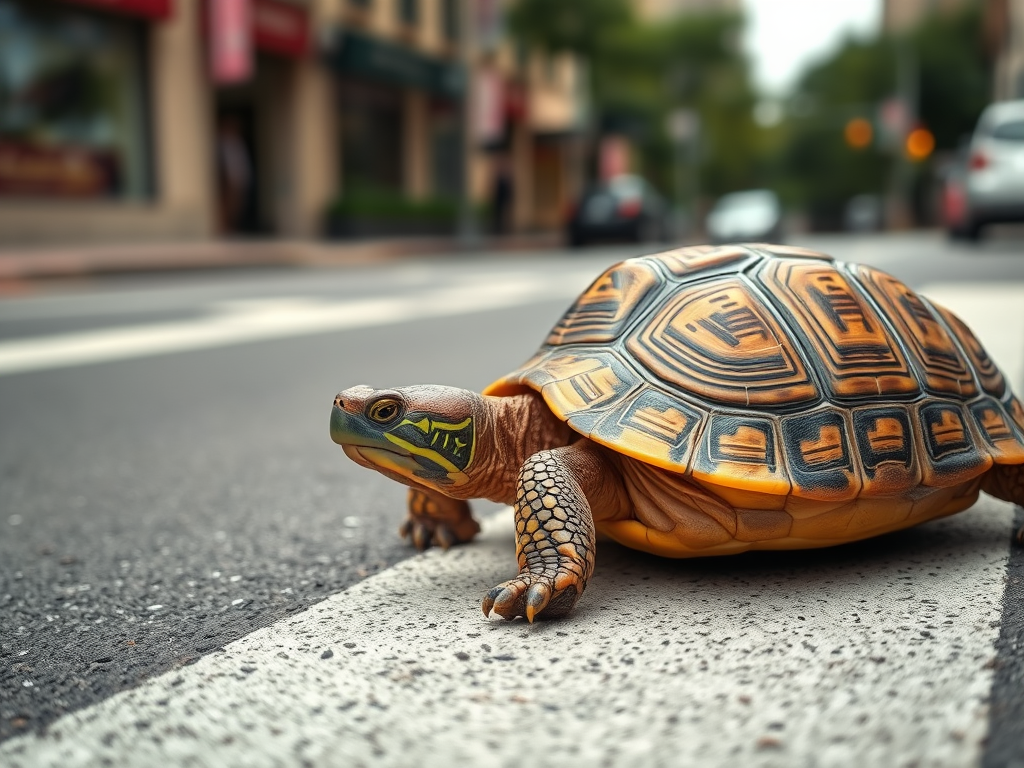
Then one summer in Oriskany, a large turtle stopped in front of our RV and stared us down. I jumped out, laid on the road, face-to-face, and begged it: What does this mean?
No answer. It eventually turned and walked away—slow, deliberate, unbothered. I watched until it was safe, mildly disappointed.
Weeks later, before a major presentation—my first in 25 years—I was spiraling. Panicked. My friend, sharing the hotel room, finally snapped: “Go splash your face. You’re driving me crazy.”
In the bathroom, a silver turtle charm fell out of the washcloth.
Tears welled in my eyes. I rushed out. “Look! The Creator sent me a turtle!”
My friend sighed, picked up a pillow, and whacked me. “I put it there, genius. Maybe I’m the miracle. Ever think of that?”
She was right. I calmed down. The presentation went beautifully. Had I been rushing, I would’ve missed that moment entirely.
Months later, burned out, sick, and disconnected, I knew I couldn’t keep living that way. I began training my replacement—an ex-priest who, somehow, knew what I needed better than I did. On my last day, he handed me two gifts: a stitched saying, To help another person is to touch the heart of God—and an Oneida creation story print.
Of the turtle.
“You’ve got the shell,” he said. “You just need to live like it.”
I didn’t get it then. Not fully. It took four more years, a chronic illness, and finally crashing from overdrive to understand. I’d been trying so hard to prove I was worth the second chance I’d been given, I forgot how to live it.
Now, forced to slow down, I hear more: in doctor’s offices, waiting rooms, quiet walks. I catch moments I used to miss.
“Slow down,” the man said. The turtle says it too.




 Deborah Sickle Hill


