Category: supernatural

  • Memento Mori- Remember You Will Die

    MEMENTO MORI- REMEMBER YOU MUST DIE

    Call me morbidly curious, gothic—not goth, macabre, perhaps even a dark coper. They all mean about the same thing. Paraphrased from the dictionary, someone having a fascination for dark and unpleasant subjects, the supernatural, death, and melancholy. A dark coper, a person who uses scary media to process fear to gain a sense of preparedness for real-world dangers.

    You would never know this looking at me. I don’t advertise. This leads me to a quandary: trying to explain my writing to people who view dark fiction (horror) as slasher movies and grotesque. Yes, there is a market for this type of film. It’s not my market, and it is definitely only a sub-genre of a vast cornucopia of artistic endeavors.

    To me, a good dark fiction novel contains deep, well-rounded characters with strong arcs and meaningful relationships. They encounter, because of their own actions or the actions of someone or something else, a situation(s) leading them to a life and death situation. Physically or psychologically. A cause to reevaluate everything they thought they knew about life. A chance to make a difference. An opportunity to do the greater good—even if the result is self-sacrifice.

    Yes, there are works of fiction where the antagonist is the main character. The twists and turns of a mind deliberately cause the protagonist to struggle. Even then, both the antagonist and the protagonist need to be well-rounded characters—why else would you root for success? Though in some situations, the result is disquieting as the antagonist wins, leaving the reader with their own sense of dread or self-evaluation. The Invasion of the Body Snatchers is a good example of this. Spoiler: the aliens win.  

    Someone asked me, “Why do you write horror? Why not write romance or dramas?”

    All my novels contain historical drama and romance. However, my answer is simple.  It’s a great way to have a safe place to explore fears and past traumas. It’s cathartic, entertaining. I like it when a character beats the odds and comes out whole. And of course, it harks back to Memento Mori. I’m drawn to it like a moth to a flame, unable to resist its calling.  (Not today—at least I hope not!)

    To date, I’ve written and self-published two fiction books. Death in Disguise is a dark murder mystery taking place in the 1950s in a small fictional town. The Revelation is a dark, supernatural tale set on an archaeological site in the 1980s. My latest finishedwork, currently vying for an agent, is called Dark Consequences, about an Irish famine victim, forced to come to America, where he makes a fateful decision bringing death to the small quarry community where he settles. It’s book one of a four-part series.

    If you’re interested in well-developed characters living somewhere in history, a solid cast of characters and plots where the consequences of decisions are life-changing, exploring the world of the supernatural, give me a try. I’m really not that scary.

  • How Many Sleeps Do You Have?

    How Many Sleeps Do You Have?

    How Many Sleeps do You Have Left?

    This is the question my 4-year-old grandson asked me.

    “What do you mean?”

    “You know, how many sleeps do you have before you have to go to heaven to see Jesus?”

    Blew my mind away. How do you answer? I told him nobody knows how many sleeps they will have before they meet Jesus.

    “But how many sleeps? A couple or a lot?”

    “So many sleeps I can’t count them.” Is my answer. It seems to satisfy him.

    There was the time when my 4-year-old granddaughter asked me.

    “Do you remember when I was your grandmother. I always loved you so much.”

    Blew my mind away. How do you answer? I told her, “Why not tell me about some of our times together?” 

    My memory is clear, as I was very close to my grandma. Granddaughter smiles, takes my hand, and we play.

    How about you? Do you have any experience with young children asking you profound questions concerning the afterlife? Tell me in the comments. I’d love to know.

  • THE LONG GOODBYE, THEN THE SILENCE

    THE LONG GOODBYE, THEN THE SILENCE

    My uncle was dying in a Florida hospital, a thousand miles away. The call came early: Expect the inevitable. Keep your phone close.

    He wasn’t just an uncle—he was a second father. But I was home with my daughter, helping her recover from major spine surgery. She needed me. I couldn’t leave.

    All day, I juggled logistics, wondering if I could fly down. My mother said, “Let us visit the hospital, then we’ll talk tonight.” But the call never came.

    By midnight, my imagination took over. Maybe he’d already passed. Maybe they were too distraught to tell me—like when my sister died when I was seven and I couldn’t say goodbye.

    At 12:30 a.m., I half-joked to my daughter, “Maybe he’ll come say goodbye.” I thought of my grandmother’s rocker that moved by itself after she died. Surely my uncle could find a way.

    Unable to sleep, I crept downstairs for Lucky Charms, passing my late sister’s Chatty Cathy doll. I pulled out my uncle’s old camera, set it on the table, and cried until empty. Then—a shadow at my feet. I screamed. The milk went flying.

    “Meow.” Just the cat.

    The phone rang—he was still alive. Instead of relief, I felt emptiness. The next night, the real call came: my uncle was gone. I went numb, then collapsed into wailing.

    I’ve seen a lot of grief in my practice, and I know: do whatever healthy thing you need to survive. I let my thoughts spiral. I isolated. Days later, I picked up his camera and started shooting stills while playing childhood music.

    My office door swung open. A warm, healing feeling washed over me—comforting, not frightening. I like to think my uncle came to give me a hug. It was what I needed to begin the long, twisting road of healing. Who are you to tell me it was anything different?

    IF YOU ARE GRIEVING, KNOW THESE THINGS:

    • No one grieves the same.
    • Don’t let anyone tell you you’re taking too long.
    • Use your support system.
    • Keep a treasured object.
    • Write letters to your loved one.
    • Join a support group when ready.
    • Seek counseling if you’re struggling—or simply to talk.
    • Pray, meditate, or find your own way to connect.

    If you’re grieving, my condolences. I hope my experience helps you on your journey. —Debbie

  • Spiritual Detours – Gettysburg

    ©Deborah Hill

    (This is NOT FICTION)

    Have you ever heard the saying, “Don’t throw out the baby with the bathwater”?

    A friend and I have both survived near-death experiences—events that altered us permanently. On long drives, we often dive deep into conversations about spirit, soul, God, and nature. We’ve walked away from rigid dogmas—those rules imposed by religion that demand your belief to belong—and instead, we’ve chased after truth. Real truth. The kind you feel in your bones.

    Hence, throwing out the bathwater and keeping the baby.

    That mindset often leads us to places charged with meaning. On this particular day, we felt called to Gettysburg National Battlefield.

    We took the Taneytown exit just before sunset. As we approached the old Cyclorama, my friend said quietly,

    “I feel something pulling me here. Something important.”

    “Tell me when to stop,” I said.

    “Stop.”

    We parked beside an older man and his massive Irish Wolfhound, Tanner. He greeted us kindly and shared that he was a local who came to the battlefield seeking meaningful encounters. Usually, he sat at Little Round Top. But tonight, he’d felt drawn here instead.

    He’d had a near-death experience—just like us.

    For over an hour, the three of us stood and talked. About life. About death. About energy, God, and the battlefield itself. “This place is alive with spirit,” he said. “Something here vibrates because of the hell that happened.”

    And I understood exactly what he meant.

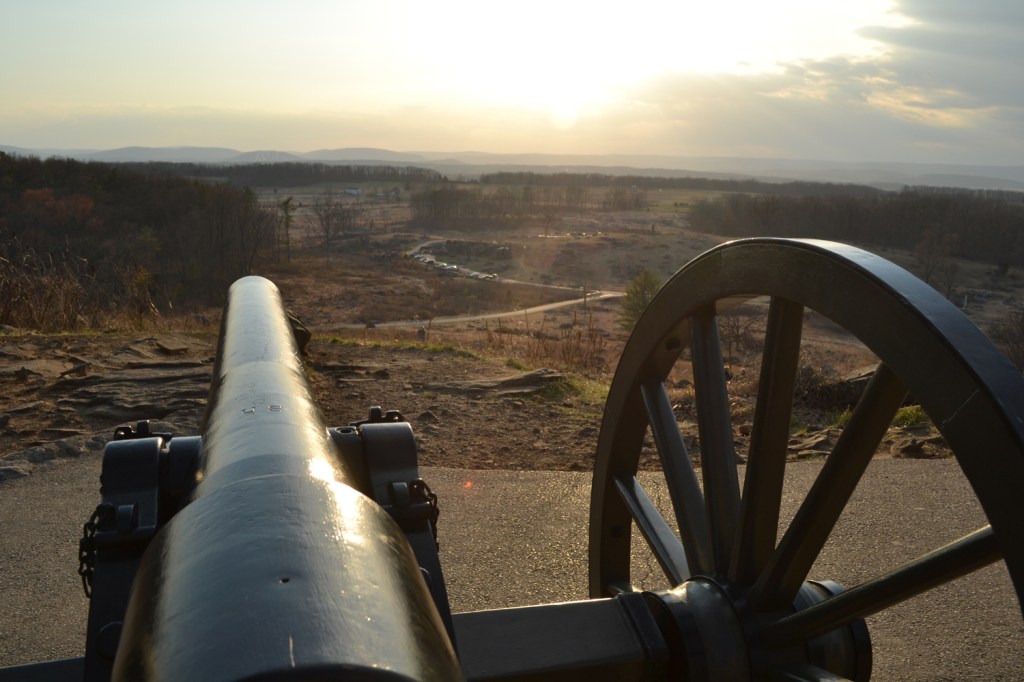
    We looked around at the silent cannons—posed and waiting, like sentinels. Witnesses to the deadliest battle of the Civil War. I shivered.

    We are sensitives—whether born or trauma-made. Drawn like moths to flame. To trauma. To death. To sacred, ruptured ground.

    “It’s the energy,” my friend said. “Spiritual energy.”

    I couldn’t disagree. What is spirit, if not supernatural energy? The Shekinah. The Holy Spirit. Energy.

    She seeks to understand it. Me? I feel it. Especially trauma. It lights something up in me.

    You don’t need a wild imagination to be humbled by Gettysburg. The place speaks for itself.

    As the sun set (the park remains open until 10:00), we parted ways with the man—three strangers connected through invisible threads. Before he left, he said, “Be careful.”

    We drove slowly through the darkening park and passed the Wheatfield. Suddenly, we both felt it—tingling skin, tight throats, nausea. The air felt electric, charged with something unseen. Then, as soon as we passed the bend, it disappeared.

    “You felt that?” she asked.

    We described it the same way.
    Yes, I had.

    At Devil’s Den, we got out and wandered behind the granite boulders. A low rumble echoed nearby—maybe thunder, maybe phantom cannon fire. That’s not unheard of here.

    My friend led me to a tall tree and stood still.

    “There’s peace here,” she said.

    But I felt dizzy. Nauseous. Unbalanced.
    “Stand next to me,” I told her.
    She did—and immediately felt the same.
    The air smelled metallic.

    Blood, I thought, but didn’t say.
    I know that smell.

    Maybe it was the dark. The uneven ground.
    But we didn’t feel normal again until we walked away.

    Later, as we drove past Little Round Top, I was hit by sudden chest pain, nausea, and a sharp pain behind my eye.

    For a split second, I thought I’d been shot.

    I swerved and pulled over.
    The sensation vanished.

    “Do you still feel peace?” I asked.
    “No,” she said. “It feels horrible now. So much death. I’m ready to leave.”

    As we exited the park, we passed the same cannons we’d seen earlier—but I saw them differently this time. They were more than relics.
    They were keepers—of sorrow, of pain, of history we can’t possibly comprehend.

    They reminded me of my own inner wounds.
    Silent. Unnoticed by most. But always there.

    Not everything in life can be explained.
    But we’re not alone.

    There are hundreds of thousands of us—like Tanner’s owner, like me and my friend—living on the fringe between the seen and unseen.
    We’ve experienced too much.
    We’ve been changed.
    And we’ve been given a gift: vision born from trauma.

    A gift that lets us throw out the bathwater—and still keep the baby.

    Maybe that’s why we keep returning to places like Gettysburg.
    Not just to understand the past.

    But to connect with a world we can’t always see.

  • Writing the Ghost Story

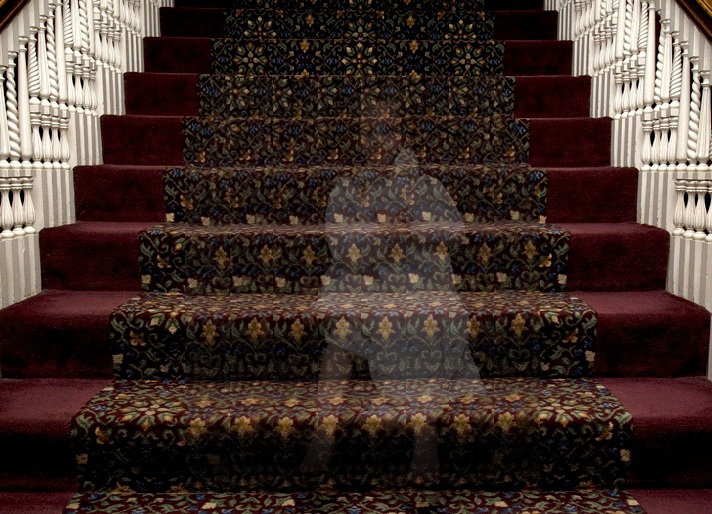
    Altered Image: Ghost on Stairs, Stanley Hotel © Deborah Hill


    Writing the Ghost Story

    4-5 Minute Read

    What makes a ghost story truly haunting?

    Ghost stories have chilled our bones for centuries—not just because of the specters themselves, but because of what they stir in us. The best ghost stories don’t just go bump in the night; they linger, unsettling our minds long after the last page is turned or the fire has burned low.

    If you’re hoping to write a ghost story—whether spine-tingling, sorrowful, or somewhere in between—here are a few timeless elements to guide your way:


    1. Atmosphere Is Everything

    A compelling ghost story begins with setting. Think of your setting not just as a backdrop, but as a character with a mood of its own—dripping with memory, silence, or decay. A fog-drenched marsh, a creaking farmhouse, a cold hospital corridor—these places pulse with potential.

    “It is the house that is haunted.” – Shirley Jackson


    2. Root It in Emotion

    The most enduring ghost stories tap into something deeply human: grief, guilt, longing, trauma. The supernatural often becomes a mirror for the emotional state of your characters. Ask yourself: What does the ghost represent?

    Whether it’s a metaphor for a buried secret or the echo of a tragedy, a ghost tied to emotion will resonate long after the scare fades.


    3. The Power of Restraint

    Don’t show everything. Let tension simmer. Often, what’s not seen is more terrifying than what is. Hint. Suggest. Let your readers’ imaginations fill in the blanks. A shadow under the doorframe. A child’s voice in an empty room. A chair rocking slowly in the attic.

    Ambiguity can be far more haunting than clarity.


    4. A Strong, Unsettling Hook

    Start with something slightly “off.” Maybe it’s a character who hasn’t slept in days. A letter that arrives from someone long dead. A recurring dream. The earlier you plant a sense of unease, the deeper your story will dig into the reader’s mind.


    5. Make It Personal

    Why this character? Why now? The haunting should feel intentional. Is it a long-buried family secret? An unresolved betrayal? A child who vanished without a trace? When the haunting is personal, the stakes rise—and so does the fear.


    6. Let the Truth Unravel Slowly

    Don’t give away the whole ghostly tale at once. Breadcrumbs of revelation—an old photograph, a diary, a recurring phrase—allow tension to build. A ghost story is a mystery wrapped in fog; each step forward should feel like sinking deeper into something forgotten.


    7. The Ghost (or Its Absence) Matters

    Some ghosts howl. Others whisper. And sometimes, the most terrifying presence is one the reader never fully sees. Whether it’s a pale figure at the foot of the bed or the unexplained scent of lavender where no one has been, make your ghost memorable—visually, emotionally, or symbolically.


    8. There Should Be Consequences

    By the end of a good ghost story, something has changed—someone is haunted, altered, broken, or freed. A ghost should leave a mark, not only on the characters but on your reader.


    Final Thought: A ghost story is never just about a ghost. It’s about what haunts us—personally, culturally, emotionally. If you write with that in mind, your story will do more than frighten. It will linger.

    Written with refinement from ChatGPT

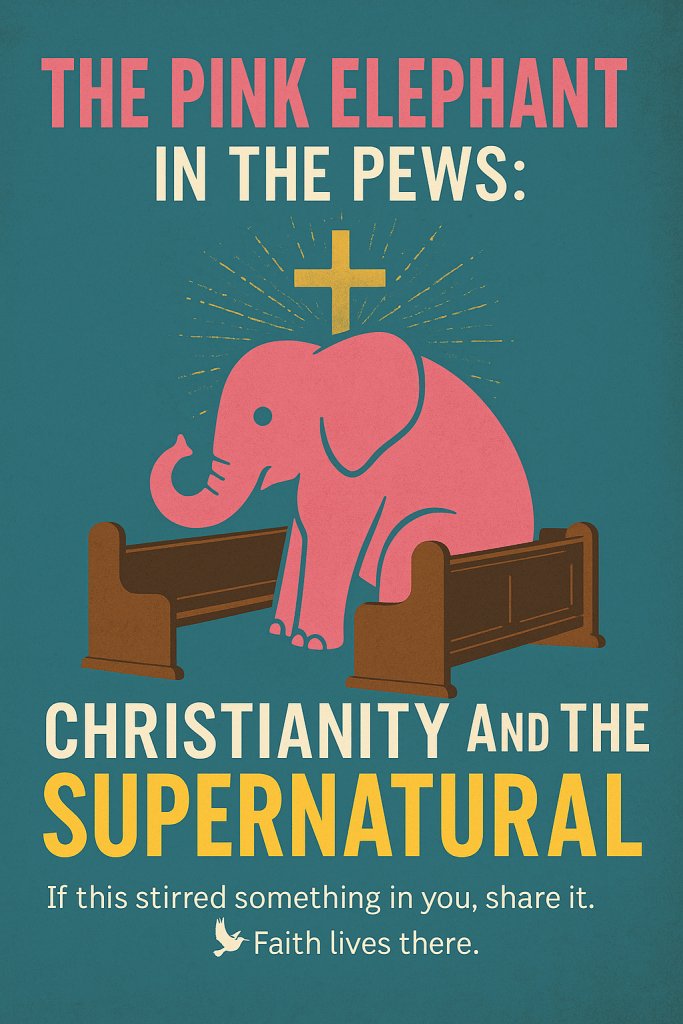
  • The Pink Elephant in the Pews: Christianity & the Supernatural

    The Pink Elephant in the Pews: Christianity and the Supernatural

    Reading time: ~4 minutes

    “The supernatural is the manifestation of events attributed to forces beyond scientific understanding or the laws of nature.”
    New Oxford American Dictionary

    What does the supernatural have to do with Christianity?

    Everything.

    Without the supernatural, there is no God. No miracles. No answered prayers. No angels or demons. No resurrection. No afterlife. No parting of the Red Sea or plagues in Egypt. Remove the supernatural, and you’re left with a shell of spiritual tradition—fairy tales dressed in Sunday clothes.

    So why do so many Christians hesitate to say they believe in it?

    It’s like caring for a beloved pink elephant and then denying it exists the minute someone asks.
    “What pink elephant? I don’t believe in pink elephants. That’s absurd!”

    But supernatural experiences didn’t end thousands of years ago, did they?

    Some argue, “The age of prophets is over.”
    Others say, “Only Jesus could perform miracles.”
    Still others cite Scripture’s warnings against sorcery, divination, and necromancy—as if these verses deny supernatural reality. In fact, they confirm it. You can’t be warned about something that doesn’t exist.

    Remember when Saul summoned the spirit of Samuel from the dead? He didn’t imagine it. Samuel appeared and spoke. That’s not symbolism. That’s a ghost. It’s right there in the Bible.

    So why the discomfort?

    Why do some Christians shut down when the supernatural is brought up—as if faith in the unseen doesn’t require belief in the unexplainable?

    Here’s the truth: If you don’t believe in the supernatural, you can’t fully believe in Christianity.

    Spirituality and the supernatural are intertwined. Without one, the other crumbles. The Bible isn’t just a collection of moral stories. It’s a chronicle of the extraordinary breaking into the ordinary. A burning bush. A virgin birth. Water turned to wine. A man raised from the dead.

    In fact, the more literally you take the Bible, the more you must embrace the supernatural. It’s not just the foundation of the faith. It is the faith.

    U.S. Catholic magazine affirms this in Tim Townsend’s article, “Paranormal Activity: Do Catholics Believe in Ghosts?” It states:

    “Ghosts confirm, rather than refute or disturb, Catholic theology of the afterlife.”
    Belief in the seen and the unseen isn’t optional—it’s essential.

    And yet, in conversations, I’ve heard this:

    “Of course I’m a Christian. Jesus died and rose again for my sins.”

    “So you believe in the supernatural?”

    “No, absolutely not. You don’t really believe in that stuff, do you?”

    Sigh.

    Why are we hiding our light under a bushel? Is it fear of judgment? Of being called foolish or irrational?

    It can’t be fear of God—because without the supernatural, there is no God to fear.

    If we deny the supernatural, we deny the very core of our faith. No resurrections. No divine interventions. No hope for eternal life. No visions, no visitations, no burning hearts stirred by an unseen presence.

    Without it, there is no mystery. No wonder. No awe.

    In the same article, theologian John Newton reflects on those who claim to see ghosts:

    “I certainly see no good reason, all other factors being equal, to deny that someone who claims to have seen a ghost has not had a genuine experience of some sort. The question then is: what sort of experience has occurred?”

    Exactly.

    Should Christians run from the supernatural? If we did, we’d have to throw out half the Bible and all of our hope.

    Without it, there’s no revival. No being born again. No faith healing. No dreams or visions. No heaven. No hell. No divine purpose. Just Sunday routines, stripped of spirit.

    And if we deny it out of fear or pride, are we not like Peter when the rooster crowed?

    So I’ll ask you plainly:
    Do you believe in the supernatural?

    Maybe the language feels uncomfortable. Maybe it’s easier to say “God” than “spirits” or “angels” or “miracles.” But that doesn’t make them any less real. We’re ants trying to comprehend the foot that built the stars. And if God could create the laws of nature, DNA, time, and consciousness itself—how arrogant are we to say what can’t be?

    We don’t have to understand the supernatural.
    But we do have to acknowledge that it’s always been part of the story.


    Call to Action:
    If this stirred something in you, share it. Start a conversation. Acknowledge the pink elephant. And most importantly—don’t be afraid to believe in what you cannot see.
    🕊️ Faith lives there.

  • Ghost or Imaginary Friend

    The driveway to our house was a mile-long tunnel, hand-cut by men long forgotten. In daylight, sunlight danced like fairies through the trees. But at night, shadows twisted into monsters that chased our old ’66 Chevy. I was five years old, safest tucked on the car floor before seat belts were a thing.

    The first time I saw him, it was a warm afternoon. I was wandering the woods around our house when I spotted an old man mowing a lawn I hadn’t seen before. He wore baggy grey pants, suspenders, and an off-white t-shirt. His hair was short and grey, his face clean-shaven. The lawnmower made no sound. Neither did the birds. The air chilled, and my skin tingled.

    He felt different, but I didn’t understand how.

    I returned often that summer. Sometimes, only trees and rubble remained. Other times, I saw him pushing that silent mower again, a small stone house behind him—only visible on certain days. When the air thickened and sounds warped, I knew I was close.

    I decided to talk to him.

    One day, I pushed through the invisible wall of static, stepped onto his lawn—and he stopped mowing. He looked at me, smiled, and in that moment my head throbbed, my breath caught, and I fell backward. He—and the world he came from—vanished.

    Later, he began appearing closer to home, sitting silently in one of our colorful metal lawn chairs. I’d tell him about my dog. He’d never speak, but I could feel his presence. I wanted him to acknowledge me. One day at lunch, he arrived. I jumped and danced in front of him. He smiled—then faded away.

    When I told my grandmother, she became angry. She called me a liar. “That man is dead. That house was torn down long before you were born.” My mother tried to explain it away as an “imaginary friend.”

    Desperate, I led them through the woods. But the house was gone.

    I was no longer allowed to wander alone, and he never came back.

    Years later, as an adult with a child of my own, I returned. Our old house was decaying—windows broken, graffiti on the walls, squatters likely nearby. The air felt wrong. We left.

    Even more years passed, and I returned again. The land was gone, replaced by townhouses. But I found what remained of our swing set and doghouse in the woods, took home a rusted piece of the past.

    Still haunted, I dug through property records. There it was: our home and his, built in the 1870s by a man named S. Disney (I’ll keep his full name private). His house sat exactly where I remembered.

    I never found a photo. But I found enough.

    Was he a ghost? My imaginary friend? A child’s dream or something more? I don’t know. All I know is I met a man who mowed a lawn that doesn’t exist anymore.

    You can believe what you want.

    But sometimes, life is stranger than fiction.