They say zombies are the living-dead—soulless husks roaming the earth in search of flesh to satisfy an unholy hunger.
But I say zombies are the dead-living—those still breathing, still walking, yet hollowed by pain, wandering this world and beyond in search of something to quiet an unrelenting restlessness.
We think hauntings happen only in places touched by death—houses, graveyards, battlefields. But hauntings happen in the mind, too.
Some people haunt themselves. Others are haunted by their everyday reality. And then there are those whose haunting was born in unspeakable terror—one that doesn’t fade with the light, but grows stronger after dark, when the vulnerability of sleep sets in.
This isn’t just restlessness of the body. It’s a soul-deep disturbance. It whispers at the edges of consciousness, like a ghost speaking through a medium. No one else sees it—only the aftershocks etched across a person’s face, voice, choices.
It’s tempting to run. I’ve run. I’ve searched shadows, scoured dark corners, tried to flee from the thing inside me. But here’s the truth:
When Grown Kids Come Home Again Estimated reading time: 6–7 minutes
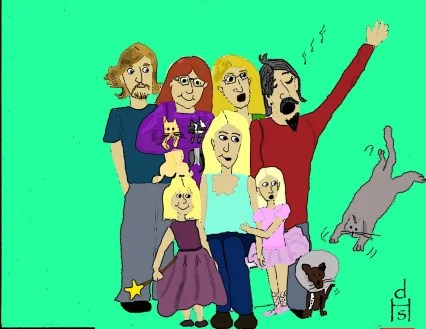
What happens when your empty nest suddenly fills back up—with adult children, grandchildren, pets, and all the baggage (literal and emotional) they bring? This humorous and heartfelt post shares our family’s journey from semi-retirement dreams to boomerang reality, complete with ghosts, minivans, and lessons learned the hard way. If you’re navigating the new norm of multigenerational living, these 10 tips just might save your sanity.
Had I known ten years ago what I know now, I could have saved the cost of seven boxes of tissues and taken a trip around the world instead. It never occurred to me that my three wonderful kids would graduate high school, launch into the world, and then circle back to the parental nest.
I watched each child proudly—and a little sadly—march down the graduation aisle to “Pomp and Circumstance.” College, marriage, big dreams—duly blessed and applauded. I called it semi-retirement. It didn’t last.
Daughter #1 came home first, with two toddlers, a dog, and half of the marital assets after her husband went fishing in different waters. Our small house quickly overflowed with boxes, furniture, and baby gear.
“We have to move,” I told my husband.
“We raised three kids here. It’s just the two grandkids and Daughter #1. We’ll be fine,” he insisted. Apparently, the hallway squeeze and the blocked dining table didn’t register.
Two weeks later, the house was for sale. When the Realtor asked what we were looking for, the responses were—predictably—very different.
Me: Five bedrooms, two bathrooms, big kitchen, fenced yard, family room, porch, maybe a koi pond. Hubby: Three bedrooms, one bathroom is fine, small yard, no need for fancy extras.
The Realtor smiled. “I think I have just the place.”
“What are you thinking?” my husband hissed. “We’re not made of money.”
“I have a feeling the other two are coming back, too,” I replied.
He looked unconvinced. “No babies. No puppies. No more.”
Fast forward: We moved into a 110-year-old house with five bedrooms, three bathrooms, a first-floor master suite, a screened-in porch, a fish pond, a fireplace, and a ghost (who eventually left due to overcrowding).
We also upgraded to a minivan. Hubby protested: “This is my red Corvette era!”
“It’s a mutant Jeep,” I replied, taking the little red car to work.
Soon after, Daughter #2 moved back with two cats. Another broken marriage. She had no winter coat, no job, and no medical insurance. Daughter #1 decided to go to college, which we agreed was a good long-term move.
Then our son returned from Boston. His funding fell through and he had to leave Berklee. He came back with a drum set, guitars, keyboards, amps, furniture, and dreams deferred.
Seven people, three cats, two dogs, and a cast of extras: friends, dates, stray pets, and visiting students. It was beautiful chaos.
Along the way, we discovered some survival tips. Here are:
10 Tidbits to Curb the Insanity of Boomerang Families:
Update Your Relationship Status: They are adults now. That dynamic shift requires mutual respect and negotiation.
Rules: It’s still your house. Adjust outdated rules, but set clear expectations.
Logical Consequences: Make consequences fair, logical, and agreed upon. Contracts help.
Future Goals: Ensure they have direction—school, work, or saving for independence.
Money and Responsibility: Tailor rent based on income. Consider savings plans. Decide what’s an emergency. Use contracts for loans.
Boundaries: From food to bathroom schedules, set and communicate clear boundaries. Label food!
Grandkids & Pets: Clarify roles. Don’t parent the grandkids unless explicitly agreed upon. Support without overstepping.
Communicate, Don’t Argue: Choose dialogue over drama. Use central messaging. Humor helps.
Avoid Their Drama: Offer wisdom when asked, but resist solving their problems.
Take Care of You: Eat well, sleep, enjoy a life outside the home. Reconnect with your partner or a trusted friend.
Boomeranging is stressful but rewarding. You may rediscover deeper relationships and shared joy. And when it’s time, you can shout upstairs, “Hey adult-child, Ghost Hunters is on—I’m off duty!”
“Have you ever watched a turtle?” an Oneida woman asked me from behind the counter at the Shako:wi Cultural Center in Oneida, New York.
“Not really,” I admitted—but told her the subject of turtles kept coming up in my life.
She smiled. “Turtles are slow, steady, and strong.”
As she gave me a tour of the center, I mentioned I was looking for a book about Deganawidah and Hiawatha—figures I admired from Travels in a Stone Canoe. I also picked up one on the Oneida creation story.
“It’s the turtle that grows and becomes the island of North America,” she said.
Months later, I found myself at a Lenape inter-tribal Winter Solstice gathering in Pennsylvania, deep into the night as we sang the Walam Olum, the Lenape creation story. As I read along, the words jumped out: and the turtle became the foundation of the earth.
Turtles again.
Overheated and restless, I stepped outside into the cold. A man wrapped in a wool blanket joined me by the fire. “I’m Walking Bear,” he said. “You looked cold. Drum too loud?”
“I just needed a break,” I told him.
He studied me. “What do you know about turtles?”
“Not a lot,” I replied.
“I saw you inside,” he said. “Sometimes, you reminded me of a turtle. Other times, it looked like you forgot how to be one.”
“Turtles are slow, steady, and strong,” I offered.
He nodded. “Turtles carry the horrors of the world and remain connected to the Creator. You have a turtle shell. I see it.”
Then, pausing, he asked: “You’ve seen the Creator, haven’t you?”
He didn’t know me, didn’t know about my near-death experience, my years of service to others, or the guilt-driven urgency I carried. I said nothing. He was called back inside. I never saw him again.
But I couldn’t stop thinking about turtles.
I researched turtle totems, animal behavior, legends—driving my friends nuts. Everyone told me to slow down. I didn’t listen.
Then one summer in Oriskany, a large turtle stopped in front of our RV and stared us down. I jumped out, laid on the road, face-to-face, and begged it: What does this mean?
No answer. It eventually turned and walked away—slow, deliberate, unbothered. I watched until it was safe, mildly disappointed.
Weeks later, before a major presentation—my first in 25 years—I was spiraling. Panicked. My friend, sharing the hotel room, finally snapped: “Go splash your face. You’re driving me crazy.”
In the bathroom, a silver turtle charm fell out of the washcloth.
Tears welled in my eyes. I rushed out. “Look! The Creator sent me a turtle!”
My friend sighed, picked up a pillow, and whacked me. “I put it there, genius. Maybe I’m the miracle. Ever think of that?”
She was right. I calmed down. The presentation went beautifully. Had I been rushing, I would’ve missed that moment entirely.
Months later, burned out, sick, and disconnected, I knew I couldn’t keep living that way. I began training my replacement—an ex-priest who, somehow, knew what I needed better than I did. On my last day, he handed me two gifts: a stitched saying, To help another person is to touch the heart of God—and an Oneida creation story print.
Of the turtle.
“You’ve got the shell,” he said. “You just need to live like it.”
I didn’t get it then. Not fully. It took four more years, a chronic illness, and finally crashing from overdrive to understand. I’d been trying so hard to prove I was worth the second chance I’d been given, I forgot how to live it.
Now, forced to slow down, I hear more: in doctor’s offices, waiting rooms, quiet walks. I catch moments I used to miss.
“Slow down,” the man said. The turtle says it too.



 Deborah Sickle Hill
