This morning I discovered a wonderful and deadly secret, Burger King now carries Cinnabons. I love Cinnabons! Until this morning, I could only get them at the airport. Usually, I could resist them, too worried about making my flight or having oozing cinnamon sauce dripping down my chin and shirt.
Now, I can go less then a mile from my home, sit in my car and indulge in cinnamon-sugar ecstasy. Burger King has Cinnabons!
Like a cocaine addict, there I sat. Could have ordered the bacon, egg sandwich or better still, the oatmeal with fruit. No, I ordered Cinnabons, two of them. I deserved them, I told myself. Reasons why, I have no clue.
I ordered, paid and planned to sit in the parking lot eating them. My napkins in hand for the dribble mess that only a Cinnabon can produce. I opened the box. Two scrumptious, twisted, doughy circles dripping in brown cinnamon syrup and decadent white icing stared at me. Oh my!
My cell phone clock buzzed. I looked at the dash clock. It’s later then I thought. if I sat in the parking lot, I’d be late for my class on spiritual discipline. You know, learn not to over indulge. Keep an even-keel, that sort of thing. So, I have to eat the Cinnabons on the go. What could go wrong?
I turn out of the Burger King parking lot and the first gob of icing hits my jeans. It’ll wait. I can’t turn, hold a Cinnabon and grab a napkin at the same time. I’m not that coordinated. Not a problem. For the three miles it takes me to get to my class on discipline, I gorge myself on these overly-large, incredibly addictive, way-more-than-I-can-eat rolls. Pleased, that I only have that one glob of icing on my jeans to contend with.
At my destination, I pulled into the parking lot and found a spot. The rolls are eaten. Not something to be proud of, but next time, I’ll order the oatmeal. No one has to know I slipped up and once again found myself in a sugary stupor. I’d gotten away with it! Ha, ha, indulge today, disciple tomorrow!
I garb a napkin to remove the incriminating evidence from my jeans only to find… it is joined by five other considerable larger globs all down my shirt and jeans. Crap! Good thing they gave me many napkins.
Did you know napkins adhere to Cinnabon icing globs like flies on flypaper? Napkins ripped, shredding all over my shirt and jeans. I look like a kid just learning how to shave, ending up with toilet paper wads all over their face!
I should be in class several minutes ago! How in the hell am I going to clean this up and look dignified? No one is supposed to know I fell off the band-wagon! I wonder if I can lick some of it off. I don’t have any water and drowning myself in caramel-mocha coffee doesn’t seem like the answer!
There is a knock on my car passenger window. It’s a friend of mine also going to this class. Her gleeful expression quickly turns to confusion. I’d be confused too if I wandered up to her car only to find her sitting there with napkin shreds hanging off globs of icing all over her shirt, hands and pants.
There is really nothing to say here except, “Burger King now has CInnabons.” She still looks confused.
“I’m not really sure how to help you with this one,” she says. Her head cocks sideways the way my dog does when I’m trying to explain the concepts of karma to him.
“That’s okay, I don’t’ know either.” I wonder if I can claim this as a new grunge/bohemian look.
So, I’m going to class wearing shredded napkins and not-strategically placed globs of syrup and icing. A smile on my face. I’m taking responsibility for my actions. I’ll take the consequences, the tisk-tisks, the smirks, and the malaise when this sugar rush crashes.
I get out of the car and straighten out my newly decorated shirt and strategically hug my friend who says, “Wow, you smell like a bakery, like Christmas cookies! That’s not too bad. It could be much worse.”
And this is why I have her as my friend. Everyone should have friends like this.
Hello, my name is Deborah Sickle Hill, Burger King has Cinnabons, and I have a problem. Damn good thing I’m taking a class on spiritual discipline. I think I have a stomachache.
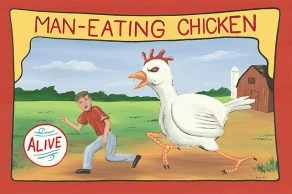
A sign in an amusement park says; look in peep hole to see a man eating chicken. Now, if you saw that sign what image do you think you’d see through the hole? Is it a man munching out on a piece of chicken? Or is it a large chicken eating a man?
What about these sentences? The man saw the boy with the binoculars. Did the man have the binoculars or the boy? Or, how about, hole found in changing room wall; police are looking into it. Are they investigating the incident or looking in the hole?
These are called syntactic ambiguities. Why am I telling you all this? Because it is a good demonstration of how our brains perceive the world around us. For every person who sees a man eating a piece of chicken there are probably equal number who see a large chicken eating a man.
If we want to understand and navigate our behaviors we have to grasp the way our brains see our world.
All around us is the Real World. This is everything that exists; no matter if we realize it or not. The real world contains trillions of pieces of information bombarding us constantly. Our brains are not equipped to handle all this so it selects what is most important and screens out the rest.
It is generally accepted that there are three filters used to screen select Real World information for our use. They are called: Knowledge, Values, and Perceptions.
Whatever information remaining after screening is now evaluated and a decision is made. Either, this information is in-line with our wants and needs and we feel good. This information is neutral and does not matter to us. Or this information is not in-line and may threaten our wants and needs and we feel bad.
If we decide that the information is in-line and we feel good, we keep our filters screening the same way, and continue to behave based on this information. The system is working well. However, if the opposite is true, we feel out of balance and our system goes into red-alert. Depending on how far off balance we feel determines how much drastic action we take.
For example, let’s say you are watching your child on the swing-set at a local playground. The weather is good, the park is not crowded, and your child is having fun. You feel good. All of the sudden, the swing chain brakes and endangers your child. Chances are at this point in time, your brain could care less what the weather is like or how crowded the park is. Instead information such as speed and what angle to leap in order to catch the falling child would be more practical.
Problems pop-up when we feel bad or out-of-balance and the adjustments we make are not the best. Our actions could make things worse. They could fix things in the short-run but not long term. Or the adjustments solve what we think is the real issue making us feel out-of -balance when it is another issue deeper down we have not addressed.
When we feel out-of –balance, we think, feel or do something different to feel better. The next step is, did it work? If not or it did not work the way we hoped, then a change in the information screened through the filters or an adjustment to the filters might be in order.
The filtering system is one of the easiest ways to get from out-of- balance to in-balance.
Knowledge Filter: This is a filter that contains pieces of information we already learned. I don’t think all information learned is actually in this filter. I think we have the ability to alter this. For example, I learned my ABCs in pre-school. This is always in my filter because I read and write daily. I learned to fish when I was four-years-old but never fish. I really don’t think this is in my knowledge filter. But if I pushed myself, I could remember some memory of fishing and probably some terms from hearing others talk of fishing.
If the information we are using to filter Real World information prevents us from acting in a way to feel good, get our needs met and be in-balance, we need to search for new knowledge. We can also reassess knowledge we already have and decide what needs to be added or subtracted.
This is as easy as someone saying, “Hey, remember back when and you had this happen. You did such-and-such and it worked out. Maybe you should try that now.”
Your reply, “Oh, I’d forgotten that. I’ll have to re-pull that knowledge and see how it changes my options.” Now you have added old information to your active knowledge filter.
Values Filter: This is the, how important is this information to me, filter. When information enters this filter a value is placed on it. Is it positive information? Information that helps us become balanced, meets our needs? Or is it negative, something that has the potential to prevent or hinder getting our needs met? Some information is neither and we don’t give it a value.
Perception Filter: This filter is the very selective, how we see the world based on everything that is us. This includes our gender, culture, experience, sexual orientation, parents, age, race, etc. The amount of inclusions in here can be astronomical. Because no one is the same as anyone else, each person’s Perception is different. Like the other filters, it can change. Perspective might be another good word for this area. To change our perspective is to change our perception filter.
All of the above is then evaluated against what Dr. William Glassier called the Quality World. The QW is sort of like the answer to the magic wand question many therapists ask. If you had a magic wand, what would life be like? In the Quality World we have pictures of how we think we can get our needs met in the most satisfying way. All our filters are balanced to provide the Real World information the system needs to best get to our Quality World picture.
For example: If I have a high need for love and a low need for power (see prior posting for more details), my Quality World might have a picture of me being adored by family and friends. There is never conflict. I do volunteer work and always put others ahead of my needs.
It is probably more specific than this. Maybe, I’m a stay-at-home mother with three adorable, cherub-like kids and a dog named Elmo. My husband, who looks like George Clooney, works as a Podiatrist and I go to the Sisters of Perpetual Mercy Church three times a week. I make an amazing meat-loaf. It’s to die for.
That picture is what my brain will use to set my filters and gather information from the Real World. It is through that information, evaluated against my Quality World picture that I will use to behave. I will use it to think, feel and act a certain way. My way, may not be your way.
That is why some of us see a man eating a chicken while others see a chicken eating a man!
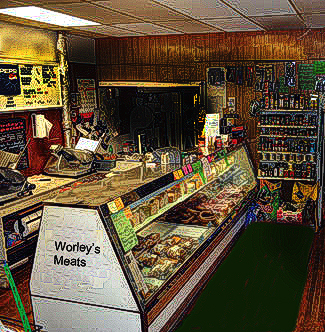
Suzie Worley hated liver. That included liver sausage. She was standing in the back room of her grandparents’ one-hundred and thirty-year-old meat market. It was now her market, handed down through the generations.
Almost daily she thought about closing the doors and selling the antiquated market despite continued faithful patronage. She had hoped Karly, her eighteen-year-old daughter, would become her apprentice and then take over the business when Suzie was no longer able to physically manage. Her daughter showed no interest in the family business and refused to help in the shop.
Times have changed, Suzie thought. She always knew she would fall in line with the family business. Suzie, like her own mother, understood the importance of family pride, responsibilities and tradition. That was why weekly, despite hating liver sausage, Suzie found herself in the back of the meat market pumping out and stuffing fifty-two pounds of liver sausage.
“Eat your liver sausage,” Suzie remembered her mother mumbling through lips that didn’t move. Her mother didn’t like liver sausage either. They were seated around the silver and red Formica kitchen table for another day of liver sausage and eggs over-easy with toast just shy of black, along with her father and maternal grandmother. It was 1965.
“Just place it in the center of your tongue,” her mother continued, “and you’ll hardly taste it.” Her mother’s eyes widened and darted from Suzie to her grandmother. It was face language for, your grandmother is watching; eat your sausage.
Her grandmother wasn’t looking. She never was. She was too busy nodding her head in approval while slurping liver sausage juice back into her toothless mouth.
“Oh dear, Oh dear, I’ve ruined another lovely blouse,” Her grandmother commented after dribbles landed on the cleavage area of her blouse. She grabbed her napkin and failed in her attempt to remedy the situation. All Suzie’s grandmother’s blouses where stained in liver sausage dribbles.
“My mother had the same problem when she ate liver sausage.” Her grandmother chuckled. “Well, it was worth it. Jesus himself couldn’t have…” Suzie mouthed the remainder of the sentence as her grandmother spoke. “… made liver sausage this good even if he used a miracle.”
No one had the heart to tell her grandmother that the pork in liver sausage is an abomination to God based on the Jewish tradition. Her beloved Jesus was a Jew and would be appalled if Mary and Martha served him liver sausage.
“Smother it in the fried onions and ketchup,” her father mumbled. Suzie estimated her father ate enough fried onions and ketchup to keep migrant, onion pickers and the Heinz ketchup company going single handedly.
She didn’t bother. It wouldn’t help. Once again Suzie slid the sausage under the table to her basset hound, Speedy. He liked liver sausage and ate a lot of it. This probably had more do to with his early death from heart failure than anything else, Suzie always thought.
1973 was the year Suzie graduated from Kemper Senior High School. She was going to drive her father’s old, mint-green, ’62 Dodge Dart with the big steering wheel and very un-cool side fins, to California. Since his stroke, it collected dust in the garage.
For months she secretly sent resumes to cruise ships berthed on the west coast for waitress positions. She was going to get as far away from the meat market as she could. She hated liver sausage and the family business. There was no way she was staying to rot and die like her grandparents and now parents. There was a world to see and it didn’t include liver sausage.
“California!” Suzie’s mother yelled. “When were you going to tell me this grand plan of yours?”
Suzie pulled her headband further back on her head so her elbow-length, brown hair stayed behind her ears. It was a nervous habit. They were standing next to the old extruder, caked in oil and cooked pate remnants. A sausage casing hung from the nozzle.
“I can’t stay here, Mom!” She pleaded, crossed her arms over her chest and flopped down on a worn, wooden bench against the wall. She hoped her mother would understand.
Her mother hated liver sausage and the meat shop too. Suzie was well aware of this. Thanks to her grandmother. Grandma had no difficulty reminding Suzie’s mother in front of Suzie about the squabbles they had over family business vs running away to nursing school. The family business had won.
In Suzie’s eyes, the store had been her grandparent’s and no one alive wanted it. No one dead cared. Suzie could feel the tears welling in her eyes. She couldn’t believe her mother wasn’t getting it.
“Your grandparents saved their money to come to this country and buy this shop,” her mother said with a catch in her throat. “Hell, that liver sausage recipe goes back generations before them. I wouldn’t be surprised if they got it from Jesus!”
“Mom, Jesus is a Jew!” Suzie sprang to her feet, twisting her ankle in her hot pink, high healed clogs.
“Don’t you think I know that?” Her mother turned away and wrung her hands on an apron she was wearing. It was floral with ruffles at the shoulders and once belonged to Suzie’s grandmother.
“I need you here,” said her mother. There was a moment of silence between them. “We need to get five pounds of chicken and beef livers, two pounds pork hearts and some pork belly trimmings from the refrigerator.”
Suzie felt her world come to an end. She thought, why did I bother to go to school, play the clarinet or get good grades? If my whole life is going to be this stupid meat shop, there is no sense in living anymore.
She had watched her grandparents slave over the machines, pumping out liver sausages. Watched her parents, who hated liver sausage, do the very same thing. It wasn’t a business. To her, it was a curse.
Karly, Suzie’s daughter, bust into the back of the meat market letting the door slam closed behind her. Suzie was startled from her reminiscing.
“I hate this crap, Mom!” Karly declared. She flopped herself down, arms crossed, onto a worn, wooden bench against the wall. Just like Suzie had done so many years ago.
Suzie realized she had become her mother, a thought that nearly paralyzed her. Maybe, times had not changed so much after all. “Then why are you here?” She asked her daughter. She opened up the refrigerator to pull out five pounds of chicken and beef livers, two pounds pork hearts and some pork belly trimmings.
“If I didn’t come help you, I’d feel guilty as hell. That’s why. I hate when you put me on a guilt trip.” She fidgeted causing the wooden bench to wobble. “Why are you here, Mom? You hate this stuff and this market too.”
Suzie paused inside the refrigerator door. The smell of raw meat once again caused queasiness. Her mother and grandmother were long dead. She remembered her own thoughts when having this conversation with her mother. No one alive wants it. No one dead cares. She shut the refrigerator door.
She wondered how many Worley women needed to devote their lives to ideas and traditions because the generation before had done so. Maybe, it wasn’t about tradition, pride or responsibility. Perhaps it was time to allow independent thinking in the family.
Suzie took off her apron and quietly hung it on the rusted nail that had held it for many decades. She ripped off a piece of cardboard from an empty, pickle jar box. “Do you have a marker?”
Karly looked at Suzie confused. She shrugged her shoulders, grabbed her back-pack set at her feet and pulled out a black marker. She stood and gave it to Suzie.
Suzie wrote on the cardboard in big, bold letters, CLOSED UNTIL FURTHER NOTICE. She pulled some meat-packing tape and walked out into the market front with Karley at her side. She tapped the sign to the front door and turned to her daughter.
“I think we’re overdue for a meeting of the minds over coffee. What do you think?”
The universe keeps telling me to slow down—loudly and often. Apparently, I have short-term memory loss.
This morning started with a doable to-do list. That lasted about 30 seconds. I noticed a water stain on the wall, which reminded me the upstairs needs painting. Since I’m turning that space into an office, it suddenly felt urgent. And that’s when it all unraveled.
7:30 a.m. “Okay, that wall… and that one… and wow, the ceiling? What mood am I going for? Time for a paint color deep-dive!”
9:00 a.m. Two hours later, I’ve selected nothing but somehow watched a YouTube video on belly fat and found myself planning a trip to Lowe’s.
10:30 a.m. In Lowe’s, I get overwhelmed by paint options. Do I want satin or semi-gloss? Quart or gallon? Also, how did I end up in the garden section eyeing Lily of the Valley bulbs?
11:30 a.m. Back home with paint and leftover pizza in the microwave, I head out to the garage to get the roller. Instead, I spot the half-dug hole for a future fish pond and—naturally—start rototilling.
11:45 a.m. I hit a rock, grab a trowel, and find myself digging with archaeological precision (old habits die hard). I find a marble. Then six more.
Clearly, someone lost their marbles, and I wonder if it’s me.
12:15 p.m. The rototiller hits steel wire and wraps around the axle. I flip the machine over and head to the basement for WD-40, dragging dirt through the kitchen.
There, I realize I forgot to switch the laundry.
12:25 p.m. Back outside, staring at the broken machine, I finally get it: This is one of those “slow your roll” moments from the universe. So naturally, I decide to blog about it.
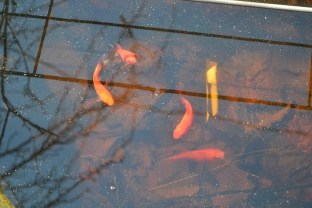
I grab my camera to document the chaos and end up taking pictures of the fish instead. They’re the real reason I came outside, after all. They survived the winter in an above-ground pond—the least I can do is give them a moment on the internet.
Sure, getting only three hours of sleep probably didn’t help this morning’s misadventure. But if I’m honest, I’ve done this well-rested too.
So now I’m making coffee. I’ll take it slow. I still have the afternoon to get something done.
Maybe I’ll paint. Or maybe I’ll finally eat that pizza still waiting in the microwave.
Kansas is the flattest place I have ever seen. Pancake flat. I-70 is one long stretch of flat, mile after mile of farmland speckled with occasional bouts of religious billboards. If you want to find your fate in the afterlife based on a billboard, I-70 in Kansas is the place to be.
Nestled deep in all this flatitute is a natural site that took my breath away. I called it the Monument Valley of the Mid-west. They call it Monument Rocks and Castle Rocks. We found it only because of a small sign on the side of the road and a reference in the Welcome to Kansas booklet.
It is located down a very long, meandering, dirt road through private ranches. There are no fences and cattle do have the right-of-way. The monoliths are considered a National Monument by the Department of the Interior and one of Kansas’ wonders.
I was positive, despite the sign saying public monument; we were going to get shot for driving across someone’s ranch. There was no hiding. There were no trees or buildings for most of the twenty-some miles of dirt road to the monuments.
They seemed to erupt out of the flatland before our eyes. Buttresses of chilling, lonely, death-white stone at least two stories high. We slowed the van down to a crawl and said nothing. There were no words to describe the awe in this eighty-million-year-old byproduct of the Niobrara Sea that once traversed from the Gulf of Mexico to Canada though this site.
I got out of the van and just stood. The only sound I heard was wind singing around and through the stone arches. The milky buttresses hungrily sucked in the rays of the bright sun leaving nothing behind. They were not quartz as I expected, but made of white chalk with streaks of grey lines.
I walked around the monoliths and arches trying to wrap my brain around my feelings. It was more than mere awe. It was spiritual. I was walking in the footsteps of countless others before me and walking over countless fossils of marine animals long ago extinct. I pulled out my camera, a video recorder and a digital voice recorder. I walked around for about an hour taking over a hundred pictures, a video, and recorded my thoughts and the environment. I left knowing I had not succeeded in capturing the experience. Some places refuse to be captured.
As we pulled away, I felt remorse and watched the site disappear in the dusty trail of our van’s wheels. I often tease that I am a restless wanderer but in this place, I felt grounded. If you get a chance, go see it. I understand the land where it sits was sold late last year but I am under the impression, visitors are still welcomed. ** Beware of rattle snakes! There are no bathroom facilities! *****
Directions: (derived from Kathy Weiser’s site, Legends of America)
Monument Rocks is located about 28 miles southeast of Oakley Kansas. Take U.S. 83 south, then 4 miles east on Jayhawk Road, 3 miles south, and 1 mile east (dry weather road only). From Scott City, travel 18 miles north on U.S. 83, east 2 miles on Dakota Road, 1 mile north, 3½ miles east, and 2½ miles north.
Castle Rock can be reached by taking the Quinter Exit #107 off I-70, traveling 15 miles south on Castle Rock Road to the intersection of GO-80 and GO-K, then 4 miles east to Castle Rock sign, and north across a cattle guard (dry weather road only).
The oh sh-t moment when life goes from wonderful to dread and we have to act fast. We all have them. Sometimes we handle the situation well and other times, well, we ponder for decades what we could have done differently. Can a person truly be prepared for those problematic moments?
We are all basically hard wired the same way. Note the word basically. It is rare in life when things are one-hundred percent. There are four things we are programmed to do in emergencies. They are flee, fight, freeze or flop. Pretty easy to understand. To flee is to run away from the situation. To fight is to attack the situation head-on. To freeze is to become paralyzed and not able to do much of anything. To flop is to faint.
Which of these tactics a person picks may be the same in all emergencies or can change depending on the circumstances. A woman who suddenly has the strength to lift a car off her child (to fight), might not attack an intruder inside her home. Can we know in advance which behavior we will chose?
Hard to say. The military trains our troops by using repetition. Instilling into them, this is what you do in the following situation. The lives of these people depend upon it. Firefighters, police officers and all other careers where lives are at stake do the same thing. But even then not everyone is able to follow that programming when needed. Why not?
It comes back to all our past experiences. Those experiences become chemical memories in our brains. When a situation occurs similar to a past situation, the brain compares it and acts based on what worked before. No matter how much training a person has, there are times the old experiences will over-ride the current situation. Why? Because, training that your life is in danger is very different from it truly being in danger.
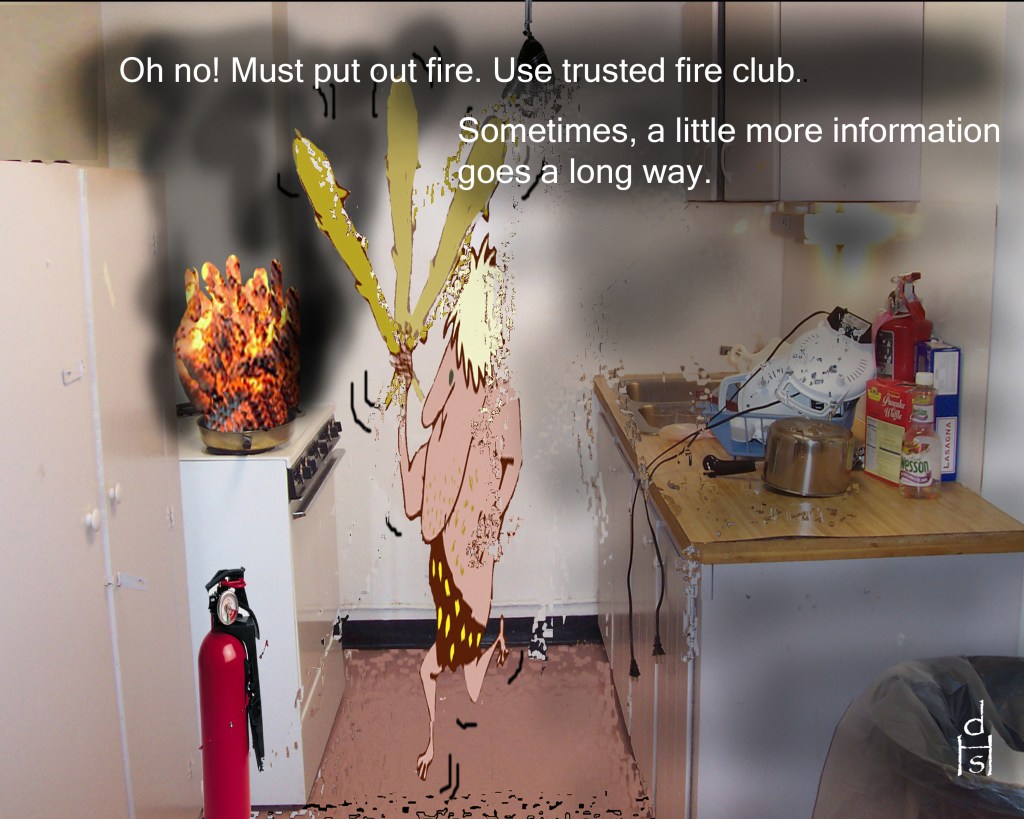
Having said that, there are times, sometimes humorously, when our reactions are way off the mark. Like the picture above where the caveman is using a club to put out a fire. The fire extinguisher is right beside him. This is where feelings step in. Fear, panic and anxiety all play a role in how effective we will behave in an emergency.
Stress produces the same type of reaction. The brain thinks there is a problem. It is either a possible emergency or real emergency and tells us to react. As a result our reactions maybe over the top for the situation. Think about the person who gets road rage because he/she is running late and the person in front is going the speed limit.
Next time you know you are feeling stressed and you find yourself over-reacting (flee, fight, freeze or flop), try to pull yourself together and regroup before reacting. Good questions would be, why am I reacting this way? Is the danger real? How realistic is my thinking? The one I like the best comes from my husband. He says to me, “I think you are reacting to things not in evidence.” Meaning, I’ve either got the cart before the horse or I believe I know what is going to happen without having a crystal ball.
None of us have true knowledge of the future but some of us think we do and base much of our choices and behaviors on this illusion. It can’t be done.
Here’s hoping you have a reaction appropriate day.
I’d love to sleep the hours I believe most Americans sleep. To be part of the: to bed at eleven, seven to eight hour sleep period and wake refreshed at six or seven a.m. people.
I’d love to sleep like this, but I can’t. Doctors have tried numerous over-the-counter and prescription aids. I’ve read multiple books on healthy sleep habits. I’ve used a sound machine, played a video of the ocean, ear phones and meditation music, hugged a stuffed animal. My diet was changed. I stopped drinking caffeine and alternated the temperature of my bedroom. Exercise, yep, I’m doing it. Meditation is great but not for my insomnia. I’m not sitting awake worrying. My life is going well. Nothing works. AHHHHH!
I was diagnosed with Post Traumatic Stress Disorder (PTSD) in 1981. Truth be known, I actually have Complex PTSD although at the time they didn’t have that diagnosis. The hows and whys of this are not important for this writing. I’m telling you this because it and some wacky thinking on my part are the reasons for my insomnia.
I am so hyper-vigilant (on edge waiting for something inevitably horrible to happen) that any noise or movement jolts me awake with a startle. Then I’m up for several hours until I can no longer keep my eyes open. With any luck, I will return to some kind of sleep. Some nights this cycle takes an hour or two, other nights I’m up all night.
The less sleep I get the more my thinking becomes derailed. Things that normally would not bother me become monumental. I start taking things more personally and become defensive. Skills and determination take a sharp decline and old thoughts of self-doubt and self-scrutiny flourish and will spiral out of control if I don’t intervene.
I’ve tried many techniques and mild to wacky interventions to help me or force me to sleep. Occasionally, I think I’ve hit the right combination of circumstance, rituals and mind-set only to find it was all a fluke. I can blame my mattress, my hubby, the cat, the noise level in the room, hormones or any number of elements. While some of this is probably a contributing factor the end result is me and a need to find a way within myself to work with who I am now in a non-judgmental way.
Sleep eludes me. So I try to spin it positive. The house is quiet, I can write. There is time to process my day and goals for the future. There is quality time with my cat. All nice things but sleep would be greatly appreciated.
So, I am curious both as an insomniac and a therapist, what have you tried when facing insomnia? Did it work?
Maybe there are some techniques or home reminds I’m not familiar with. If you have any I’d love to compile them for anyone who needs aid. Myself included. Sweet dreams!
Can another person really influence another enough to cause the first person to commit acts normally not within their personality and choices?
The answer to the first question is very difficult and has to be measured case by case. Even then, the judgment and punishment or rehabilitation of this person is really going to depend on the society in which the events occur. Said differently, there is no definitive yes or no. Defining the actions of the person, their mind set, their motive, the overall effect of their actions and how many people their actions affected all need to be taken into account. Not an easy task when you consider that most of us can’t sit around a table with friends or family and all agree on the definition of things dear to us, like, is there a god, and if so, what is this thing we call god. How does God influence, control, or look like?
What I have been hearing now, in cases of the past and in smaller circles such as in the actions of a friend to another or a spouse to another is, “I would never do that.” “No one could ever make me act that way or do that crime.”
I have bad news for this folks, you really don’t know until you have been faced with the manipulation strong enough to cause a variety of reactions known as Stockholm Syndrome, Helsinki Syndrome, Battered Person Syndrome to name only a few.
All these syndromes are named on events where there is an element of traumatic capture – bonding. Where for reasons of survival and coping, the target or victim bonds or becomes linked with their capture or perpetrator. It can range from: keeping the perpetrator’s actions secret, behaving in a way deemed by the perpetrator to keep the victim/target or their loved ones safe, to falling in love or having deep sympathy toward the perpetrator.
Horribly tortured victims (to use an extreme example) have gone to court to help their perpetrator because of this phenomenon. Whole groups of people have helped kill one another because they so believed in the cause of the perpetrator. Victims/targets commit heinous acts of violence for their perpetrator because either they have been manipulated enough to believe in the cause even if it is totally against their norm. Every day abused people stay with their abuser and tell you they love them and will not go to court to prosecute. I could keep going but I think this is clear enough.
Events where you might be familiar with this phenomenon might be Patty Hearst, Jim Jones cult, Charles Manson family, Salem Witch trial girls, Nazi Germany, some military hazing, college hazing, spousal abuse, child abuse, bullying in school. The list goes on.
I’d like to point out that the victim/target does not have to be in complete bondage (held without physical ability to leave) in order for this to happen. This is because the definition of bondage is larger than physical location. Bondage occurs whenever the victim/target believes there is no way out.
How can this possibly happen to someone?
Unfortunately, it is easier then you might think. The very elements of what most of us would consider a model person make the victim/target shine like the noon day sun to a perpetrator. Traits such as trusting others, people pleasers (people who put others ahead of themselves), people who believe others can change and give them opportunities to do so, sympathetic, empathetic, the world is a wonderful place people, God will protect me people, it won’t happen to me, it happens to other people individuals. NOTE: not everyone with these traits will become a victim/target.
Should we go around not having those traits? No, what a horrible world we would have if we didn’t! But what we need to know is that there are individuals who have learned the art of psychological manipulation and use it to the detriment of someone they know or seek out.
It might be easy to say you can just look at a person and figure out who are the manipulators. Usually, the most dangerous kinds of manipulators appear kind, caring, helpful and claim they have your best interest at heart. Families of these people often know the truth about them, but to the outside world they can appear wonderful, model citizens.
How does manipulation work?
This profile is generic but in my experience and research demonstrates most of the following steps typically used on a victim/target.
They search for their target or happen upon them.
They behave in ways to gain the target’s trust.
They start manipulating information to confuse the target. i.e. “If you vote for this person, you will lose your house.” Knowing that there is no connection between who you vote for and the status of your home ownership.
Manipulation of information increases and becomes more personal. i.e. “If he loved you, he wouldn’t work so long. I love you and I show it by not working all those hours. Why would you want to be with someone who does not love you when you can be with someone who does?”
They set up situations so the information they are telling the target appears factual.
They work to convince the target that it is in their best interest to listen and do what they say. This can be used through the manipulation of information or through threat and actual violence.
They start to separate the target from familiar family and friends. Anyone who might be perceived as a deterrent by the perpetrator.
The goal of the perpetrator is to cause as much confusion, cause an inability to reality check data fed by perpetrator to target, and wear the target down. This is typically done by causing lack of sleep, food refusal, environmental changes to make the target have to cope more to survive or violence /threat of violence. The key here is the target has to depend more on the perpetrator for their well being. Typically the target starts to trust the perpetrator more than family and friends.
The target starts to see the perpetrator as correct, in their best interest to listen to and agrees to do what they say. Typically, this starts with small things the perpetrator wants the target to do and the target is rewarded. i.e. “If you agree to say nothing about what just happened I promise you I will never beat you up again.” The target does what is asked. There are no beatings and reinforces that the request worked. Only the perpetrator changes from beating-up the target to some other form of torment.
At some point the perpetrator may ask for the target to prove their worthiness or sorrow at making the perpetrator behave as they do. Notice, the perpetrator at this point convinces the target it is the target’s fault they are in this situation. This intensifies the shame and often prevents the target from searching help. They feel they deserve whatever happens to them.
Proof activities or behaviors by the target can be typically radical, dangerous and demeaning. The target is pumped full of information which propels them to act on the proof activity. At this point the target does the activity for one or more of the following reasons: they believe the lies told by the perpetrator, they fear retribution from perpetrator, they fear being the cause of something horrible happening to someone else (including the perpetrator) if they don’t comply.
If the target manages to figure out what is happening and attempts to escape the bonds with the perpetrator, threats or actual extreme violence is not uncommon. Oddly enough, sometimes the perpetrator may fake a suicide attempt to guilt the target into compliance.
By putting these steps in numeric form, it sounds very concrete and easy to say, well I would easily see through that and it would not happen to me. Remember that these perpetrators have so confused the target that they trust the perpetrator, feel they need the perpetrator to survive or have to comply with them for the target to survive. They have convicted the target that people normally deemed trustworthy and helpful are the true enemy. They can even convince the target that they are in love with the perpetrator. No one is better than the perpetrator. No one else is more correct in their views, attitudes and desires then the perpetrator. No one else can save, help or care for the target like the perpetrator can. The perpetrator’s needs and wants and dictations are all that matter. The target is essentially brain-washed.
The result sometimes is devastating. Horrendous crimes are committed. The target allows horrible things to happen to them. And in the end, if they get out of the situation, it can take years to un-due the damage. Families and marriages are destroyed. Career can be ruined. Lives lost.
If the event causes events ending in the court system, often the target is not able to testify accurately about what happened. Even after the perpetrator is gone, the effects of the manipulation are so strong, the target continues to believe the lies told them and in the actions they took on behalf of the perpetrator.
These targets – victims need extensive help to recover. Depending on what they did, how far from who their sense of ‘this is not who I am’, and the extent of the brain-washing typically determine rates of recovery. But recovery with psychological scars is possible. I don’t think anything can totally remove the guilt, shame and shock when the target figures out and heals from what happened.
So, it comes down to the question: What responsibility does a person have for their actions when under the influence of a skilled manipulator? How do we as a society work with this?
I can still hear some readers saying, “I don’t get it.” I rather think unless you have had the unlucky experience of being in the shoes of a target, or worked extensively with the topic you probably will not totally get it.
When I look back at events in my life surrounding this topic, I still have a hard time getting it. I’m a strong, independent minded individual. It didn’t matter. I was caught off guard and my personality coupled with shaky, stressful events in my family life made me a prime target. I used to believe that people are good and trustworthy. I always gave people the benefit of a doubt. I felt people can change and really, honestly want to. If they do or say something horrible to me, it is in accident or some other deeper reason they are not aware of.
It did not register that some people are none of these things and instead feed their own natures and desires on others. When I looked at historical events such as Nazi Germany or the Jim Jones cult suicides, I would think, those leaders were evil. Why didn’t anyone see it and do something? My experiences have taught me why.
So, I get it. I didn’t do anything resulting in legal action. Thank God. But I have worked with enough people who have. The personal damage is horrific. When I hear of events unfolding in the world where there is suspect of a manipulator in the background, my heart rips a bit.
Just remember, if you are like me and do get it, you are not alone. If you don’t get it, I hope the f… hell you never have to.
Setting out to find a life partner is like fishing. Fishermen have to know what kind of fish they are fishing for and where that type of fish is likely to be found. If they are after tuna, hopefully, you wouldn’t see them fishing in a river. They have to know what kind of bait to use to entice the fish. They have to know their own abilities and have good skills in fishing. Knowing all this, they go to their favorite fishing place and throw in their line and wait. If they are lucky a fish shows interest. Skill is in the length of time and reel play needed to keep the fish interested and not bored. Hopefully, the fisherman gets his fish.
Okay, dating is not quite like fishing. There are some differences but the basics are the same. The person looking needs to know the type of person that holds their interest. Next, they have to know where to best find that type of person. The fisher of a life partner has to assess if they have the correct personal characteristics to attract this type of person. They have to be confident that what they have to legitimately offer and be sincere in offering. This is where the analogy stops.
People are not fish and the idea of baiting someone sounds horrid. However, I find using this fishing analogy works well in getting people to realize some of the behaviors they chose to find a mate are as wacky as fishing for tuna in a river. Two reasons for dating disasters and the destruction of the beginning relationships are: One or both people have minimal ideas on what they really want in a relationship. One or both people don’t know what their needs are and the ways they have learned to get those needs met. One or both parties do not realize that everyone in the world processes and sees the world somewhat differently. When you add the hormonal component involved with sexual attraction and the chemical reaction we call falling in love, is it any wonder new relationships have a high turn-over rate?
To be a fisherman in good form and help prevent fishing disasters, it is best for the fisherman to know his/herself before those hormones kick in. I’m going to review some ideas then look at an example.
Review: All choices in life revolve around the same basic questions and concerns. What is it I really want and need? What am I doing to get it?Is it working? If not, reassess what you are doing?
Our choices must also include two very important pieces of information: ALL BEHAVIOR IS PURPOSEFUL (Everything you think, feel and do is for a purpose – always). THE ONLY PERSON YOU CAN CHANGE IS YOU.
All our behaviors are based on our needs. Everyone has the same needs, only in different degrees. Universal needs are: Love and belonging (feeling connected to a bigger whole), Power, Freedom, Fun, Survival, Purpose in life (spiritual).
How we get these needs met depends on several factors: Our total knowledge (learning and experience), Our values. Our perceptions (how we choose to see the world around us).
OUR EXAMPLE:
Let’s look at Joe (not a real person) for an example of this in action.
Joe has a high NEED for LOVE and a low need for POWER. His goal (WANT) is to find someone to marry who will love him unconditionally the way he wants to love them.
Joe’s TOTAL KNOWLEDGE comes from:
His divorced parents:
Mom said. “Your father never loved me. I know this because he never helped me with the chores.”
Joe heard: to show a woman you love them, help with the chores.
Dad said. “We loved one another but she let herself go and well I have needs. Your mom turned out to be a total dog. Son, marry a younger beautiful woman and you will always be content.”
Joe heard: Stay in shape, dress sharp and marry a younger, beautiful woman to keep love alive.
Joe has read all about love and relationships in books and magazines and has learned:
Love takes a lot of work
There are stages of love in a relationship
Couples who make it, communicate well and have date nights
Money is the number one reason couples split up
Joe loves to listen to country music, watch TV and go to the movies. He has learned:
Relationships break up all the time
No matter what men do in a relationship, it’s usually wrong
Men have a very hard time staying with one woman
If you work hard enough you can get someone to fall in love with you
If someone steals your girl, you can work hard and win her back
Women want a tender man who is good in bed, has a good job, makes good money, is handsome, maybe a bit quirky and can take care of them
Romance and love hit fast and hard. Go with it.
Joe has friends. All of them are divorced and some remarried. He hears them say things like:
She left me for her tennis instructor.
My secretary is better in the sack.
She just doesn’t get me.
We grew apart.
She was a nagging bitch anyway.
Joe hears:
Stay in shape or you’ll lose her to some athletic guy.
Don’t look at other women, it’s too tempting.
Keep an open communication so you don’t grow apart.
Remember there are stages of love, stick with it.
There are reasons people complain. Find out and correct problems if needed.
Now Joe is ready to find the girl of his dreams. He is at an art gallery opening and spots the young and beautiful Sally. He knows she is the one and there is no turning back. He can feel it. The fact he does not know her is of no consequence. He had everything he needs to make this work. So he thinks.
PROBLEM
Joe has not looked at the most important piece of information needed to make this relationship work. Sally has her own TOTAL KNOWLEDGE independent of Joe! Because Joe decided, based on his knowledge, values and perceptions that they were destined to be together, he inadvertently placed his heart on the line. He fell romantically in love and it ended up looking like this.
Joe: Tries to be attentive. Sally: Thinks he is smothering.
Joe: Brings her flowers and writes her romantic poetry. Sally: Thinks flowers are a waste of money and only for funerals or for saying I’m sorry. She hates poetry.
Joe: Wants to spend intimate evenings at home watching TV together. Sally: Wants to belong to various up and coming professional and social groups. These keep her out of the house most nights.
Joe: Reminds her of his good, high paying job and income. But he doesn’t stop there. He also reminds her that he is there to take care of her. Hinting she can stay home and take care of the kids when they come along.
Sally: Thinks he is a male chauvinist. There is no way in hell she would consider staying home. She is one of the up and coming, not trying to gain a homemaker of the year award.
Who is in the wrong? Neither! Joe has a strong need for love and a low power need. Sally has a low need for love and a strong need for power. The relationship fails and Joe is devastated. He has no clue why it did not work.
Because of Joe’s total knowledge and values, he chose to only see the things in his world that agreed with them. Those were his perceptions. It all went together and it never occurred to him Sally saw things differently. Joe had TUNNEL VISION.
Joe’s tunnel vision prevented him from seeing Kelly at the gallery the night he fell in love with Sally. Kelly had introduced herself to Joe but he hadn’t really seen her after seeing Sally. She was not as stunning in his eyes.
Kelly was looking for someone just like Joe to fall in love and get married. She would have been thrilled with poetry, romance, nights home together and a long committed relationship with family.
Joe missed it! This was probably not the first or the last time Joe’s tunnel vision would blind him to getting his needs and wants met.
FISHING LESSON FOR THE DAY
Know your needs and wants (the real ones, not the superficial ones).
Have a handle on how you are thinking, feeling, behaving and how you are screening your reality to get those needs and wants met.
When you met someone REMEMBER – they have their own needs and wants. They have their own ways of thinking, feeling, behaving and screening their reality.
Slow down and reassess yourself and the situation often. If needed, make changes in your thinking, feeling or behaving.
** Now I know someone is going to ask, why would Sally continue to go out with Joe?
Let’s look at Sally a little closer.
Sally has a strong power need. Her goal (want) is to find a man with enough money, connections and good looks to wine/dine and help elevate her and her career. She wants to live the way her parents did without the commitment to marriage.
Sally’s parents are married.
Mom says. “Your father and I love one another, I suppose. But he’s a lawyer. I’ve got the country club. Marry someone rich, someone who will get you into the upper crust of society.” Sally heard: Men are your ticket to the rich and powerful of society. Love is not important, prestige is.
Dad says. “I’m a powerful attorney. I don’t have time for trivialities of marriage. I got married because it is what I was supposed to. It looks good for politics and moving ahead in life.” Sally heard: Marriage if anything is for convenience and if you don’t have to, don’t do it.
Sally does not like to read books on relationships. Occasionally she reads magazines on high fashion and celebrities. She has learned:
The more men you have experience with the better
Men are a great spring board for a woman to succeed
Men can be thrown away when a better opportunity arises
Men’s feelings are not as deep or important as a woman’s
Women have been oppressed too long. It’s your turn, baby.
Sally does not watch TV. She listens to Indie and World music but never notices any relationship issues implied in them. If she goes to a movie, it is only to see an Indie film specific about world concerns and oppressed people getting ahead. She has learned:
You have to be tough in this world
You are truly on your own
Make sacrifices to better yourself
Think global not home based
Sally’s friends have never married nor do they want to. They have all gone through many men all propelling them further in their own pursuits. They all think their moms were naive and or dumb.
Sally hears:
Don’t get married
Date only men with money who can help propel your career
It’s all for me to help me so I can help the world
I’m not going to be a pasty fool like my mom.
Sally meets Joe. His money and continuous attempts to convince her of his great and powerful job tell her he meets her criteria. She can use this even if the rest of him is old fashioned and a bit of a bore. Only his old fashioned ways and smothering behaviors make him too much of a liability for her needs and wants. She dumps him for Kevin who has more of a power need similar to her own.
Sometimes the Joe’s do find the Kelly’s in the world and there are still problems that arise. Why would this happen?
Remember Joe gives flowers and poetry to show love? It could be as easy as Kelly was raised that a man shows love by doing more family events and activities with kids and extended family. Only she never told him. Joe thinks he is doing everything right to show his love. In Kelly’s mind, she loves the flowers and poetry. But they are not demonstrating the deep love she needs from him. Kelly needs for Joe to volunteer to do things with the family.
If both of them know what their needs and wants are AND WHAT THAT LOOKS LIKE (What behaviors a person would see as testimony of meeting that need or desire. i.e. flowers mean I love you vs. time spent with family means I love you). The next step is to TALK about it. Neither of these people is more right or wrong, only different!
Once they each have more information they can chose to change their behaviors or keep things the way they are accepting the possible unhappy or disastrous results.
So, if you are having relationship issues or are fishing for that special someone –
GIVE YOURSELF A GIFT
Know your real true wants and needs
Know what they look like in action
Remember everyone is different
Give yourself time to explore and grow
Get more information if things are not making sense or you feel out of balance
Self evaluate often
Communicate always
Remember you can only change you. You are ultimately responsible for you, your feelings, thinking and behaviors. Happy fishing!
The driveway to our house was a mile-long tunnel, hand-cut by men long forgotten. In daylight, sunlight danced like fairies through the trees. But at night, shadows twisted into monsters that chased our old ’66 Chevy. I was five years old, safest tucked on the car floor before seat belts were a thing.
The first time I saw him, it was a warm afternoon. I was wandering the woods around our house when I spotted an old man mowing a lawn I hadn’t seen before. He wore baggy grey pants, suspenders, and an off-white t-shirt. His hair was short and grey, his face clean-shaven. The lawnmower made no sound. Neither did the birds. The air chilled, and my skin tingled.
He felt different, but I didn’t understand how.
I returned often that summer. Sometimes, only trees and rubble remained. Other times, I saw him pushing that silent mower again, a small stone house behind him—only visible on certain days. When the air thickened and sounds warped, I knew I was close.
I decided to talk to him.
One day, I pushed through the invisible wall of static, stepped onto his lawn—and he stopped mowing. He looked at me, smiled, and in that moment my head throbbed, my breath caught, and I fell backward. He—and the world he came from—vanished.
Later, he began appearing closer to home, sitting silently in one of our colorful metal lawn chairs. I’d tell him about my dog. He’d never speak, but I could feel his presence. I wanted him to acknowledge me. One day at lunch, he arrived. I jumped and danced in front of him. He smiled—then faded away.
When I told my grandmother, she became angry. She called me a liar. “That man is dead. That house was torn down long before you were born.” My mother tried to explain it away as an “imaginary friend.”
Desperate, I led them through the woods. But the house was gone.
I was no longer allowed to wander alone, and he never came back.
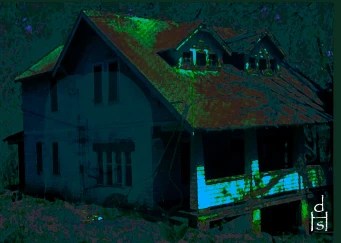
Years later, as an adult with a child of my own, I returned. Our old house was decaying—windows broken, graffiti on the walls, squatters likely nearby. The air felt wrong. We left.
Even more years passed, and I returned again. The land was gone, replaced by townhouses. But I found what remained of our swing set and doghouse in the woods, took home a rusted piece of the past.
Still haunted, I dug through property records. There it was: our home and his, built in the 1870s by a man named S. Disney (I’ll keep his full name private). His house sat exactly where I remembered.
I never found a photo. But I found enough.
Was he a ghost? My imaginary friend? A child’s dream or something more? I don’t know. All I know is I met a man who mowed a lawn that doesn’t exist anymore.






 Deborah Sickle Hill