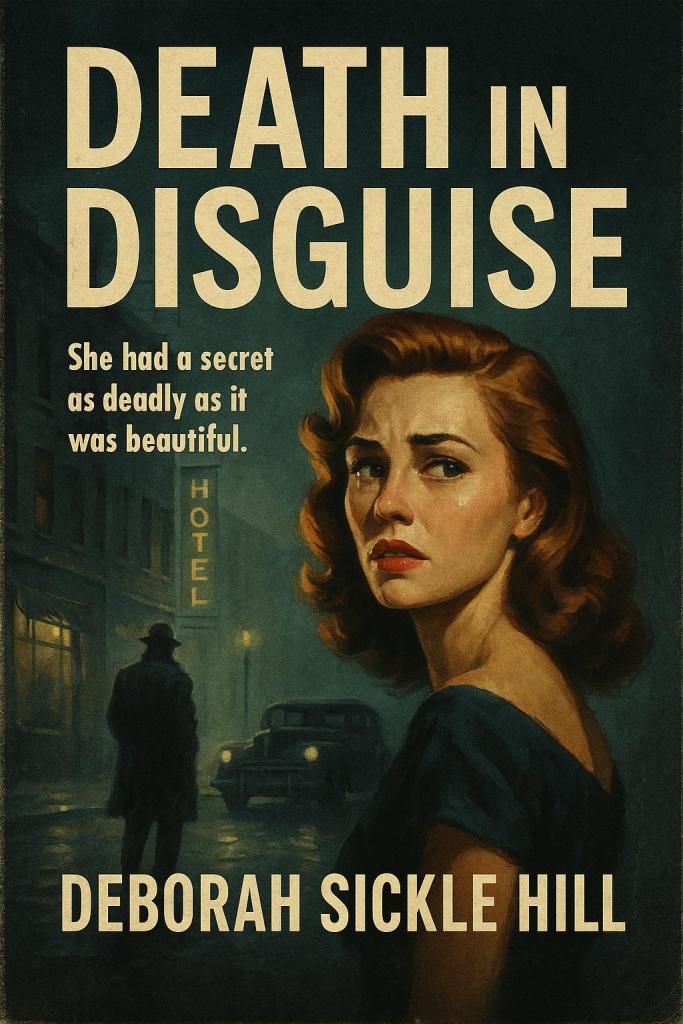
“You cheating son of a bitch!” Muriel screamed at him.
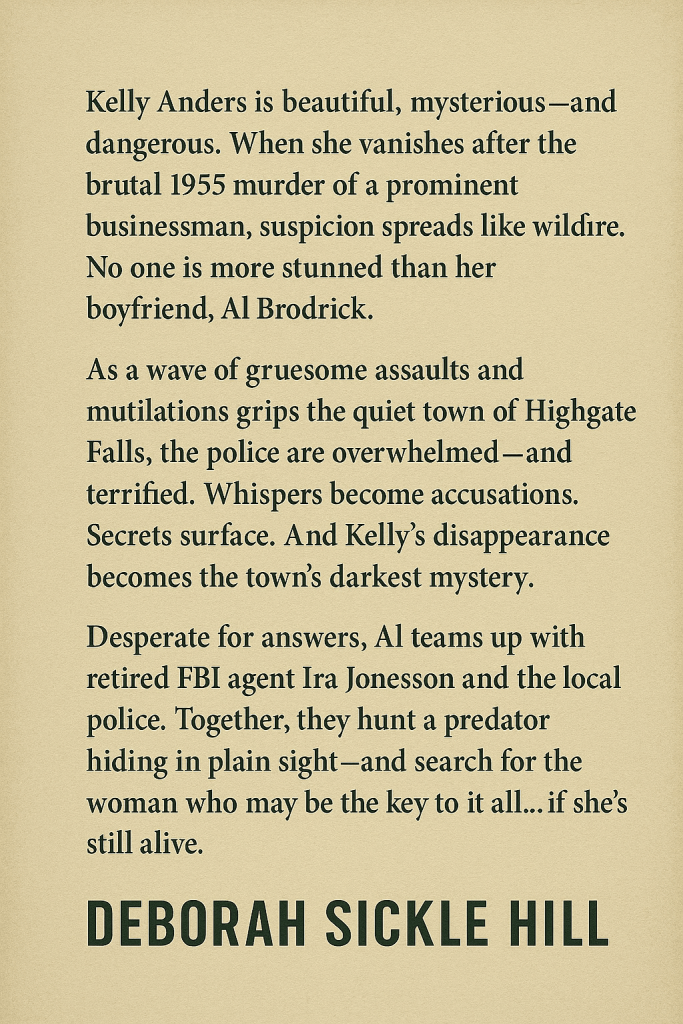
That’s the first line of my novel, Death in Disguise. It took me ten years to get that sentence on paper to my satisfaction—not because of writer’s block. I wrote the first draft in a few months. But then fear took over.
Not fear of rejection from publishers. That’s part of the business. This was deeper: fear that my story wasn’t good enough—that I wasn’t good enough. So it sat on a shelf.
We talk a lot about writer’s block, but not enough about writer’s fear. For me, it was perfectionism, tangled in the belief that my debut had to be flawless or it wasn’t worth sharing. That kind of thinking leads to silence.
In those ten years, I wrote constantly. I filled binders with stories, red-inked drafts, and characters I loved. But envy started to creep in. Artists hang their work. Musicians perform. Writers? We wait to be read. Unless we’re published, our creations often stay invisible.
Eventually, I took a class called Writing from the Heart. It broke through the perfectionism. I began to understand that perfection is a myth—and often a trap. Growing up as a performer, I believed hard work equaled flawless results. In writing, that’s rarely the case. Without feedback, I kept polishing drafts in isolation, terrified to let them go.
I tried sharing with family and friends. Some promised to read but didn’t. I took it personally—maybe too personally. I confused their silence with rejection. I let it hurt my relationships, when really, it wasn’t about me. People have their own reasons. I had to learn that support doesn’t always look like a critique.
Eventually, my parents read a draft—and loved it. My daughter even edited one and said, “Mom, I couldn’t put this down.” That was the moment I started to believe in my work again.
I decided to publish Death in Disguise independently—not because I wasn’t good enough for a big publisher, but because I wanted full creative control. It was a steep learning curve, but I embraced every part of it. After years of fearing imperfection, I took the leap. I made the baby—I wanted to deliver it myself.
We all have voices in our heads—old mentors, harsh critics, even well-meaning family members—who plant doubt. But writing isn’t about impressing anyone. It’s about sharing something true. Screaming into the forest and hoping someone hears.
My book is finally out. I’m proud. Nervous. Ecstatic. And yes, a little scared. But this time, fear isn’t the driver. I am.
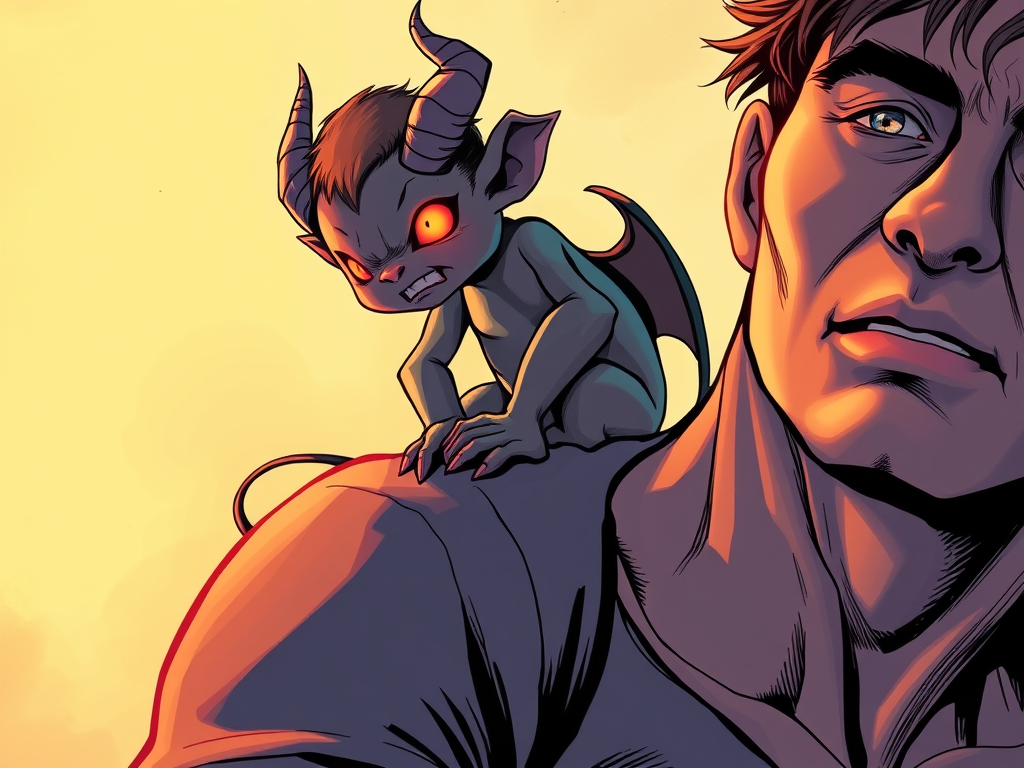
I have a demon that sits on my shoulder. Its name is They. I didn’t realize it was there for years, but it’s been whispering to me all along— They won’t like that. They think you’ll fail. They said it can’t be done. It’s insidious, cunning, even charming. And it’s a liar.
Perhaps, you’ve encountered this demon as well. I’ve seen it cling to friends, family, and clients. I often recognize its voice in others before I hear it in myself. It’s sneaky like that.
The demon “They” is a master of disguise. It whispers through the voices of others: “You’re wrong. You’re worthless. Everyone thinks you’re a joke.” It can play pitcher and batter in the same game—stirring conflict, self-doubt, and shame.
But here’s the truth: there is no demon. It’s your inner voice telling you these things, and if you are not careful, that voice will convince you to think, say, or do just about anything.
So how do you fight back?
Identify the voice within. Notice when thoughts shift, when shame creeps in, when lies feel like truth. It may have started out as someone else telling you these things, but now it’s you.
Refuse to obey. You have a choice. Don’t swallow every voice that speaks.
Replace the lies. Speak truth aloud. Write it on notes. Practice love toward yourself. Do it daily. Do it loudly.
Choose your people. If others live by their demons, either strengthen your armor—or walk away.
Because in the end, the demon They only wins if we forget the source.
We decided to take the family on a trip to Disney World. It was the first time for our five- and seven-year-old granddaughters. The drive? About 18 hours. We pulled out of the driveway at 5:30 a.m. No problems.
The seven-year-old had been learning about states in school, so as we crossed each state line, we’d shout its name and everyone would cheer. One state down—so many more to go.
Somewhere in our third state, the five-year-old sighed and said, “I’m tired of all these little states. Just tell me when we get to the state of Japan.” No problem.
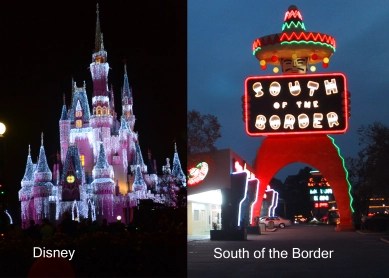
The day rolled on smoothly. The kids napped between viewings of Cinderella for the thousandth time. Before we knew it, the giant, gaudy South of the Border sign appeared on the horizon. If you’ve never seen it, it’s a long-standing tourist trap-slash-rest stop sitting right on the North/South Carolina border. Bright lights, oversized cement animals, buildings painted in every color of the rainbow. It’s been around since the 1950s, and for us, it’s almost a mandatory stop on the way to Florida.
We pulled into the lot. “Everybody up!” I called. “Time to stretch!”
The five-year-old popped up, looked out the van window, and gasped. “We made it! Oh my gosh, we’re really at Disney World! I can’t believe it!”
Without missing a beat, my husband said, “Yep! We made it to Disney World! I think I just saw a princess go around the corner!” I gave him a look. He leaned in and whispered, “Just think of all the time and money we’d save if they really believe this is Disney.” He’s smiling. I’m not.
Meanwhile, the seven-year-old had leapt from the van and planted herself in front of her twirling little sister.
“This is NOT DISNEY!” she shouted, her voice rising with each sentence. “Do you see any CASTLES? Do you see any PRINCESSES? Do you see MICKEY MOUSE!?”
The five-year-old stopped twirling and looked crushed. “Rats. I thought this was Disney.” She crossed her arms and added, “Well… at least tell me we’re as far as Japan.”
My husband and I just stared at each other. I said, “Well, I suppose we could take her to Epcot. They do have a Japan.”
He shook his head. “No, no. All we have to do is tell her the Georgia Welcome Center is the entrance to Japan. She’ll never know the difference.”
I’ve said before that ALL BEHAVIOR (Everything you think, feel, and do) is based on your experiences, perceptions, and your deepest needs.
We all have the same needs, but in different degrees. Someone may have strong love and belonging needs while another has strong survivalist needs.
To understand your behaviors, figure out which universal need is your strongest. In doing so, you can get an ah-ha about your thoughts, feelings, and actions. In doing this, you can open yourself up to new experiences and understanding to hopefully make healthy choices in your life to get your need(s) met. You can have more than one strong need.
EVERYONE HAS THE SAME NEEDS IN DIFFERENT DEGREES
Love and belonging
Power
Freedom
Fun
Survival
Purpose in life (spiritual)
Below are examples of behaviors you might see in someone with a high degree of need in a specific area. See if you can find yourself. Beside each behavior, place a number based on whether it fits you. At the end of each section, count up the points and see in what order your universal needs stack up. (These are ONLY SOME examples of typical behaviors)
Scoring:
1 = Not me at all
2 = Maybe relates to me but very rarely
3 = Relates to me but only under certain circumstances
4 = I do this more often than not
5 = This is me, no question
LOVE AND BELONGING
Enjoys social activities
Cooperative with others
Likes to belong to clubs, groups, community events
Seeks out friendships
Family is very important
Craves intimacy
Self esteem derived from what others think of them
Feel lonely and/or depressed if not involved in a greater cause or group
Strives to please others
Puts others needs before their own
Has many friends
Teacher’s/boss’s pet
Tends to be affectionate
More likely to be a follower then leader
Strives to find others needs and to fill them
High need to be liked by others
Hard time saying NO
Purpose in life is in ability to help others
POWER
High achiever
Competitive
Desires recognition for achievements/ skills
Strong will for self-worth
Needs to win at games
Needs to feel correct
Pride in completing challenging goals
Enjoys being highly skilled
Need to dominate situations/and or people
Over achiever
Involvement in political/social activist activities
Aggression
Involvement in behaviors that make the person feel stronger/invincible (excessive drinking, fighting, risk taking behaviors)
Wants to be influential
Need to be affiliated with other people at the top of their game
Desires to gain higher education to feel better about self
Sexually aggressive
Gives up family/friends to climb their career ladder
Has a hard time being told they are wrong
Prefers independent sports as opposed to team sports
FREEDOM
Desire to make their own choices
Does not want responsibilities to tie them down
Does not like to listen to people in authority
Strives to be their true selves regardless of consequence
Does not want to make commitments
Does not give in to peer pressure
Independent
Likes to choose their own path
Likes to be seen as outside the box
Likes to keep their opinions open and not make decisions
Craves spontaneity
Enjoy independent thinking and creativity
Not satisfied with other’s answers, needs to find things out on their own
Restrictions make them restless
Likes to be self-sufficient
Bores easy with daily routines
Relates to other’s needs for freedom
Creative expressionism
Does not do well maintaining or seeing need for planning
FUN
Likes to throw parties
Craves the energy of new/adventurous things
Likes to be around other people with common interests
Can be indiscriminate
Pleasure centered
Easily bored with daily routines
Does not take self/life too seriously
Enjoys playing but does not need to be competitive
Humorous
Willing to break tradition for fun, excitement, joy
Searches for humorous things/people/events
Can bore easily in long term relationships
Likes to travel to learn and experience new things
Creative for pleasure and not for completion of a project
Craves originality
Does not like confrontation
Enjoys learning in nontraditional ways
Can be seen as always on the go
Enjoyment of life is seen as most important
SURVIVAL
Fears for the future
Stores or hordes food/water/survival tools
Low trust of others/government
Fears losing their freedoms
Needs to feel prepared for anything
Typically very tense
Fears the unknown
Very observant
Instinctive
Self efficient
Can become impulsive, aggressive is threat of survival is challenged
Can be considered primitive in thinking/living (so busy concern about surviving all else is put to the side)
Strong ego, pits self against others
Can be seen as greedy
Needs things to be predictable to feel safe
Sees threats where others do not
Often intolerant of differences in other people or ways of living
Can have conspiracy based thinking
Feels insecure/anxious inside
PURPOSE DRIVEN (SPIRITUALITY)
Desires to be closer in relationship with higher being/power/element
Explores self/meaning of life
Needs purpose in life to feel whole
Can become judgmental and self-righteous
Can be religious/external doctrine focused
Can fears doing the wrong thing or for the wrong reason
Can be existential and altruistic
May break from tradition to explore other cultural spiritual practices
Maybe willing to give up much to gain spiritual wisdom
May have complex rituals of behavior to feel closer to a higher power or their true being
May seek out paranormal experiences or classify experiences as miracles, demonic or other worldly
May refuse to conform to society norm of religious or doctrine related thoughts, dictates
Can be more tolerant of differences in people and cultures then average person
May have experienced one or more profound mystical, paranormal or other worldly event
May seek out others who share similar experiences or views of life and/or a higher power
May seek and find spiritual values/meaning in life based on nature/science
May engage in experimental/chemical/risk taking behaviors to find a feelings of nirvana or out of body experience
Attempts to fill voids in life/past through higher thoughts/learning/spiritual education/practice
May extend need for meaning of one’s life to reason and causation for universe and life in general
Total scores:
Love and Belonging: _________
Power: _________
Freedom: __________
Fun: ___________
Survival: ____________
Purpose of Life (Spirituality): __________
Ask someone close to you to take the same quiz and compare the results. It may help explain why you gravitated toward them or why there are conflicts between the two of you.
Let’s say you have a strong love and belonging and someone else has a strong freedom need. Can you see how these two people might have misunderstandings and conflicts? Once you know the needs, why the person chooses the behaviors they do, it gives an opportunity to communicate to find a common ground that meets both needs.
** Information based on the work of Dr. William Glasser
I’ve been breaking down basic rules for healthy relationships. In Part 3 we looked at identifying our NEEDS. Now we need to explore our WANTS.
Ask someone what they want and often they can give you a very quick definitive answer. But is that answer REALLY what they want?
I can say, “I want chocolate chip cookies.” This sounds simple enough; however, it really isn’t. In this particular case, I’m watching television and I’m anxious about a meeting I’m having in the morning. I’m not hungry or deprived of sweets but chocolate chip cookies are what hits me that I want.
Knowing what I know about myself and human behavior, I know chocolate chip cookies are not really what I want. I don’t want the calories or the mess of making them. I’m not hungry. So, I start to dissect this WANT. Broken down, it looked like this:
I want chocolate chip cookies, more specifically
I want chocolate, more specifically
I want to stop feeling anxious, more specifically
I want to not go to this meeting tomorrow, more specifically
I want to feel I have more control over the outcome of tomorrow’s meeting, more specifically
I want to feel more confident in my ability to handle the unknown of tomorrow’s meeting
Why is this important to me? Because I see myself as self-reliant, intelligent and due to my past, I have a strong need to feel in control. When I get into situations where I can’t be or do these, I get anxious and feel out of balance. I need to do something to feel back into balance.
As I’m watching TV, my brain jumps to the old stand-by, carbohydrates! They are the building blocks of changing the body chemistry for a short period of time. Will chocolate chip cookies help me feel self-reliant, intelligent and in control? NO! They will only make me feel fatter and give me more dishes to clean. Making and eating chocolate chip cookies is a horrible plan to get my needs and wants met. It’s time to plan another strategy. Instead of cooking and eating chocolate chip cookies, I can take that energy and plan a healthier way to prepare for this meeting.
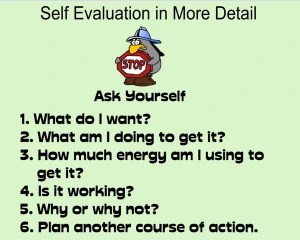
When you know your real wants, you can better evaluate what behaviors you are choosing to accomplish your want. So, step one is to EXPLORE what your REAL WANT is. Step two is to EVALUATE if the behaviors you are choosing will get you closer to that goal. Step three, if the answer to step two is no, INVESTIGATE other options. Get more information. Think about in the past, what you might have done that did work in a similar situation. Step four, make a PLAN and follow through.
In my case, I had to address the demons in my thinking. I had to explore the negative images and thoughts I was allowing to run amok in my brain. My poor body was only reacting to my thoughts. The result was anxiety and the desire to feel better through food. I also had to relax, journal and start saying a positive mantra.
Patterns of behavior do not change overnight, but you have to start somewhere. I was still anxious, but much more in control of me, feeling more self-reliant because I took the steps and therefore feeling more intelligent and back in balance.
If your behavior (thinking, feeling or acting) does not get a need met or a want achieved, a re-evaluation is in order. More than likely, what you think you want is only the surface-want or you are using the wrong behaviors to get you there. Dig a little deeper and do the steps.
It’s been about two months since I last wrote. The Restless Wanderer was traveling for three weeks and came back with a fairly significant upper respiratory infection. This rolled into creating a Halloween display for 800 children, making a video for a reunion party, and doing a major rewrite on a manuscript. Now, here it is two weeks before Thanksgiving and I’m wondering where the year went.
About three months ago I was interviewed for a local magazine asking how to deal with holiday stress. The reporter asked the usual questions that I think anybody can find the answers to if they look under a leaf. Eat properly, get enough sleep and exercise. I think the top piece of advice would be WATCH YOUR EXPECTATIONS. The first part of watching your expectations is to understand what you’re doing and why. That brings us to a mini history lesson.
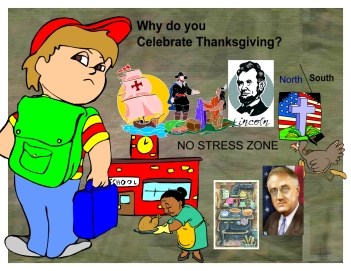
The topic is Thanksgiving. Do you know why we celebrate Thanksgiving? Do you know why you celebrate Thanksgiving the way you do?
According to the book, Thanksgiving: The biography of American Holiday, the original holiday, in 1620, lasted three days and consisted of fasting, humility, prayer and a feast on the last day.
Prior to this, it was common tradition to set aside a day for giving thanks to God. There were days for giving thanks (Thanksgiving) in all the first colonies, in Native American traditions and in Europe. Standards or protocols for how to give thanks and when varied.
In school, thanksgiving teaches us about the English settlement called the Massachusetts Bay Colony, now known as Plimouth (yes that is the correct spelling) and about the Pilgrims. I think the average American believes we celebrate thanksgiving to commemorate the goodwill between the Native Americans and the Pilgrims the first winter in 1621. I wonder how many realize it started out as a somber religious experience.
According to Plimouth Plantation historians, the holiday was ratified by the Constitutional Congress but the date varied state by state. When the Civil War broke out, President Abraham Lincoln proclaimed Thanksgiving as a national holiday to help reunite the country. He actually wanted two thanksgivings a year; one in remembrance for Gettysburg to be held the third Thursday in November and the other a more general occasion. The day was designed as a day for praying for the orphans, widows and aid for our war torn country. There was no special meal or tradition.
We can thank Franklin D. Roosevelt for deciding the date of Thanksgiving. Surprisingly, you can say he is also the father of Black Friday. He tied Thanksgiving to the traditional Christmas season so there could be more Christmas shopping which would help the economy. The year was 1941.
The time between Lincoln and Roosevelt in how we celebrated Thanksgiving is not very clear to me. It does look like in the north, people started having large family dinners and many in the south had no idea about the holiday. I think what people did, how they did it and what they ate was very much individualized.
Wait a minute, what about all those decorations with Pilgrims and Indians and all the things we learned in school about Thanksgiving? According to Plymouth Plantation historians, that storyline started in the early 1900s. Why then? They claim it had something to do with two manuscripts that increased people’s interest in Plymouth (our modern spelling), Pilgrims, and the Wampanoag Indians.
The American school system chose to use Thanksgiving as a time to teach American freedom and citizenship to children. By the 20th century we had a set culinary expectation of what Thanksgiving required. In 1943 Norman Rockwell gave us his famous painting entitled, Freedom from Want, and the ideal Thanksgiving tradition was carved in stone.
Now you know the rest of the story. Or do you? I know our Thanksgiving usually consists of turkey, stuffing, mashed potatoes, sweet potatoes, cranberry relish, corn, green bean casserole, rolls and pumpkin pie. My mother used to add sauerkraut, harvard or pickled beets, red cabbage and lima beans. Depending on where you live in the country, this list varies. But what did the Pilgrims eat?
According to a special on the History Channel their diet was a little different. They would have had things like cod, lobster, eels, oysters, clams, eagles, partridges, ducks, swans, geese, turkey, deer, wheat flour, Indian corn, pumpkins, carrots, grapes, beans, peas, onions, lettuce, chestnuts, walnuts and acorns. All of it lovingly prepared with seasonings from liverwort, parsnips, olive oil, and currants. Yum!
Next we look at how our own histories mixed with the national holiday. The result is your expectation of what Thanksgiving is and what it looks like.
So what’s on your table? And how much is on your table? Why did you choose the music, the decorations, the amount and type of food for Thanksgiving?
Is it a badge of honor to say you ate so much you have to unbuckle your pants? Is it worth having a meltdown if the rolls are slightly burnt? Do you have to do all the work or do you delegate?
How much of your holiday do you allow to happen vs. you trying to control it?
Are you responsible if someone doesn’t like your food or is not having a good time? Is the final revile of the Thanksgiving dinner and your sense of self worth tided together? If something happens and the entire meal is ruined, can you still rejoice because you have family and friends gathered together?
These are important questions that help you examine the things you do to prepare and implement Thanksgiving. You alone are in charge of what you think, what you do and how you feel.
The more fluid you are, the less stress you will feel.
Being more fluid means you’re going with the flow. When something happens, it might be disappointing but not catastrophic. The fluid person knows this, expects issues to happen and rolls with the punches.
It’s very easy during the holidays to get wrapped up and twisted in what the media shows us, our families and what our holidays should look like. We often assume every other family is having a Norman Rockwell picture. We forget the media has an agenda and also that nobody’s life is perfect.
So, if your Thanksgiving is not what you remembered when you were a child or you’re not able to provide the Thanksgiving dinner you would like to for your family, don’t sweat it. More than likely, your memories of what was or your dreams of what could be are seen through either rosy or blue tinted glasses. While it’s good to have expectations, goals and plans to make the day a memorable one, remember, you’re only human and your family will love you unconditionally; even if you’ve burned the turkey or dropped the green bean casserole on the floor and have to remake it. If you have a dysfunctional family, the kind that grumbles, argues, complains about everything and never gets along, your dinner unfortunately, is not going to change any of that. Work on that the rest of the 364 days of the year.
Last point: If mom or Aunt Busybody scrutinizes what you’re trying to accomplish and you feel like no matter what you do it’s not good enough, that’s not about you but about them. Give it back to them as a present. Don’t feel bad, don’t suck in the venom, keep telling yourself it’s not about them. Enjoy your day. Enjoy your family and friends. Live in the moment. Happy Thanksgiving!
It’s almost Halloween time! You may not realize this because it’s only September 12th… but that’s beside the point. I saw my first woolly caterpillar and a yellow leaf. The county fair is in town. That can only mean one thing: Halloween is almost here.
Since moving to our current home—a little house right on a main road—Halloween has become an event. It reminds me of my childhood, when neighborhoods came alive with decorations, and every porch was lit up with spooky fun. Around here, we’re still one of the only houses that decorates the way we do—but that’s okay. I’m convinced it’ll catch on.
Year One: The Great Candy Shortage
We didn’t know what to expect our first Halloween here. I bought a couple of bags of candy, and we all sat on the front porch, excited. An hour in, we were out of candy. Out of individual snack bags. Out of school lunch cookies and chips. Out of cup-a-soup. Out of oatmeal packets. We even gave away extra pens, hotel shampoos, and those little soap pellets you put in dishwashers. I sent my husband to the corner store for reinforcements. When he came back, we were greeting kids with a smile and the only thing left: encouragement.
Year Two: Enter the Pirates
That’s when I realized—no, I may not be Walt Disney, and no, I don’t have Disney’s budget, but I do have creativity, cardboard, and a glue gun. I created a theme: Pirates of the Caribbean: Bohemian Chic. Everything was repurposed. I sewed, stuffed, sawed, glued, painted, and dyed my way through old curtains, coat racks, and clearance bins. Neighbors gathered to watch the madness unfold.
And then—of course—a hurricane hit. Everything was in shambles. But I wasn’t deterred. I rebuilt it all, piece by soggy piece.
Halloween night arrived with full sound effects, lighting, and family members dressed as pirates mingling with life-size figures. And then it snowed. I looked at my husband and said, “Well, I guess we’ve left the Caribbean and landed in the Aleutian Islands.”
We figured no one would show up. He secretly hoped they wouldn’t (we’d bought a lot of candy). But they came—cars lining the road, families taking pictures with our set. Parents told me they couldn’t afford to take their kids to places like Disney, and this—this little yard of foam and fabric—was the closest they’d ever get. I was humbled. It wasn’t about perfection. It was about joy.
Year Three: Cancelled but Not Defeated
I had big plans. The storyline, the moving parts, the upgraded pirates. But another hurricane hit. Halloween was officially canceled. Still, we dressed in costume, set up what we could, and greeted the brave 20 kids who ventured out. That small turnout meant the world. And it set my heart on fire for the next year—this year.
Year Four: Pirates Meet the Haunted Mansion
This year, I’m combining my two favorite Disney rides: Pirates of the Caribbean and The Haunted Mansion—with a dash of absurdity thrown in for fun. Think ghostly pirates, DIY tombstones, and dollar-store elegance.
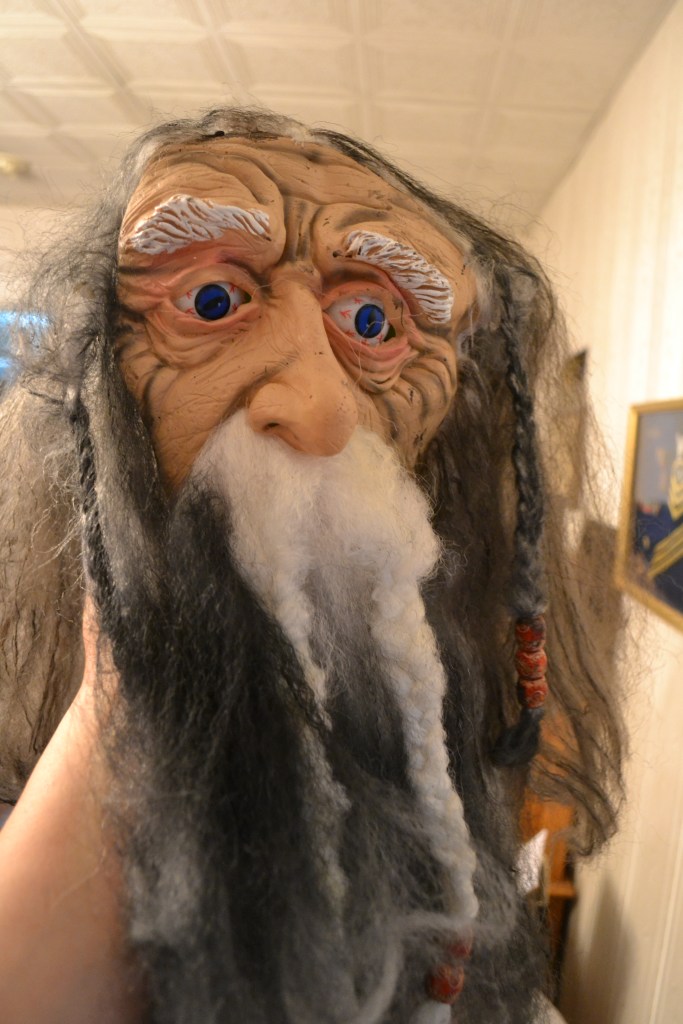
So far, I’ve created a Grim Reaper from old Goodwill sheets, a coat rack, my daughter’s head (molded in plastic wrap), crack filler, and truck-liner spray paint. Cost: $15.00.
My tombstones are crafted from warped shelving, ruined ceiling tiles (thanks again, hurricane), accessories from old costumes, Dollar Store treasures, caulking, and—my beloved duct tape. Still to be painted, but they’re coming along.
I’ve also upgraded my pirate hands. No more stuffed gloves! Now they have bendable wire skeletons so I can actually pose their fingers. (Small victories matter.)
If folks are interested, I’ll keep posting updates on my DIY adventure as we countdown to Halloween. The display might not be Disney-level, but it’s real, it’s ridiculous, and it brings people joy.
Now, quick question— Has anyone checked the forecast for October 31st? Hurricane… yes or no?
The headline read: Toddlers found Amid Bloodbath. Four-year-old Amy and two-year-old Abbey (not their real names), had witnessed the murder/suicide of their parents. The girls were rescued a day later playing around their dead parents. The police were able to place the children with extended family thought they could cope. They were wrong.
Amy, once toilet-trained, started soiled her pants on a regular basis. Abbey started sucking her thumb and refused to leave her sister’s side. For reasons no one could understand, the two would suddenly become enraged and on one occasion Amy lunged at her uncle (the current guardian) with a kitchen knife lacerating his leg. Both girls asked frequently, when their parents were coming back. Amy on occasion, would become nauseated and vomit when she would walk in and see her aunt preparing raw meat for dinner. Neither girl slept well and night terrors accompanied with screams that woke the entire house occurred weekly. When they played, the themes were often violent with toys being destroyed and their behaviors escalating into physical fights between them. Abbey refused to be held, would cry a lot and bite herself. Amy refused to play with other children and her daycare provider said she sometimes resembled a trapped animal that lashed out when you tried to come near her.
Their home placement quickly became jeopardized as the already distraught family was not prepared for, nor did they understand, what was occurring. The result, the children ended up in foster care, with a family that had wonderful intentions but was not properly trained on what to expect from traumatized children, how to help them and how to cope.
From the family’s perspective the children should have been relieved and happy to be in a loving, caring environment. They became very confused and angered with the girl’s behavior did not match what they expected. They returned the children to the county for another placement. This happened several times before the girls ended up with a specialized foster care family who already had four special needs children.
The girls were seen by multiple counselors/therapists and doctors. Many of which did not have specialized training in helping children who have been traumatized. By the time the girls were ready to go to middle school, they were separated, living in different homes (the fifth for Amy and the eighth for Abbey), were promiscuous, hard to handle, occasionally heavily drugged by well-meaning doctors and their school performance was very poor with frequent suspensions.
This is a horrendous story. It is horrendous because the children experienced such a horror. Worse because no one knew information to help understand the natural reactions the children were having as a result of the events they experienced. By the time I got the case, years of compounded stress and trauma had to be unraveled.
There is an old myth that children are very resilient that they bounce back from adversity better than adults. Notice I said myth. Children are just as traumatized and reactive as adults to traumatic events. Children, however, often present different then their adult counterparts.
To the unaware adult, the child is acting out, being obstinate, not reacting to the events. The child typically is not able to sit down and tell you or debrief the events the way an adult can. Depending on their age, children are not able to verbally process the events and their meaning due to limited cognitive development. For example, children do not have a concrete understanding of death as being final until around age ten.
The case with Amy and Abbey is extreme; however, traumas do occur frequently to children. Divorce, child and domestic abuse, school bullying, parents who are involved in severe drug and alcohol abuse, deaths or serious illness in the family, loss of income of a parent, moving to a new school and home. All these and many more are examples of events that are very stressful and at times traumatic enough to cause severe reactions in a child.
It is important to anyone with a child who has or is currently stressful and/or traumatic or who work with children to understand the nature of trauma on a child to learn ways children express and process these events.
The brain acts like a movie camera during a traumatic event. It will record the images, sounds, smells and touch feelings associated with it. This occurs so the brain can figure out how to react for protection. Integrate this into the person to make sense of the event. How to self protect if it happens again or try to prevent it from happening again. The behaviors you see in a child are the outward manifestations of these attempts.
Here are some of the behaviors you may find in children coping with extreme stress and or trauma in their life.
Children will typically digress in their developmental levels (forget learned behaviors like toilet training, talk babyish, need stuffed animals to sleep, night lights, want more cuddle time, forget how to do skills learned in school)
Nightmares, night terrors, sleep walking, sleep talking, refusing to go to bed or sleep.
Refusing to eat, over eating, nauseated at certain foods, craving certain foods such as feel good foods, wanting a pacifier or bottle fed.
Refusing to go to the bathroom, soiling their clothing, smearing feces, obsessive masturbating.
Aggressive or violent behaviors, crying spells and tantrums.
A drop in school performance, decrease in grades, acting out in school, not wanting to go to school.
Moodiness, bursts of anger, crying spells, moppyness, laughing inappropriately, pulling out hair, twirling hair, pulling out eye lashes or eye brows, hurting themselves on purpose, clumsiness or accident prone.
Flashbacks (experiencing the trauma event as if it is currently happening), responding to things that remind them of events (the blood of raw meat for someone who witnessed a bloody event).
Promiscuousness, early involvement with smoking, drugs and alcohol, deviant behaviors, abuse of others, abuse of self, disrespect for adults or specific adults.
If extreme stresses or a traumatic event happens to your family, your child or a child in your care, note these reactions. Do not assume the child will manage without help. It is better to act as if need is eminent then to ignore the potential as behaviors of a child’s distress may not show up right away. It may take days or weeks to show. There are times where the child appears to do well and after they reach a more developed cognitive ability (the older they get) their mind will once again address what they experience and this is when you may see behaviors develop. The sooner the child is able to get help, the better things will be for them.
Use the services of school counselors, professional counselors/therapists (make sure they are trained in childhood trauma if trauma is the issue), a doctor’s care maybe necessary as well. Learn all you can about how severe stress and trauma affects children and incorporate this for the children in your care. If you are also a part of the extreme stress or trauma, remember that you are also struggling on various levels. Take care of yourself.
Extreme stress and trauma can occur in anyone’s life. Be prepared if you have or work with children. Know the signs and how to get help. The emotional health and well being of a child may depend on it.
Have you ever wondered if people in developing countries spend time dreaming about “something better”? Or is this constant questioning—this hunger for more—a distinctly Western habit, born of comfort, choice, and relentless comparison?
I first learned to long for something more when I saw Cinderella as a child. The girl in rags, waiting to be rescued from misery, dreaming of a love that would change everything. Or Casper—the lonely ghost who just wanted to be accepted and loved. If I really thought about it, I could name a hundred stories with the same core message: there must be something better out there.
But how do we decide when “what we have” isn’t enough? In my work as a therapist, I’ve seen people thrive in hardship and suffer in abundance. It seems happiness isn’t about circumstances—it’s about mindset.
We hear sayings like, “When life gives you lemons, make lemonade.” But what if you don’t want lemonade? What if you want mangoes or chocolate cake or something no one ever offered you? Is the quest for more a refusal to settle—or an inability to accept?
Maybe it’s not about choosing between reaching for more and embracing what is. Maybe the real trick is balancing both.
I’ve met people living with far fewer material resources—like in North Africa or Haiti—who radiate joy. Is that joy selective, performative, or real? Maybe they’ve learned to be content while still holding hope. Maybe they’ve mastered the paradox that trips so many of us up.
Because the truth is, some people will always chase “what’s next,” and others will find deep satisfaction in the present. The happiest lives may not be the ones that had the most—but the ones that struck a balance between striving and surrender.
So if you’ve ever been told, Sorry, the life you wanted is out of stock, you still have choices. You can keep hoping, keep growing. You can pour your dreams into the life you already have. Maybe that’s not settling. Maybe that’s the truest form of freedom.

 Deborah Sickle Hill