(This is NOT FICTION)
Have you ever heard the saying, “Don’t throw out the baby with the bathwater”?
A friend and I have both survived near-death experiences—events that altered us permanently. On long drives, we often dive deep into conversations about spirit, soul, God, and nature. We’ve walked away from rigid dogmas—those rules imposed by religion that demand your belief to belong—and instead, we’ve chased after truth. Real truth. The kind you feel in your bones.
Hence, throwing out the bathwater and keeping the baby.
That mindset often leads us to places charged with meaning. On this particular day, we felt called to Gettysburg National Battlefield.
We took the Taneytown exit just before sunset. As we approached the old Cyclorama, my friend said quietly,
“I feel something pulling me here. Something important.”
“Tell me when to stop,” I said.
“Stop.”
We parked beside an older man and his massive Irish Wolfhound, Tanner. He greeted us kindly and shared that he was a local who came to the battlefield seeking meaningful encounters. Usually, he sat at Little Round Top. But tonight, he’d felt drawn here instead.
He’d had a near-death experience—just like us.
For over an hour, the three of us stood and talked. About life. About death. About energy, God, and the battlefield itself. “This place is alive with spirit,” he said. “Something here vibrates because of the hell that happened.”
And I understood exactly what he meant.
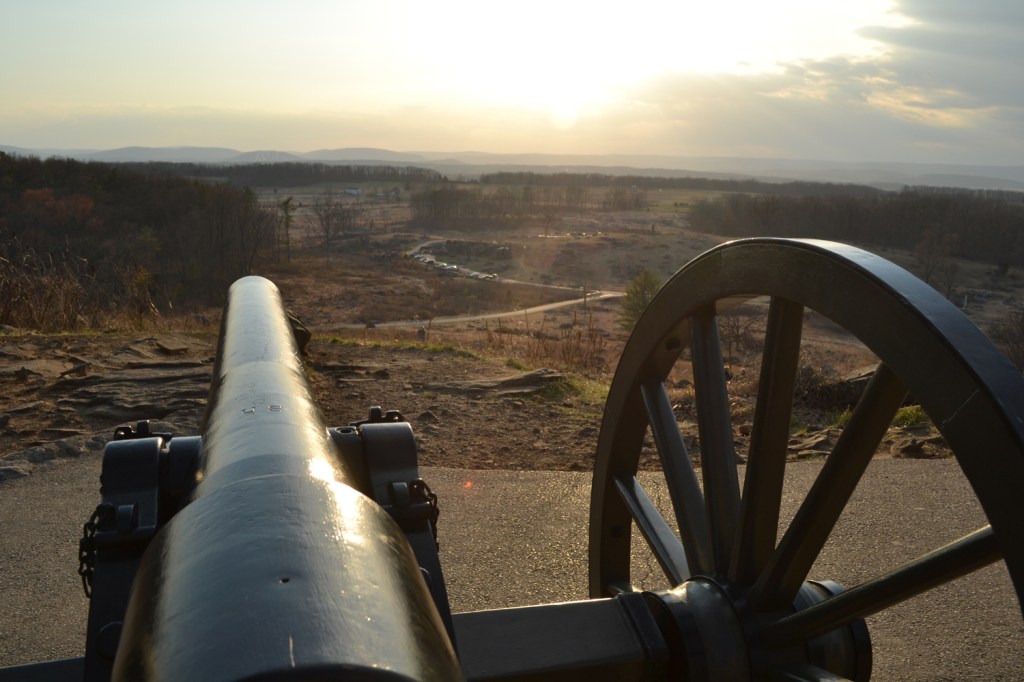
We looked around at the silent cannons—posed and waiting, like sentinels. Witnesses to the deadliest battle of the Civil War. I shivered.
We are sensitives—whether born or trauma-made. Drawn like moths to flame. To trauma. To death. To sacred, ruptured ground.
“It’s the energy,” my friend said. “Spiritual energy.”
I couldn’t disagree. What is spirit, if not supernatural energy? The Shekinah. The Holy Spirit. Energy.
She seeks to understand it. Me? I feel it. Especially trauma. It lights something up in me.
You don’t need a wild imagination to be humbled by Gettysburg. The place speaks for itself.
As the sun set (the park remains open until 10:00), we parted ways with the man—three strangers connected through invisible threads. Before he left, he said, “Be careful.”
We drove slowly through the darkening park and passed the Wheatfield. Suddenly, we both felt it—tingling skin, tight throats, nausea. The air felt electric, charged with something unseen. Then, as soon as we passed the bend, it disappeared.
“You felt that?” she asked.
We described it the same way.
Yes, I had.
At Devil’s Den, we got out and wandered behind the granite boulders. A low rumble echoed nearby—maybe thunder, maybe phantom cannon fire. That’s not unheard of here.
My friend led me to a tall tree and stood still.
“There’s peace here,” she said.
But I felt dizzy. Nauseous. Unbalanced.
“Stand next to me,” I told her.
She did—and immediately felt the same.
The air smelled metallic.
Blood, I thought, but didn’t say.
I know that smell.
Maybe it was the dark. The uneven ground.
But we didn’t feel normal again until we walked away.
Later, as we drove past Little Round Top, I was hit by sudden chest pain, nausea, and a sharp pain behind my eye.
For a split second, I thought I’d been shot.
I swerved and pulled over.
The sensation vanished.
“Do you still feel peace?” I asked.
“No,” she said. “It feels horrible now. So much death. I’m ready to leave.”
As we exited the park, we passed the same cannons we’d seen earlier—but I saw them differently this time. They were more than relics.
They were keepers—of sorrow, of pain, of history we can’t possibly comprehend.
They reminded me of my own inner wounds.
Silent. Unnoticed by most. But always there.
Not everything in life can be explained.
But we’re not alone.
There are hundreds of thousands of us—like Tanner’s owner, like me and my friend—living on the fringe between the seen and unseen.
We’ve experienced too much.
We’ve been changed.
And we’ve been given a gift: vision born from trauma.
A gift that lets us throw out the bathwater—and still keep the baby.
Maybe that’s why we keep returning to places like Gettysburg.
Not just to understand the past.
But to connect with a world we can’t always see.
 Deborah Sickle Hill
What’s on your mind?